Vastu for Modern South Indian Apartments
Vastu Shastra is a traditional Indian system of architecture and spatial arrangement that associates the eight cardinal and ordinal directions with specific elements and energies. In South India, it remains a significant consideration for many homebuyers across Tamil Nadu, Karnataka, Telangana, Andhra Pradesh and Kerala, influencing both end-use decisions and resale demand.
The challenge today is that most buyers are no longer building independent houses on open plots where Vastu was traditionally applied. They are choosing apartments with fixed layouts, shared walls and limited scope for structural change. Our view is that Vastu should be treated as one input among many — useful for narrowing a shortlist and guiding interior choices, rather than as a rigid pass-or-fail filter that eliminates otherwise sound homes.
Core Directional Principles
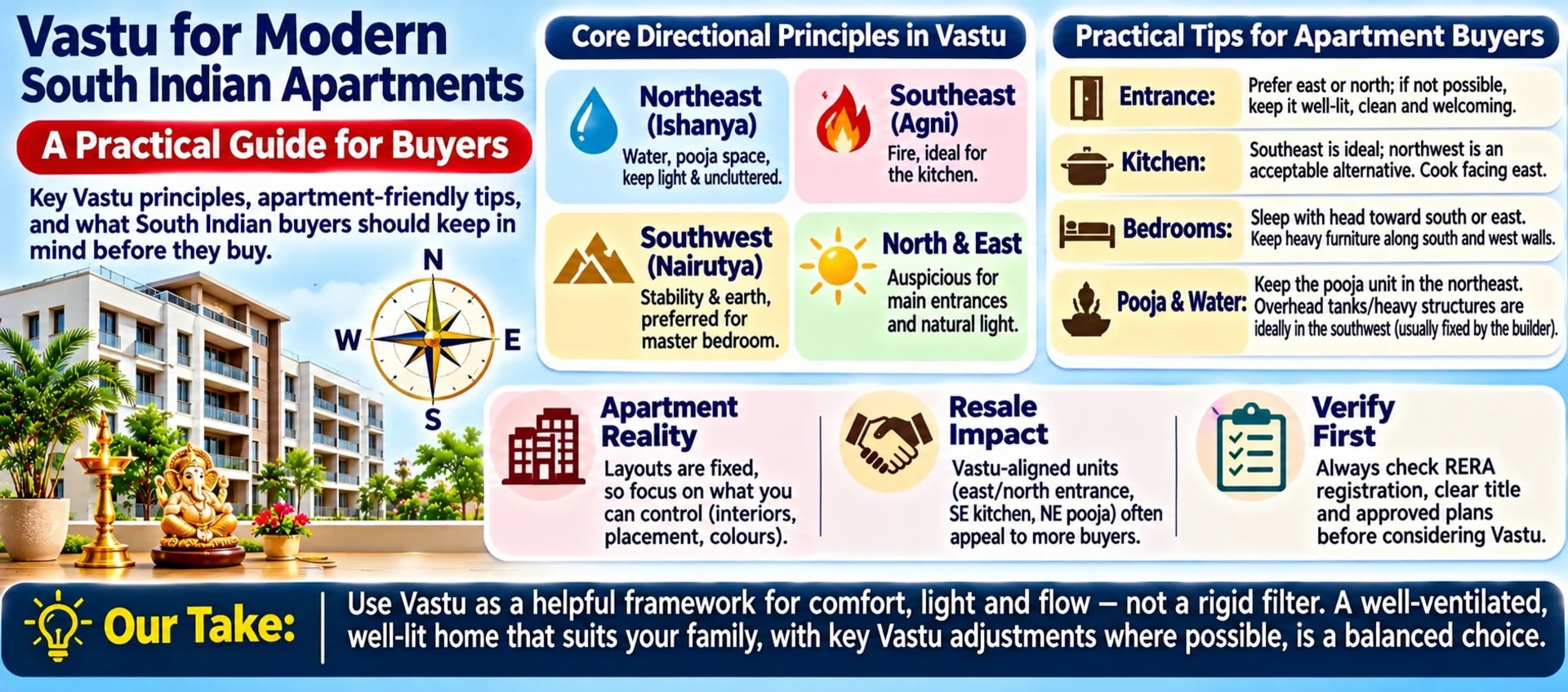
In classical Vastu, the northeast (Ishanya) is associated with water and is considered ideal for pooja rooms and water sources. The southeast (Agni) is linked to fire and is traditionally recommended for kitchens. The southwest (Nairutya) is associated with stability and earth, making it a preferred location for the master bedroom. The north and east are valued for natural light and are considered auspicious for main entrances.
Practical Tips for Apartment Buyers
Entrance
An east- or north-facing main door is widely preferred in Vastu. In apartments, where the door direction is fixed by the building plan, the practical workaround is to keep the entrance well-lit and clutter-free, and to use thresholds, nameplates and plants to create a welcoming threshold regardless of orientation.
Kitchen
If a southeast kitchen is not possible, the northwest is often cited as an acceptable alternative. Positioning the cooking range so the cook faces east is a commonly suggested adjustment.
Bedrooms
Sleeping with the head toward the south or east is a frequent recommendation. Heavy furniture and storage are typically advised along the south and west walls.
Pooja and Water
The northeast corner is traditionally reserved for the pooja space and kept light and uncluttered. Overhead tanks and heavy structures are generally advised toward the southwest rather than the northeast, though in apartments these are determined by the developer and lie outside an individual buyer's control.
Our editorial take is that buyers should separate the elements they can control from those they cannot. The flat's facing, the position of the overhead tank and load-bearing walls are fixed. But placement of the bed, the pooja unit, mirrors, and the choice of lighter colours for the northeast are all adjustable at the interiors stage — which is where most practical Vastu compliance in apartments actually happens.
Consider a hypothetical couple comparing two similar 2BHK units in a Chennai gated community. One is north-facing with a kitchen that happens to sit in the southeast; the other is larger and better priced but west-facing with an awkward kitchen position. A Vastu-conscious buyer might reasonably pay a modest premium for the first, while another buyer might prioritise space and value and address Vastu concerns through interior adjustments. Neither choice is objectively wrong — it depends on how much weight the household places on these principles.
It is worth noting that Vastu has resale implications in several South Indian markets. A unit that aligns with widely held preferences — an east or north entrance, a southeast kitchen, a northeast pooja space — can appeal to a larger pool of future buyers. We would caution, however, against overpaying purely on Vastu grounds, since preferences vary and valuation should still rest on location, construction quality, approvals and connectivity.
Verify the Fundamentals First
Before applying any Vastu lens, buyers should confirm that the project has the necessary regulatory approvals, including RERA registration where applicable, clear title, and a sanctioned building plan. Vastu alignment adds no value to a home that carries legal or structural risk.
As apartment living continues to dominate urban South India, demand for Vastu-aligned layouts is likely to remain strong, and more developers are expected to market Vastu-compliant floor plans as a differentiator. Buyer attitudes may also gradually become more flexible, with interior-level adjustments increasingly accepted as a reasonable substitute for structural compliance.
Our closing advice: use Vastu as a helpful framework for comfort, light and flow rather than a source of anxiety. A naturally ventilated, well-lit home that suits your family's routine will deliver most of what Vastu ultimately aims for — and if specific compliance matters to you, consult a qualified practitioner before you sign, not after.