Flat vs Villa vs Plot: Matching the Buy to Your Life Stage
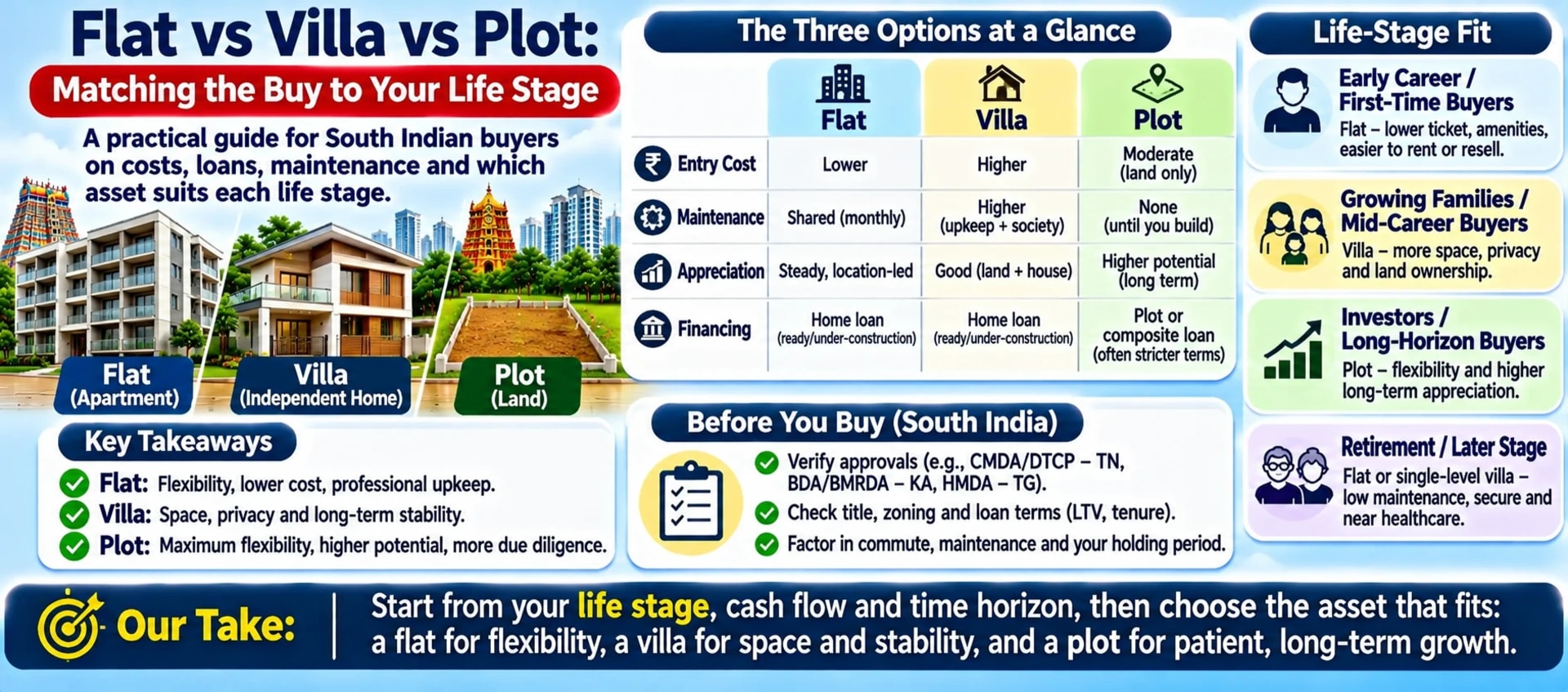
Across South India's major markets — Bengaluru, Chennai, Hyderabad, Coimbatore and Kochi — homebuyers broadly choose between three asset types: apartments (flats), independent villas, and residential plots. Each carries a different cost structure, maintenance burden, and appreciation pattern.
The three options at a glance
Flats are typically the lowest entry point and come with shared amenities and professional maintenance, usually governed by an owners' association and a monthly maintenance charge. Villas offer land plus a built structure in gated layouts, combining privacy with community infrastructure. Plots are bare land, offering maximum flexibility but no immediate rental yield and no built structure to live in.
Financing differs by asset type. Lenders generally offer home loans for ready and under-construction flats and villas, while plot purchases are often funded through composite or plot-plus-construction loans that may carry stricter terms, including a requirement to begin construction within a defined period. Buyers should confirm current loan-to-value limits and tenure caps directly with lenders, as these vary by bank and borrower profile.
In our view, the 'best' asset is less about the property type in the abstract and more about liquidity, time horizon and how much maintenance you can realistically manage. A buyer who travels constantly will experience a villa very differently from a family that is home every evening.
Early career and first-time buyers
For buyers in their late 20s and early 30s making a first purchase, a flat is often the pragmatic choice. It offers a lower ticket size, security in a gated community, and amenities without personal upkeep. Compact 1BHK and 2BHK units along employment corridors — such as OMR in Chennai, the Outer Ring Road belt in Bengaluru, and the HITEC City periphery in Hyderabad — have historically attracted this segment.
The flat's biggest advantage at this stage is reversibility. If a job relocation or a change in plans arrives, a well-located apartment tends to be easier to rent out or resell than a plot in a still-developing layout.
Growing families and mid-career buyers
Buyers in their late 30s and 40s, often with children and more stable incomes, increasingly consider villas in gated communities. Villas provide more carpet area, private outdoor space and a sense of ownership of land, while still offering shared security and clubhouse facilities. The trade-off is a higher purchase price and greater responsibility for upkeep.
Consider a hypothetical dual-income couple in their early 40s with two school-age children. They might weigh a spacious 3BHK flat near the city against a villa 15 kilometres further out. The villa offers more room and a garden, but a longer commute and higher maintenance — a classic space-versus-convenience decision many families in this stage face.
Investors and long-horizon buyers
Plots appeal most to buyers with a longer time horizon and appetite for lower liquidity. Land in approved layouts on city outskirts is often purchased for long-term appreciation or future self-construction. Buyers should verify approvals from the relevant authority — such as DTCP or CMDA in Tamil Nadu, BMRDA or BDA in Karnataka, and HMDA in Telangana — before committing.
Plots can be the highest-reward option, but they demand the most diligence. There is no builder reputation to lean on and no rental income to offset holding costs, so clean title, correct zoning and genuine layout approvals do the heavy lifting here.
Retirement and later stages
Older buyers often prioritise low maintenance, security and proximity to healthcare. A well-managed flat or a single-level villa in an established community typically suits this stage better than a plot requiring future construction effort.
As South Indian peripheries continue to add metro lines and road infrastructure, plotted developments along emerging corridors are likely to see rising interest, though appreciation is expected to remain uneven and highly location-dependent rather than uniform across markets.
Our bottom line: start from your life stage, cash flow and how long you intend to hold, then let the asset type follow. A flat for flexibility, a villa for space and stability, and a plot for patient, diligence-heavy long-term plays remains a useful rule of thumb for most South Indian buyers.