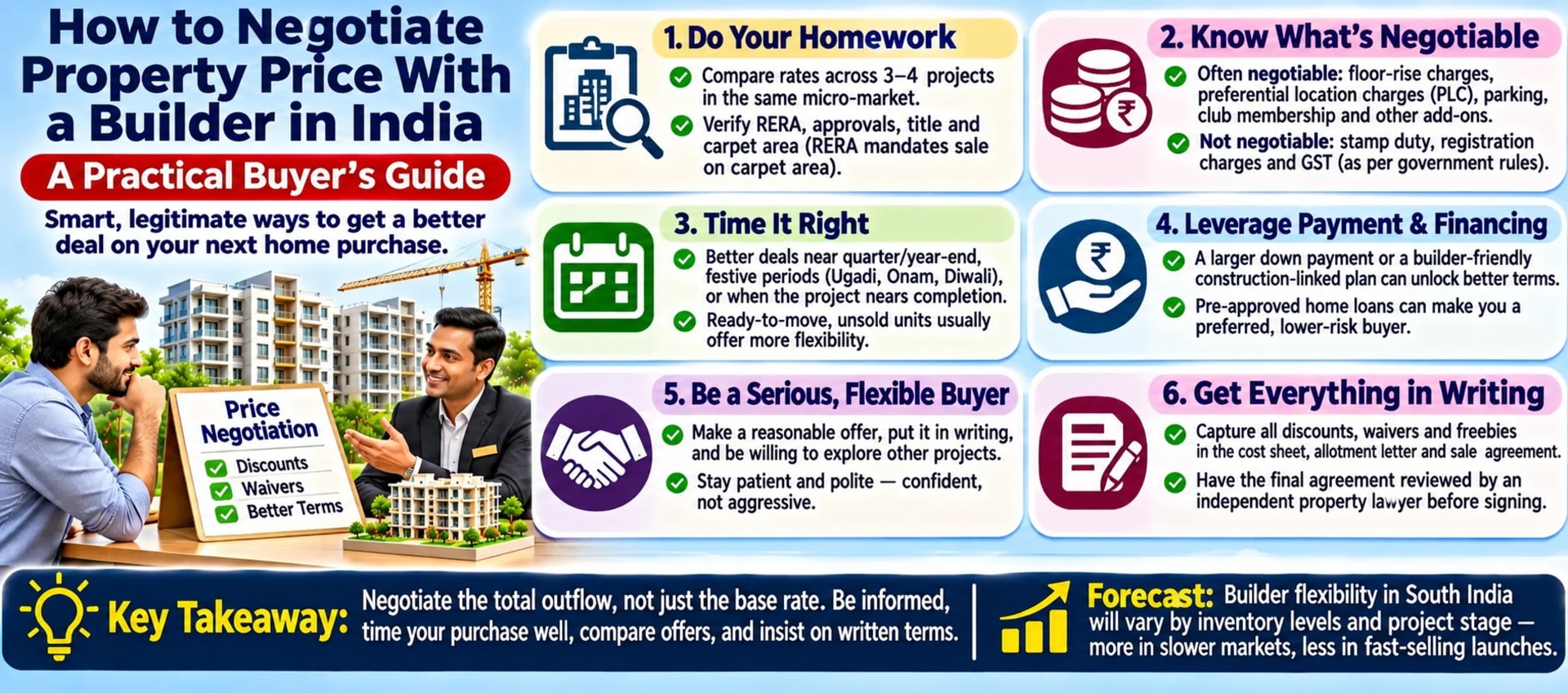
How to Negotiate Property Price With a Builder in India
Negotiating with a builder is a routine, legitimate part of buying a home in India. Unlike resale deals handled directly between owners, builder negotiations often involve sales teams working within approval limits set by management, which means the quoted price is rarely the final price.
In our experience covering the South Indian market, buyers who treat the sticker price as fixed tend to overpay. The listed rate per square foot is usually a starting position, and builders build in room to offer discounts while still protecting their margins. Walking in informed and unhurried is the single biggest advantage a buyer can hold.
Do Your Homework First
Before negotiating, compare per-square-foot rates across at least three to four projects in the same micro-market. In cities like Chennai, Bengaluru, and Hyderabad, rates can vary significantly between localities such as OMR, Whitefield, and Gachibowli, and even between projects on the same stretch of road.
Verify key documents independently: the RERA registration number, approved building plan, title documents, and the carpet-area versus built-up-area breakdown. Under the Real Estate (Regulation and Development) Act, 2016, builders are required to sell on the basis of carpet area, and project details should be listed on the respective state RERA portal.
Knowledge of comparable rates changes the tone of the conversation. When you can cite a competing project's pricing credibly, the sales team understands you are a serious, informed buyer rather than someone to be upsold. We find this shifts the discussion from whether there is a discount to how much.
Understand What Is Actually Negotiable
Beyond the headline price, several line items are often open to discussion: floor-rise charges, preferential location charges (PLC), car parking, club membership fees, and the mix of quoted charges. Statutory costs such as stamp duty, registration charges, and GST on under-construction properties are set by the government and are not negotiable with the builder.
Our view is that focusing only on the base rate is a mistake. Many builders prefer to hold the headline rate steady for records but are willing to waive floor-rise or offer free parking and a club membership. Negotiating the total outflow, not just the per-square-foot number, usually yields the better overall deal.
Time Your Purchase
Builders often become more flexible near the end of a financial quarter or financial year, during festive periods such as Ugadi, Onam, or Diwali, and when a project is close to completion with unsold inventory. Ready-to-move units that have been on the market for a while can offer more room to negotiate than freshly launched phases.
Consider a hypothetical buyer evaluating two similar apartments on OMR in Chennai. One is in a newly launched tower with full inventory; the other is in a near-complete project where the builder has a handful of unsold units and a looming completion deadline. The buyer is likely to find the second builder more willing to waive floor-rise charges or throw in covered parking, simply because unsold stock closer to delivery carries holding costs.
Leverage Payment Terms and Financing
If you can make a larger down payment or opt for a construction-linked plan that suits the builder's cash flow, you gain bargaining power. Some builders offer better rates to buyers with pre-approved home loans, as it reduces the risk of a deal falling through at the financing stage.
A willingness to walk away remains the most underrated tactic. Buyers who make a reasonable offer, put it in writing, and are prepared to explore other projects tend to be taken more seriously than those who signal urgency. Patience and politeness, in our assessment, consistently outperform aggressive haggling.
Get Everything in Writing
Any discount, waiver, or freebie agreed verbally should be captured in the cost sheet, allotment letter, and finally the sale agreement. Do not rely on verbal assurances from the sales team. Have the agreement reviewed by an independent property lawyer before signing.
As inventory levels and interest rates shift across South Indian metros, buyer bargaining power is likely to vary by micro-market and project stage. In pockets with high unsold inventory, builders are expected to remain open to incentives, while fast-selling launches in premium corridors may offer less flexibility.
Ultimately, negotiation is less about confrontation and more about preparation. A buyer who has researched comparable rates, understood which charges are flexible, timed the approach well, and insisted on written terms is well positioned to secure fair value without souring the relationship with the builder.