Under-Construction vs Ready-to-Move: The Core Trade-Off
Every homebuyer in South India eventually faces the same fork in the road: buy an under-construction (UC) property that is still being built, or pay for a ready-to-move (RTM) home you can occupy immediately. Each path carries a distinct mix of cost, risk, and timing considerations that have shifted noticeably over the past few years.
What Sets Them Apart
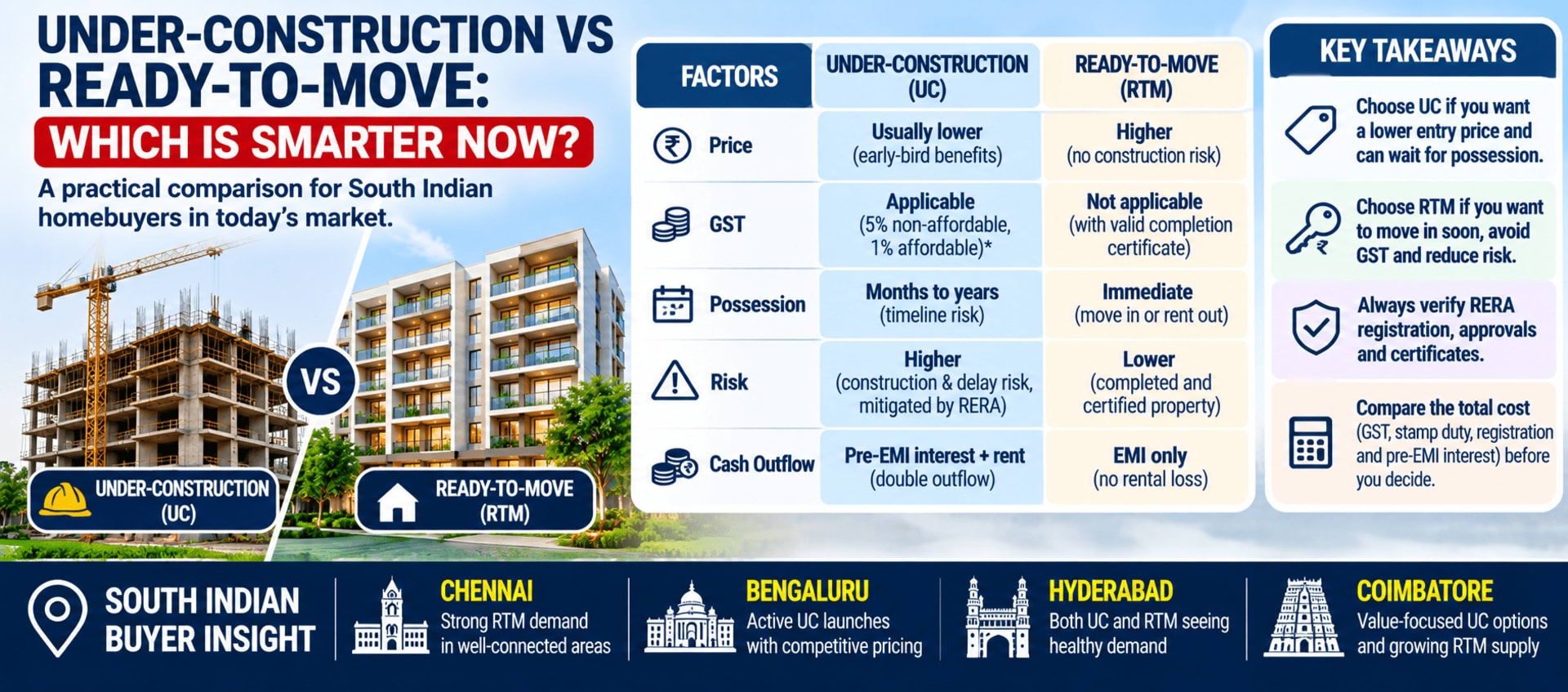
Under-construction homes are typically sold off-plan or mid-build, with possession dates that may be months or years away. Ready-to-move homes have received their completion or occupancy certificate and can be registered and occupied right away. One of the most cited financial distinctions is GST: under-construction residential properties attract GST, while completed properties with a valid completion certificate do not. Current GST rates for residential housing are widely reported at 5 percent for non-affordable and 1 percent for affordable housing, without input tax credit.
The Risk Picture Under RERA
The Real Estate (Regulation and Development) Act, 2016 (RERA) was introduced to protect buyers of under-construction homes by mandating project registration, escrow accounts for a portion of collected funds, and penalties for delayed delivery. Each southern state operates its own authority — such as TNRERA in Tamil Nadu, K-RERA in Karnataka, and TS-RERA (now under the Telangana framework) in Telangana. Buyers are advised to verify a project's RERA registration number before committing.
In our reading of the current South Indian market, the gap that once made under-construction homes dramatically cheaper has narrowed. As inventory of completed projects has grown in corridors around Chennai, Bengaluru, and Hyderabad, the price premium for the certainty of a ready home feels more justifiable than it did during the previous boom, when buyers routinely accepted construction risk to save on price.
That said, we would not write off under-construction entirely. For buyers with a longer horizon and a tolerance for delay, a well-chosen UC project from a developer with a clean delivery record can still offer better entry pricing and a wider choice of units, floors, and layouts — options that are often already sold out in finished towers.
The Hidden Cost of Waiting
For under-construction purchases funded by a home loan, buyers often pay pre-EMI interest during construction while simultaneously paying rent on their current home — a double outflow that erodes the apparent discount. Ready-to-move buyers avoid this overlap because EMIs begin against a home they can live in immediately. There is also no rental loss and no uncertainty about possession timelines.
Consider a hypothetical buyer comparing two similar two-bedroom flats on a growth corridor. The under-construction option is priced lower per square foot but is two years from possession, during which the buyer continues paying rent and pre-EMI interest. The ready-to-move option costs more upfront but allows immediate occupation and saves two years of rent. Running both numbers side by side — not just the sticker price — is what reveals which is genuinely cheaper for that individual.
Our practical advice is to treat the decision as personal rather than universal. End-users who need a home soon, value certainty, and want to avoid the rent-plus-interest squeeze will usually find ready-to-move the lower-stress choice. Investors and patient buyers chasing capital appreciation may still favour under-construction, provided they stress-test the developer's track record and the realism of the possession date.
Looking Ahead
With RERA enforcement maturing and buyer preferences leaning toward certainty, demand for ready-to-move and near-completion inventory is likely to stay firm across major South Indian cities in the near term. Under-construction launches from established, well-capitalised developers are also expected to retain appeal, particularly where pricing meaningfully undercuts finished stock. Interest-rate movements and local supply levels will likely remain the key swing factors.
Before You Decide
Whichever route you choose, verify the RERA registration, read the builder-buyer agreement carefully, confirm the completion or occupancy certificate for ready homes, and model the full cost including GST, stamp duty, registration charges, and — for under-construction — pre-EMI interest. These figures vary by state and project and should be confirmed with current official sources before you sign.