NRI Real Estate Investment in India 2026
Non-Resident Indians (NRIs), Persons of Indian Origin (PIOs) and Overseas Citizens of India (OCIs) continue to be among the most active segments in India's residential property market. South India — particularly Chennai, Bengaluru and Hyderabad — remains a strong draw for the diaspora in the Gulf, the US and Southeast Asia.
What NRIs can and cannot buy
Under the Foreign Exchange Management Act (FEMA) and RBI guidelines, NRIs and OCIs are permitted to purchase residential and commercial property in India without prior RBI approval. However, they are generally not permitted to buy agricultural land, plantation property or farmhouses, unless such property is inherited or gifted. Buyers should confirm the current wording of these restrictions before transacting.
Paying for the property
Payments for property must be routed through normal banking channels using inward remittances or funds held in NRE (Non-Resident External), NRO (Non-Resident Ordinary) or FCNR accounts. Transactions in foreign currency cash or traveller's cheques are not permitted for property purchases under FEMA rules.
Tax on rental income and gains
Rental income earned in India is taxable in India, and tenants or payers are typically required to deduct TDS before remitting rent to an NRI landlord. On sale, capital gains tax applies — long-term capital gains arise on property held beyond the specified holding period, while gains on property held for a shorter period are taxed as short-term. The applicable holding periods, tax rates, surcharge, cess and any indexation or exemption benefits should be verified against the Finance Act provisions in force for the relevant assessment year.
TDS on property sold by an NRI
When an NRI sells property, the buyer is responsible for deducting TDS on the sale consideration at the rate applicable to non-residents, which is higher than the rate for resident sellers. NRIs can apply to the Income Tax Department for a lower or nil deduction certificate where their actual tax liability is lower. The exact rates and procedures change periodically and must be confirmed.
Repatriation of sale proceeds
RBI rules allow NRIs to repatriate sale proceeds of up to two residential properties, subject to conditions including that the property was acquired in line with FEMA and that applicable taxes have been paid. There are also annual limits on repatriation from NRO accounts. Documentation such as Form 15CA/15CB is typically required, and the current thresholds should be checked with an authorised dealer bank.
In our view, the single biggest avoidable mistake NRIs make is treating tax and repatriation as an afterthought. The purchase itself is straightforward; it is the exit — getting money cleanly back out of India after a sale — where paperwork gaps and TDS mismatches cause months of delay. We'd argue the right time to engage a chartered accountant is before you sign, not after you sell.
Best South Indian cities to watch
Chennai's growth corridors along OMR (Old Mahabalipuram Road) and the GST Road continue to attract IT-sector and NRI demand. Bengaluru remains India's largest tech-employment hub, supporting sustained rental demand across its eastern and northern suburbs. Hyderabad's western corridor, anchored by HITEC City and the Financial District, has seen significant office and residential activity. Coimbatore is increasingly cited as an emerging tier-two option.
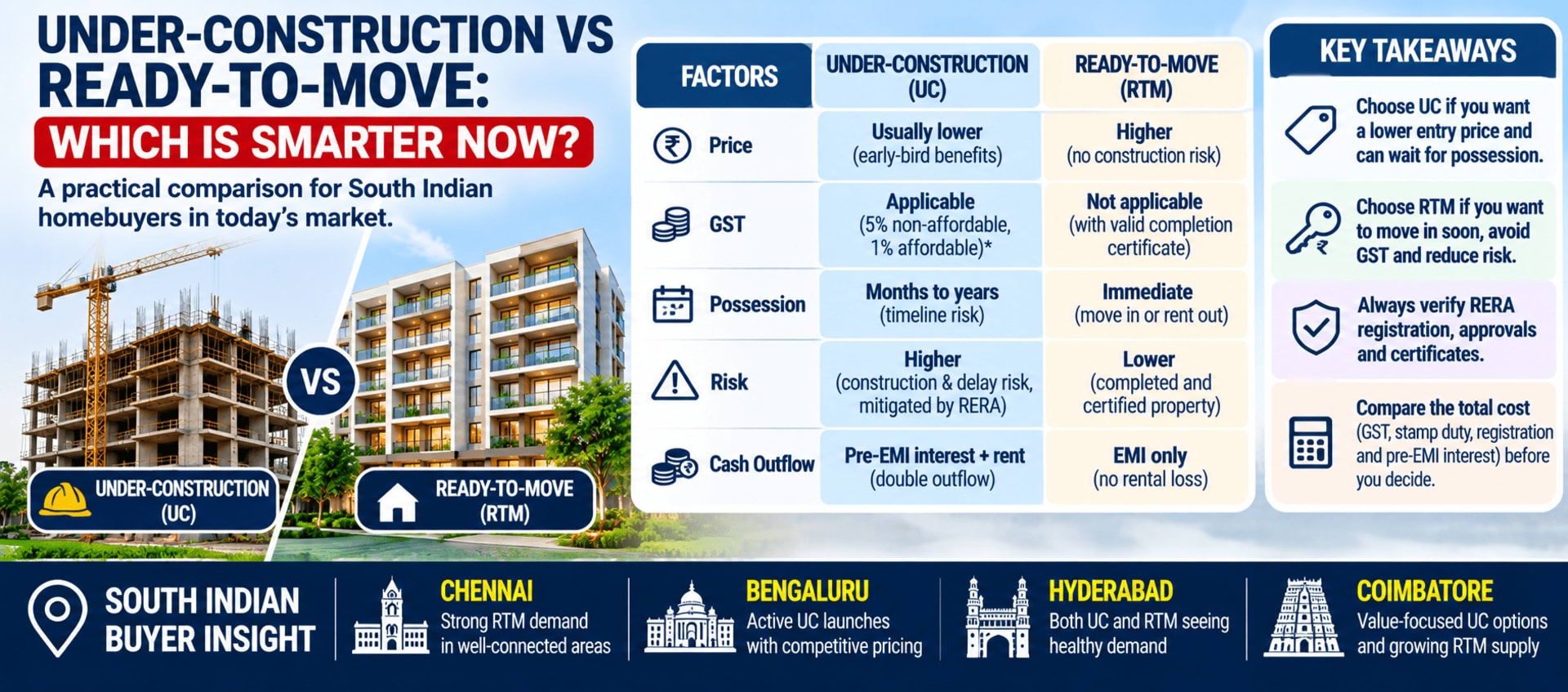
For a distance-managed NRI investment, we tend to favour completed or near-completion projects from established developers over early-stage launches. The yield premium on an under-construction unit rarely compensates an overseas buyer for the construction-risk and follow-up burden they cannot easily manage from abroad. RERA registration and a clean title audit matter more here than any marketing brochure.
Consider a hypothetical NRI based in Dubai comparing two Chennai options: a ready-to-move apartment near OMR with a sitting tenant, and a pre-launch tower slightly inland at a lower headline price. The ready unit generates rent from day one and lets them verify the asset in person on a single trip, while the pre-launch unit ties up capital with no income until handover. This illustrates why cash-flow timing often outweighs a lower sticker price for an overseas buyer.
Looking into 2026, NRI participation in South Indian residential markets is likely to stay resilient, supported by continued office expansion in Bengaluru and Hyderabad and infrastructure upgrades around Chennai's growth corridors. Any shift in home-loan interest rates or changes to NRI tax provisions could meaningfully influence the pace of this demand, so these should be monitored rather than assumed.
Practical checklist
Before buying, NRIs should verify the project's RERA registration, conduct a legal title and encumbrance check, confirm their eligibility under FEMA for the specific property type, and keep remittance records for future repatriation. A Power of Attorney to a trusted representative in India can simplify registration and documentation when the buyer cannot be physically present.
Our bottom line: South India offers NRIs a credible mix of rental demand and long-term appreciation, but the advantage goes to disciplined buyers who treat compliance as part of the investment, not a hurdle. Get the FEMA eligibility, tax position and repatriation path mapped out first — the city choice is the easier decision.
Note for readers: regulatory details, tax rates, TDS percentages and repatriation limits referenced here are subject to change and must be confirmed with a qualified chartered accountant, legal advisor or authorised dealer bank before acting.