Commercial vs Residential Investment in South India: 2026 Analysis
South India's major property markets — Bengaluru, Hyderabad, Chennai, Kochi, and Coimbatore — continue to anchor much of the country's real estate activity, driven by the IT services sector, global capability centres (GCCs), and manufacturing corridors. Investors heading into 2026 face a familiar fork: the steadier appreciation and liquidity of residential property versus the higher income potential of commercial assets.
Understanding the yield gap
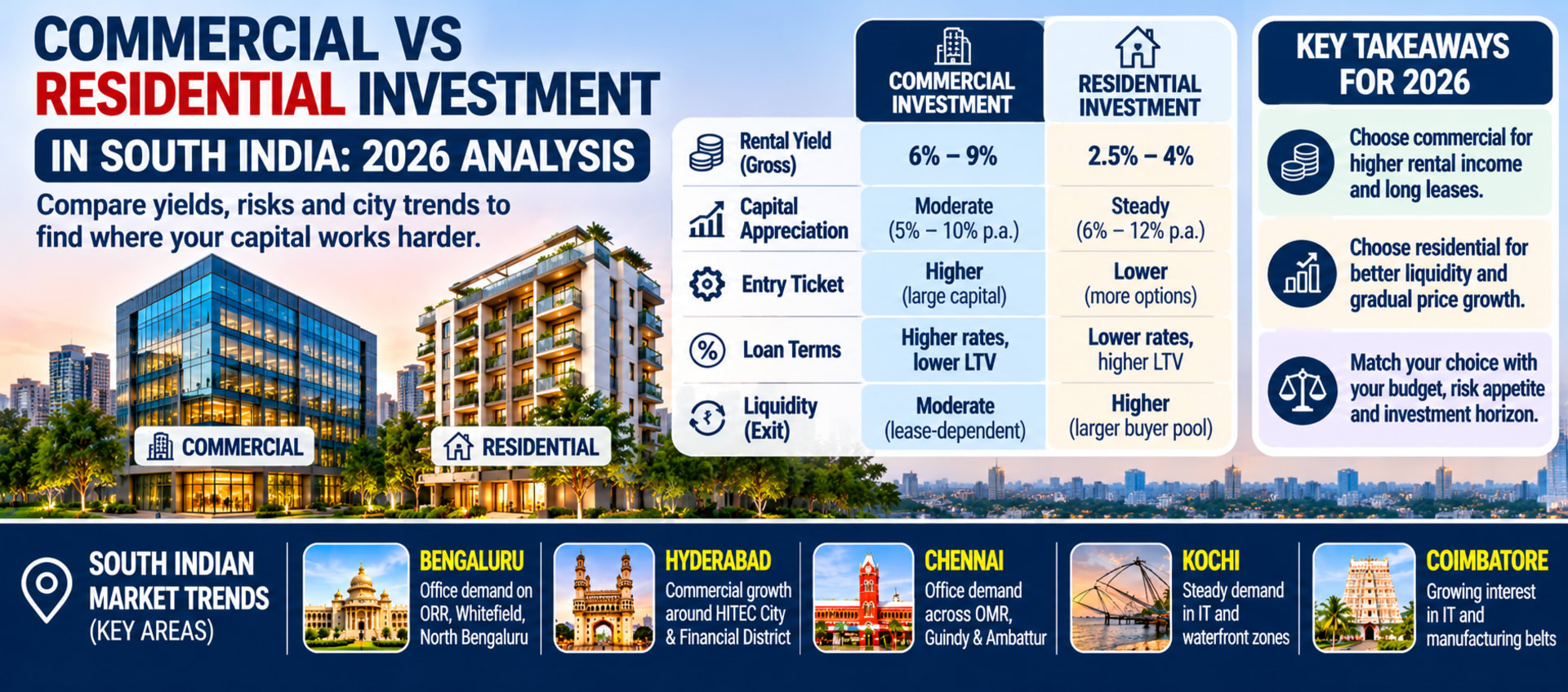
As a broad rule of thumb, commercial property in Indian metros has tended to deliver gross rental yields in the region of 6–9%, while residential yields have typically sat lower, around 2.5–4%. These ranges vary significantly by micro-market, asset grade, and tenant profile, and should be checked against current local data before any investment decision.
That yield gap is the single most important variable most investors underweight. Residential buyers often focus on headline price appreciation while quietly accepting thin rental returns; commercial buyers accept more complexity in exchange for stronger cash flow. Neither is objectively 'better' — the right choice depends on whether your priority is monthly income, capital preservation, or long-horizon growth.
City-by-city texture
Bengaluru remains the region's dominant office market, with sustained demand along the Outer Ring Road, Whitefield, and the emerging North Bengaluru corridor near the airport. Hyderabad's commercial growth has clustered heavily around HITEC City and the Financial District in Gachibowli, while Chennai's office demand spans OMR, Guindy, and the Ambattur belt. These spatial patterns are directional and should be verified against the latest absorption and vacancy reports.
On the residential side, affordability pressure has pushed demand toward peripheral and mid-income corridors — areas like Sarjapur Road and Devanahalli in Bengaluru, Kompally and Tellapur in Hyderabad, and the GST Road and OMR stretches in Chennai. Ticket sizes, inventory overhang, and launch volumes differ sharply across these pockets.
What stands out across these cities is how tightly commercial fortunes are tied to the GCC and IT hiring cycle. When global tech spending tightens, office leasing slows first — so a commercial investment is effectively a bet on sustained corporate expansion in a specific micro-market. Residential demand, by contrast, draws on a broader base of end-users and is generally less cyclical, though not immune to interest-rate swings.
Capital, leverage, and barriers to entry
Commercial assets usually demand larger entry tickets and attract higher loan interest rates and lower loan-to-value ratios than home loans, which benefit from more competitive retail lending. Fractional ownership platforms and REITs have lowered the entry barrier for commercial exposure in recent years, but investors should scrutinise fees, lock-ins, and the regulatory standing of any such platform.
Consider a hypothetical investor with a budget of around ₹1 crore. They might buy a single mid-segment apartment in a growth corridor, betting on appreciation while earning modest rent — or take a fractional stake in a Grade-A office asset leased to an established tenant, prioritising higher monthly income but accepting less control and potentially harder exit. The comparison illustrates the classic trade-off between liquidity and yield; actual outcomes would depend entirely on the specific assets and timing.
Risk and exit considerations
Residential property is generally more liquid, with a deeper resale buyer pool. Commercial exits can be slower and more dependent on lease status — a long, stable lease to a strong tenant can enhance value, while an imminent vacancy can depress it. Due diligence on title, approvals, and RERA registration applies to both, and specifics must be confirmed project by project.
The 2026 outlook
Given continued GCC expansion and infrastructure build-out such as metro extensions and peripheral ring roads, commercial demand in Bengaluru and Hyderabad is likely to stay resilient through 2026, though leasing momentum is expected to remain sensitive to global tech spending. Residential prices in well-connected South Indian corridors are likely to see continued, if more measured, appreciation rather than the sharp spikes of recent cycles.
Our editorial view is that the commercial-versus-residential question is better reframed as a portfolio one. Investors seeking stable monthly income and willing to accept lower liquidity may lean commercial, ideally via diversified or fractional structures; those prioritising flexibility, easier financing, and end-use optionality are usually better served by residential. For many, a blend — anchored to a specific, well-researched micro-market rather than a city-wide generalisation — is the more defensible 2026 strategy.
Before committing capital, verify current yields, vacancy rates, circle rates, and RERA status for the specific project and locality, and consult a qualified financial or legal advisor. Market conditions cited here are directional and require independent confirmation.