Stamp Duty and Registration Charges in Tamil Nadu, Telangana, and Karnataka 2026
Stamp duty and registration charges are statutory levies paid to the state government when a property transaction is recorded. They are distinct from the property price, GST on under-construction homes, and brokerage, and they apply at the point of registering the sale deed. For buyers across South India, these charges are often the single largest closing cost after the down payment.
Why these charges matter
Stamp duty is calculated on the higher of the agreement value or the government-notified guideline value (also called circle rate or market value). This means that even if a buyer negotiates a lower price, the duty may still be computed on the official guideline value for that locality.
Tamil Nadu
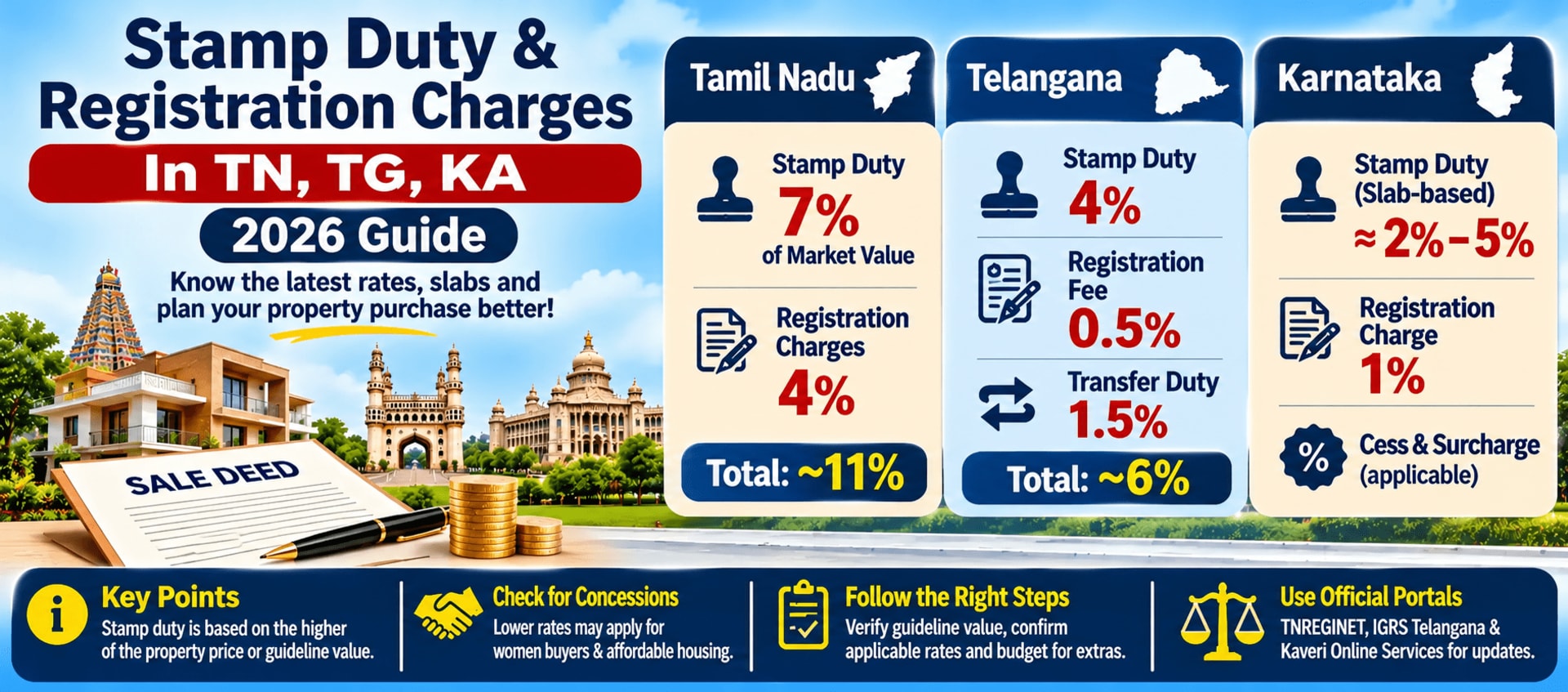
In Tamil Nadu, stamp duty on sale deeds has historically been levied at 7% of the property's market value, with registration charges at an additional 4%, taking the combined outgo to roughly 11%. These rates are among the higher ones in the country and apply across Chennai, Coimbatore, Madurai, and other districts.
Tamil Nadu has, in recent years, revised guideline values and restructured certain charges, so the exact percentage applicable in 2026 for a given document type should be confirmed with the Tamil Nadu Registration Department (TNREGINET portal) before closing.
Telangana
In Telangana, stamp duty on sale deeds has generally been around 4%, with a registration fee of about 0.5% and a transfer duty of roughly 1.5%, bringing the total to approximately 6% of the market value. The state uses a centralised market-value system accessible through the IGRS Telangana portal.
Karnataka
In Karnataka, stamp duty has typically ranged on a slab basis: around 5% for properties above a certain value threshold, with concessional rates such as 3% and 2% for lower-value properties. A registration charge of about 1% and a cess and surcharge component usually apply on top. Buyers in Bengaluru, Mysuru, and Mangaluru should verify the current slabs on the Kaveri Online Services portal.
How the three states compare
Looking at these three markets together, our reading is that Tamil Nadu sits at the higher end of the cost spectrum, Karnataka occupies a middle band with meaningful concessions for affordable housing, and Telangana tends to be the most moderate on combined outgo. For a buyer deciding between comparable cities, this differential can shift the effective cost of ownership by a few percentage points of the property value — not trivial on a large ticket.
Consider a hypothetical buyer evaluating a 75 lakh apartment. If the combined duty and registration works out to around 11% in one state, that is roughly 8.25 lakh in closing charges; at around 6% in another, it would be closer to 4.5 lakh. The illustration shows why the same budget can stretch differently depending purely on the registration regime — the exact figures depend on the slabs confirmed at the time of purchase.
Concessions and nuances to check
Several states offer rebates or lower rates where the property is registered in a woman's name, or for first-time and affordable-housing buyers. The availability and quantum of such concessions vary by state and change with annual budgets, so each should be checked against the latest government order rather than assumed.
Practical steps for buyers
Before registration, obtain the current guideline or market value for the exact survey number and locality, confirm the applicable document type and its rate, factor in any cess or surcharge, and budget for incidental costs such as scanning, user charges, and legal fees. Most of these can be estimated using the official state registration portals.
The road ahead
Given the fiscal reliance of state governments on property-related revenue, stamp duty and registration frameworks across Tamil Nadu, Telangana, and Karnataka are likely to see periodic guideline-value revisions through 2026, and rates are expected to remain broadly stable rather than fall sharply. Buyers would be prudent to treat any current rate as subject to revision and verify close to their registration date.
Our overall take is that stamp duty should be modelled into affordability from day one, not treated as an afterthought at closing. For high-value South Indian markets, the gap between states is large enough that it deserves a line item in any serious buy-versus-buy comparison — but the specific numbers in this draft must be confirmed against official 2026 notifications before a buyer relies on them.