What Is an Encumbrance Certificate?
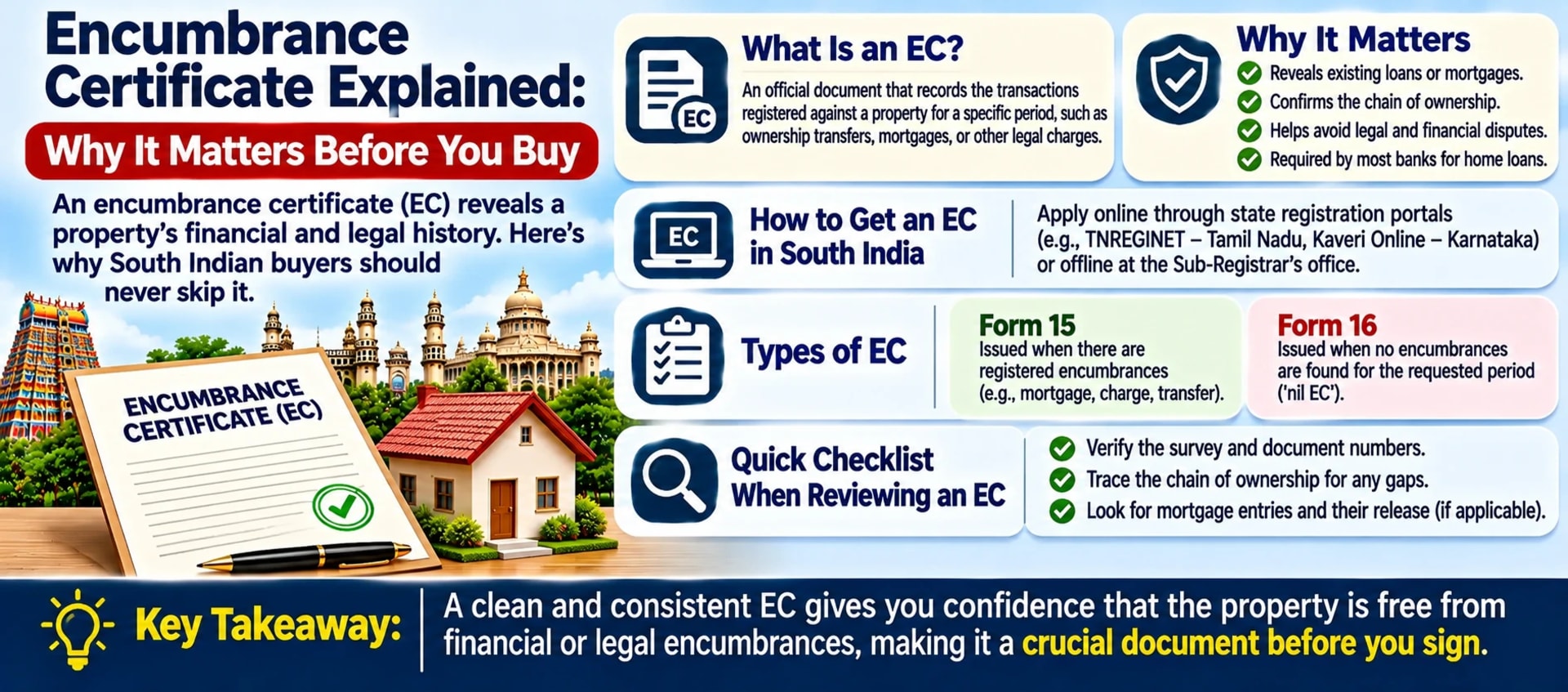
An encumbrance certificate (EC) is an official document that records the transactions registered against a specific property over a given period. In practical terms, it tells a prospective buyer whether a property carries any financial or legal liabilities — such as an existing mortgage, loan, or transfer of ownership — that have been formally registered.
The EC is issued by the office of the Sub-Registrar under whose jurisdiction the property falls. It draws on the records maintained during property registration, which is governed by the Registration Act, 1908. Buyers typically request an EC covering a continuous period — often spanning several years or decades — to build a reliable picture of the property's history.
How It Works in South India
Across Tamil Nadu, Karnataka, Kerala, Andhra Pradesh and Telangana, most states now allow applicants to obtain an EC online through their respective registration department portals — such as TNREGINET in Tamil Nadu and Kaveri Online Services in Karnataka. Applicants can also apply offline at the Sub-Registrar's office using the prescribed form.
The application generally requires property details including the survey number, document number, and the extent of the land, along with the period for which the certificate is sought. A nominal fee applies, which varies by state and by the number of years covered.
There are commonly two forms of EC. Form 15 is issued when there are registered encumbrances on the property for the requested period, listing each transaction. Form 16, sometimes called a 'nil encumbrance certificate', is issued when no encumbrances are found for that period.
Why It Matters Before You Buy
In our view, the EC is one of the most underappreciated documents in a property transaction. Many first-time buyers focus heavily on price, location and amenities, yet treat title verification as a formality to be rushed through at the lawyer's desk. An EC is a cheap, accessible safeguard against an expensive mistake — and skipping it tends to be a false economy.
A clean EC matters for financing too. Most banks and housing finance companies in South India require an encumbrance certificate as part of their legal due diligence before sanctioning a home loan, precisely because it helps confirm the property is free of prior mortgages.
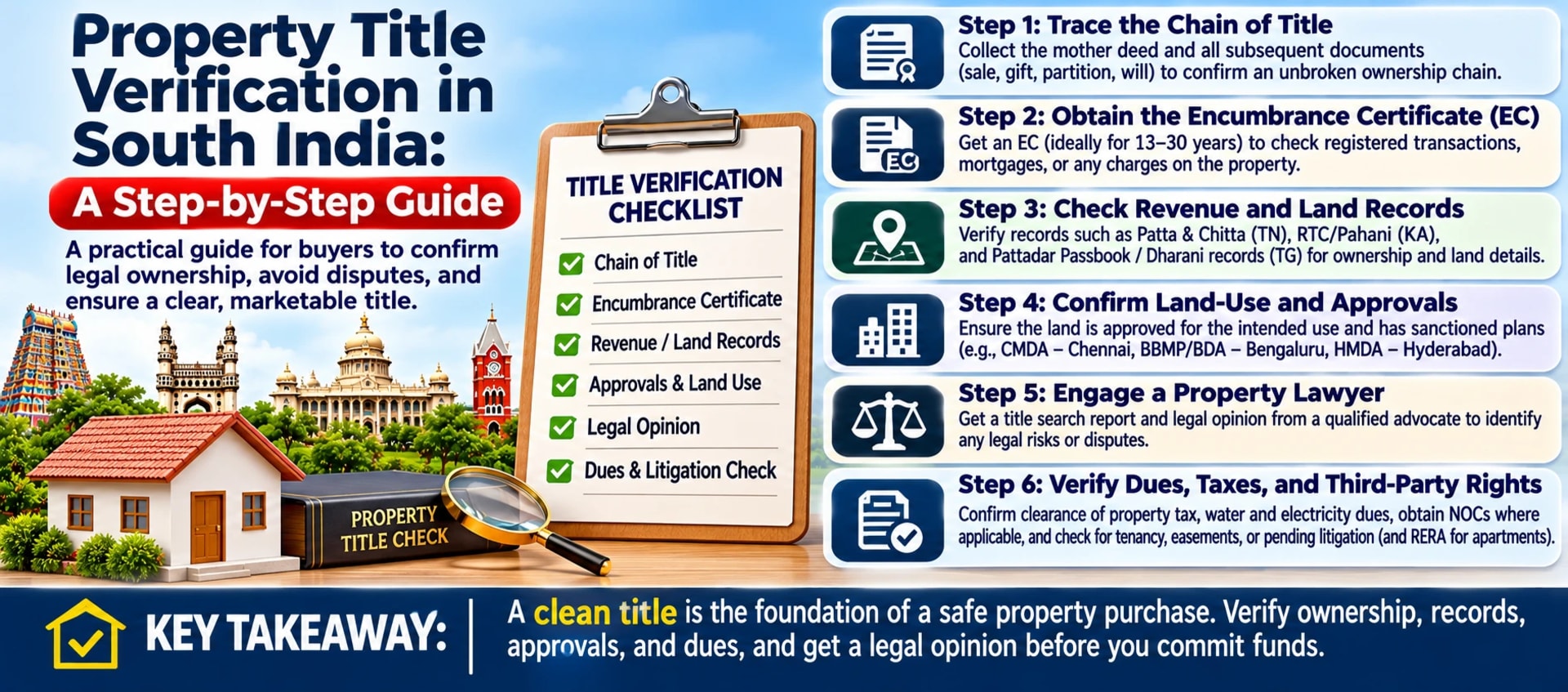
It is worth remembering what an EC does not do. It reflects only transactions that were actually registered. Unregistered agreements, oral family arrangements, pending litigation, or tax dues may not surface in it. We therefore read the EC as a strong starting point for due diligence, not the final word — it should sit alongside the title deed chain, patta or khata records, and a lawyer's independent title search.
Consider a hypothetical buyer evaluating a resale apartment in a suburb of a large South Indian city. The paperwork looks tidy and the seller is persuasive. On pulling a 20-year EC, the buyer notices a mortgage entry from several years earlier with no corresponding release of charge. That single line prompts a question — has the seller's earlier loan actually been cleared? — that could save the buyer from inheriting someone else's debt. This scenario is illustrative, but it reflects the kind of red flag an EC is designed to reveal.
A Practical Checklist
When reviewing an EC, buyers should verify that the survey and document numbers match the property being purchased, trace the chain of ownership for gaps, and look specifically for mortgage entries alongside any later release of those charges. For a property purchased with an earlier loan, the release of the mortgage should appear as a registered entry.
Our editorial recommendation is simple: treat the EC as non-negotiable and obtain it early, before you pay a significant advance. Reviewing it at the start of a deal gives you leverage and time; discovering a problem after you have committed money gives you neither.
As state registration departments continue to digitise their records, obtaining an EC is likely to become faster and more transparent over the coming years, with longer historical periods expected to be searchable online. Buyers should still anticipate occasional gaps in older, pre-digitisation records that may require a manual search at the Sub-Registrar's office.