RERA Complaint Filing: How to Escalate When Your Builder Delays Possession
The Real Estate (Regulation and Development) Act, 2016, commonly called RERA, was enacted to protect homebuyers and bring transparency to property transactions. Each state operates its own RERA authority with a dedicated online portal for complaints, registrations, and project tracking.
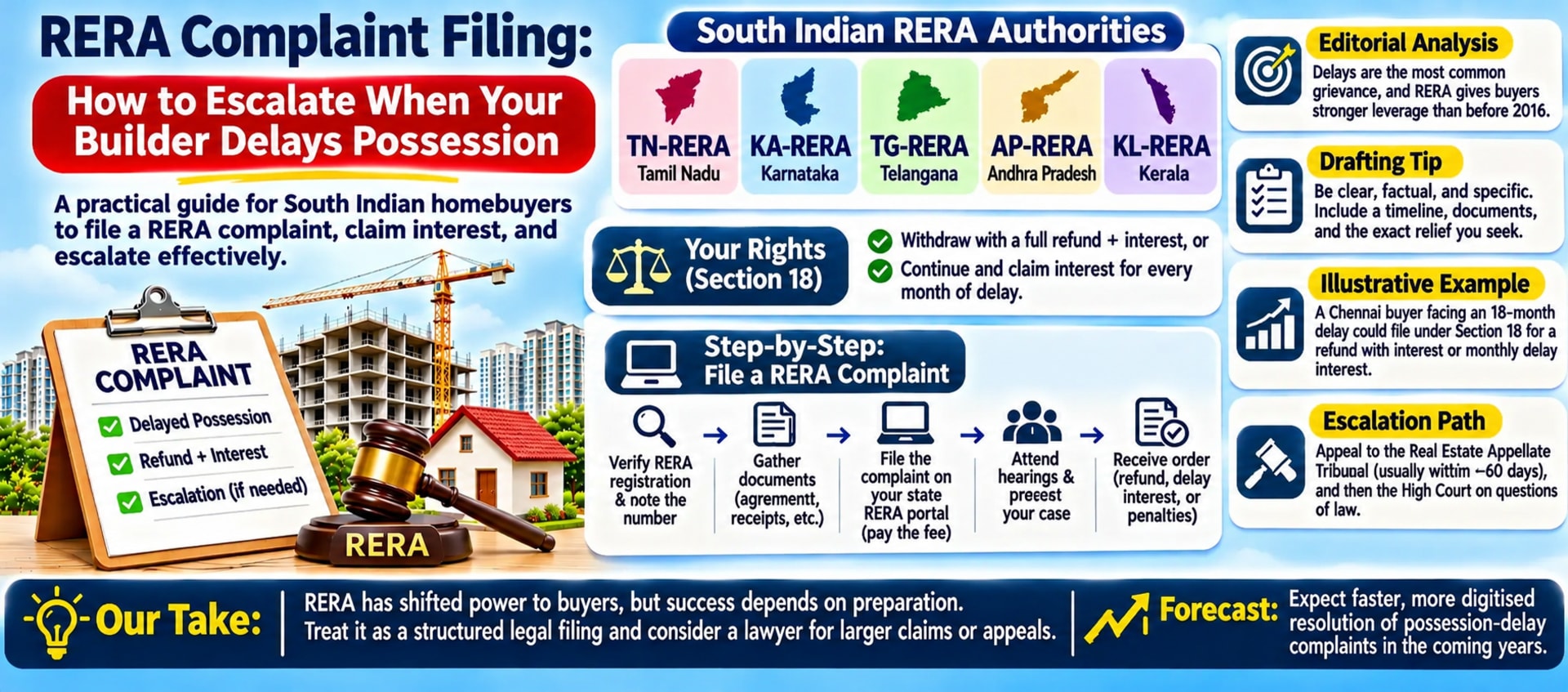
In South India, the main regulatory bodies are TNRERA (Tamil Nadu), K-RERA (Karnataka), TG-RERA (Telangana), AP-RERA (Andhra Pradesh), and K-RERA (Kerala). Each maintains a separate website where buyers can verify project registration numbers and file grievances against promoters.
Why Possession Delays Are the Most Common Grievance
In our editorial experience covering South Indian markets, delayed possession remains the single most frequent reason buyers approach RERA. The agreement for sale typically commits the builder to a possession date, and when that date slips without a valid force-majeure justification, the buyer gains a clear statutory basis to act. The key is understanding that RERA gives you leverage you simply did not have before 2016.
Under Section 18 of the RERA Act, if a promoter fails to complete or hand over possession by the date specified in the agreement, the buyer is entitled to either withdraw from the project with a full refund plus interest, or continue and claim interest for every month of delay until possession is handed over.
Step-by-Step: Filing Your RERA Complaint
First, confirm the project is RERA-registered and note its registration number from the state authority's website. Second, gather documentation — the sale agreement, payment receipts, allotment letter, and any written communication about the delay. Third, log in to your state RERA portal, locate the complaint or grievance section, and fill the prescribed form.
A complaint usually requires a nominal filing fee that varies by state; several South Indian authorities have historically set this in the range of a few hundred to around one thousand rupees. The exact fee, prescribed form number, and accepted payment modes should be checked directly on your state's current RERA notification.
After submission, the authority schedules hearings where both parties present their case. RERA adjudicating officers can order refunds, direct payment of delay interest, or impose penalties on non-compliant promoters. Interest on delays is commonly pegged to the State Bank of India's highest marginal cost of lending rate plus a fixed percentage, as defined in state rules.
Drafting a Complaint That Actually Lands
From what we have observed, complaints succeed or fail on documentation discipline rather than legal eloquence. A clearly stated timeline — booking date, agreed possession date, actual status — backed by stamped receipts tends to carry far more weight than emotive language. Buyers who articulate a specific, quantified relief (the exact refund or interest sought) generally make the adjudicator's task easier.
Consider a hypothetical buyer who booked an apartment in a suburban Chennai project with a committed possession date, paid roughly 80 percent of the cost, and then faced an eighteen-month delay with no construction progress. Such a buyer could file under Section 18, attach the agreement and receipts, and seek either a full refund with interest or monthly delay interest while retaining the booking — illustrating how the two remedy paths work in practice.
Escalating Beyond the First Order
If either party is dissatisfied with the authority's order, an appeal can be filed before the Real Estate Appellate Tribunal within a limited window, often around 60 days from the order. Appeals typically require the promoter to pre-deposit a portion of any amount due to the buyer before the tribunal hears the matter.
Beyond the Appellate Tribunal, further appeals on questions of law may lie with the jurisdictional High Court. Buyers should be aware that each escalation stage has its own time limits and procedural requirements that differ between states.
Our Take for South Indian Buyers
RERA has meaningfully shifted bargaining power toward buyers, but outcomes still depend on how prepared the complainant is. We would encourage buyers to treat the complaint as a structured legal filing — organised, dated, and specific — rather than a letter of grievance. Engaging a lawyer familiar with your state's tribunal is often worthwhile when large sums or appeals are involved.
As enforcement matures, state RERA authorities in South India are likely to continue digitising complaint handling and tightening compliance monitoring, which could gradually shorten resolution timelines for possession-delay cases. Buyers should expect, but not assume, steadily more responsive grievance redressal in the coming years.
Before filing, always verify the latest fees, forms, interest formula, and appeal timelines on your specific state RERA portal, as these details are periodically revised through official notifications.