Sale Deed vs Agreement to Sell: What South Indian Buyers Should Know
When buying property in Chennai, Bengaluru, Hyderabad, Kochi or anywhere across South India, two documents dominate the paperwork: the agreement to sell and the sale deed. Though often confused, they serve very different legal purposes and come into play at different stages of a transaction.
What Is an Agreement to Sell?
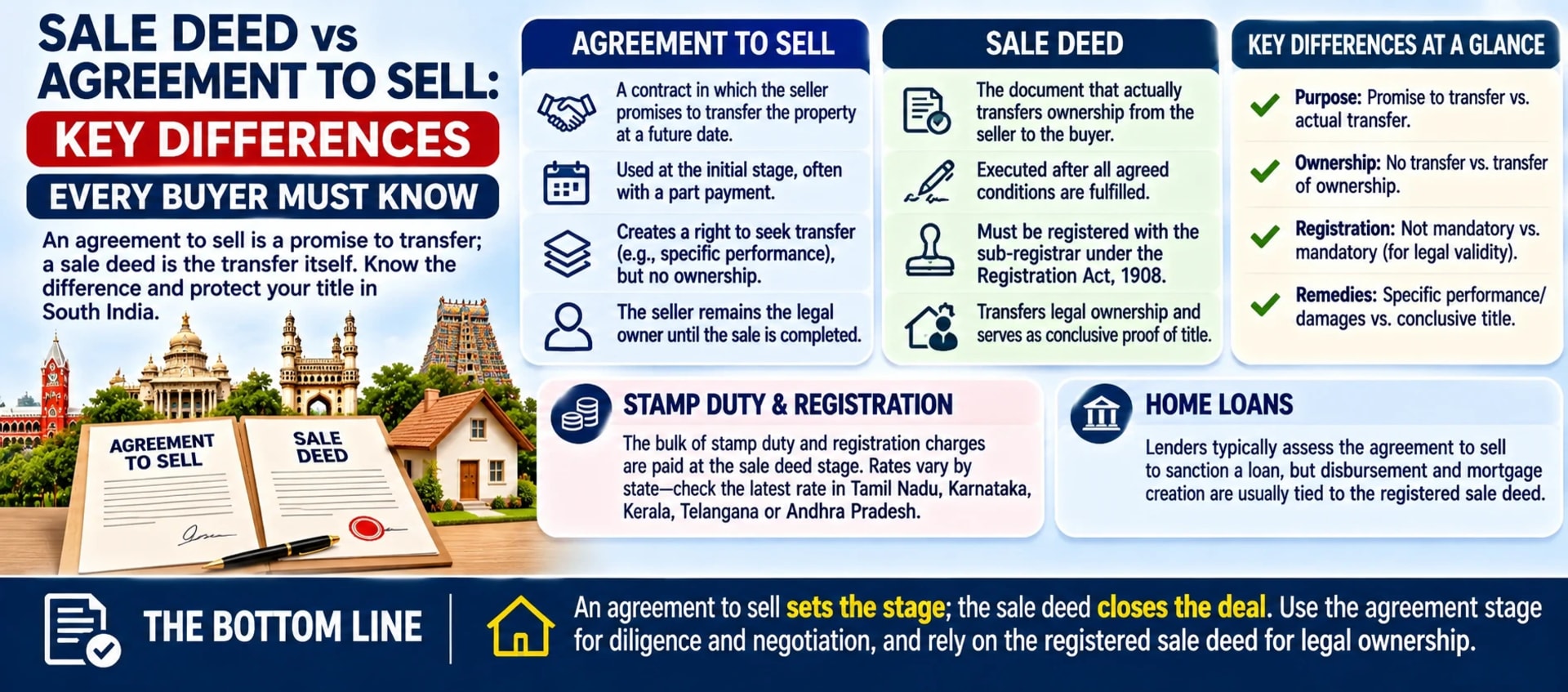
An agreement to sell is a contract in which the seller promises to transfer the property to the buyer at a future date, usually once agreed conditions are met — such as full payment, clearing of dues, or obtaining regulatory approvals. It records the intention to transfer ownership but does not, by itself, transfer ownership.
Under the Transfer of Property Act, 1882, an agreement to sell creates a right in favour of the buyer but does not create any interest in or charge on the property itself. In practical terms, this means the seller remains the legal owner until the sale is completed.
What Is a Sale Deed?
A sale deed is the document that actually transfers ownership from the seller to the buyer. It is executed once the terms of the agreement to sell are fulfilled, and it must be registered with the local sub-registrar's office to be legally valid under the Registration Act, 1908.
Stamp Duty and Registration
In most states, the bulk of stamp duty and registration charges are paid at the sale deed stage, since that is when title passes. Stamp duty rates vary by state — Tamil Nadu, Karnataka, Kerala, Telangana and Andhra Pradesh each set their own rates, and some apply concessions based on gender of the buyer or property value. Buyers should confirm the current applicable rate with the relevant state registration department before budgeting.
The Core Legal Difference
The simplest way to remember it: an agreement to sell is a promise about the future, while a sale deed is the present-tense act of transfer. Breach of an agreement to sell typically gives the aggrieved party remedies such as specific performance or damages, whereas a registered sale deed is treated as conclusive proof of ownership transfer.
In our experience reviewing South Indian transactions, a large share of buyer disputes trace back to treating the agreement to sell as if it were final ownership. It is not. Until the sale deed is executed and registered, a buyer's position is contractual rather than proprietary, and that distinction becomes painfully clear if the seller defaults or attempts a parallel sale.
We'd argue the agreement to sell is the stage where most due diligence should happen — title search, encumbrance checks, verifying approvals and khata or patta records. By the time you reach the sale deed, you want zero surprises. A well-drafted agreement that clearly spells out timelines, penalties for delay and conditions for refund is a buyer's strongest safeguard.
Consider a hypothetical buyer in Bengaluru who signs an agreement to sell and pays a 20% advance, expecting registration within three months. Suppose the seller then receives a higher offer and stalls. Because only an agreement to sell exists, the buyer does not automatically own the property; they would need to pursue specific performance in court to compel the transfer. Had the sale deed already been registered, the property would clearly be theirs. This scenario illustrates why the gap between the two documents matters.
Home Loans and the Two Documents
Lenders typically assess the agreement to sell to sanction a home loan, but disbursement and the creation of mortgage security are usually tied to the registered sale deed. Buyers relying on financing should coordinate loan timelines with the registration schedule to avoid gaps.
With states across South India continuing to digitise land records and registration processes, the end-to-end journey from agreement to sell to registered sale deed is likely to become faster and more transparent over the coming years. Buyers can expect greater reliance on online encumbrance and title verification tools during the agreement stage.
The Bottom Line
An agreement to sell sets the stage; the sale deed closes the deal. Treat the agreement stage as your window for diligence and negotiation, and treat the registered sale deed as the only document that confirms you legally own the property. When in doubt, consult a qualified property lawyer familiar with your state's rules before signing either document.