Rental Yield vs Capital Appreciation in South India
Every property investor eventually faces the same fork in the road: should you buy for steady monthly rent, or for long-term price growth? In South India's four major markets — Bengaluru, Hyderabad, Chennai and Kochi — the answer increasingly depends on the micro-market rather than the city as a whole.
Defining the two metrics
Rental yield is the annual rent a property earns expressed as a percentage of its purchase price. Capital appreciation is the increase in the property's market value over time. Residential rental yields across major Indian metros have historically sat in roughly the 2.5% to 4% range, while commercial and well-located apartments can run higher.
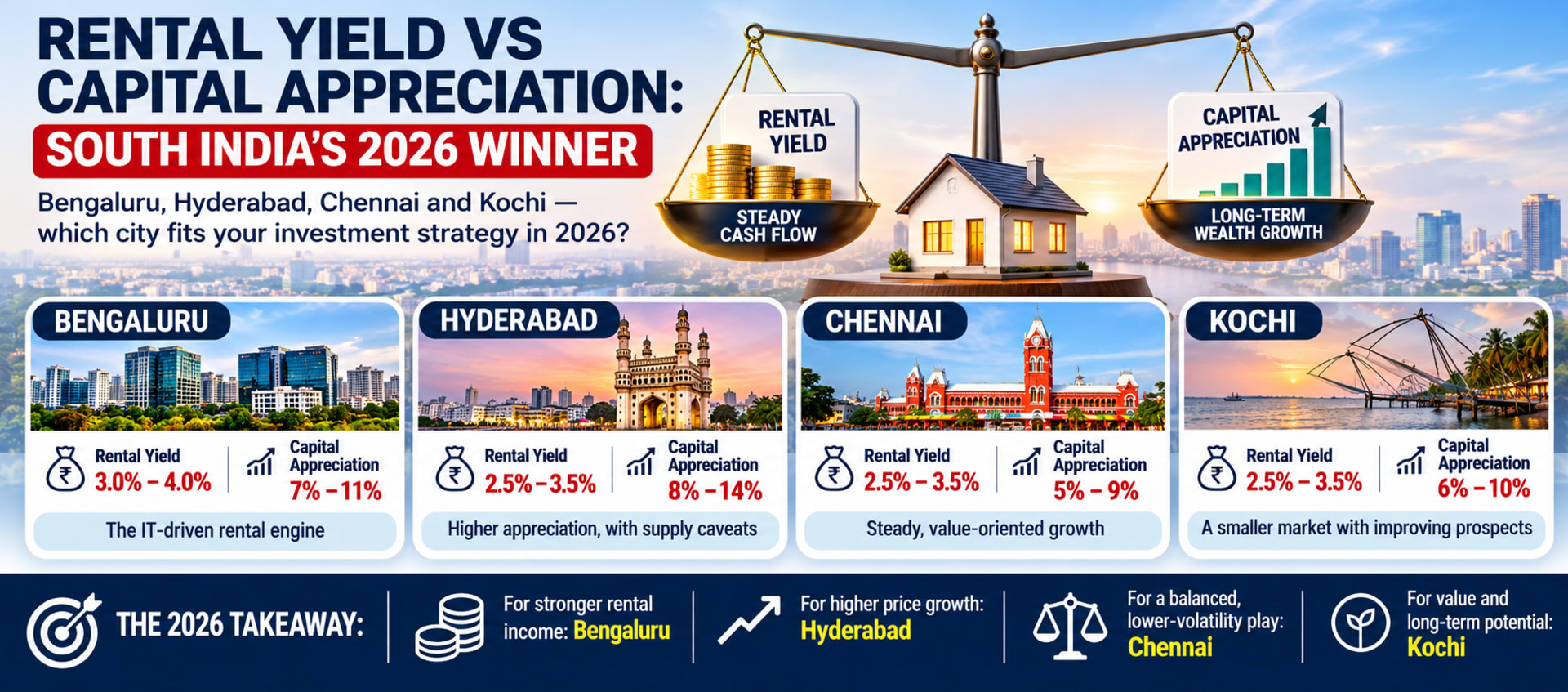
Bengaluru: the IT-driven rental engine
Bengaluru's deep tech employment base keeps rental demand resilient in corridors like Whitefield, Sarjapur Road and the Outer Ring Road. Reports in recent years have pointed to some of the strongest rent growth among Indian metros for the city, driven by return-to-office trends and limited ready inventory in prime pockets.
Our reading is that Bengaluru remains the most balanced of the four markets — it offers both a liquid rental tenant pool and a credible appreciation story, provided you buy close to employment nodes rather than on the distant fringe. The trade-off is a higher entry price, which compresses the headline yield even when absolute rents are strong.
Hyderabad: appreciation with supply caveats
Hyderabad has seen significant price growth in the HITEC City, Gachibowli and Kokapet belt over the past several years, supported by infrastructure spending and corporate expansion. However, large new supply in some western corridors has raised questions about near-term rental saturation.
Chennai: steady, value-oriented growth
Chennai's market, including the OMR IT corridor and emerging zones toward the south and west, has tended to appreciate more gradually than Hyderabad but with lower volatility. Its manufacturing and IT mix gives it a diversified demand base for both end-users and tenants.
Kochi: a smaller but improving market
Kochi offers lower entry prices than the three larger cities, with pockets around the IT corridors and waterfront developments drawing interest. Liquidity is thinner, which can affect both resale speed and the consistency of rental demand.
A tale of two buyers
Consider a hypothetical investor with a fixed budget choosing between two flats. One sits in a mature, high-demand IT corridor where rent covers a healthy share of the EMI but prices have already run up. The other is in an emerging suburb where rent is modest today but infrastructure is improving. The first buyer prioritises cash flow and lower vacancy risk; the second is betting on appreciation and can tolerate years of weak yield. Neither choice is wrong — they simply reflect different time horizons and risk appetites.
Which city 'wins' in 2026?
In our view, the framing of a single winner is misleading. For investors who want the strongest blend of rental income and capital growth, Bengaluru's established corridors still look hard to beat on fundamentals. For those chasing aggressive appreciation and willing to accept supply-driven volatility, Hyderabad's western belt is the more opportunistic play. Chennai suits conservative, long-hold investors, while Kochi appeals to those seeking a lower-ticket entry with patience.
Looking ahead, rental yields in top South Indian corridors are likely to stay compressed relative to global norms as prices continue to outpace rent in prime zones. Capital appreciation is expected to remain the dominant return driver for well-located assets, though growth is likely to be uneven across micro-markets rather than uniform across any single city.
The bottom line
The smarter question for 2026 is not 'which city?' but 'which strategy, in which corridor, for how long?' Yield-focused buyers should scrutinise tenant demand, vacancy rates and maintenance costs; appreciation-focused buyers should track infrastructure timelines and upcoming supply. The best decisions pair your personal cash-flow needs with on-the-ground micro-market data.
Before you decide
Always verify current circle rates, project RERA registration, loan eligibility and recent transacted prices in your chosen locality before committing. Published averages mask wide variation between adjacent neighbourhoods.