Karnataka RERA 2026: A Home Buyer's Pre-Booking Checklist
The Real Estate (Regulation and Development) Act was enacted at the national level in 2016, and each state notified its own rules and regulatory authority thereafter. In Karnataka, the state authority is commonly referred to as K-RERA, and it maintains a public portal where registered projects and agents are listed.
For buyers across South India, RERA remains one of the most useful tools available precisely because it shifts the burden of transparency onto the developer. Our view is that the single biggest mistake first-time buyers make is treating a project's marketing brochure as the source of truth, when the regulator's own database should always come first.
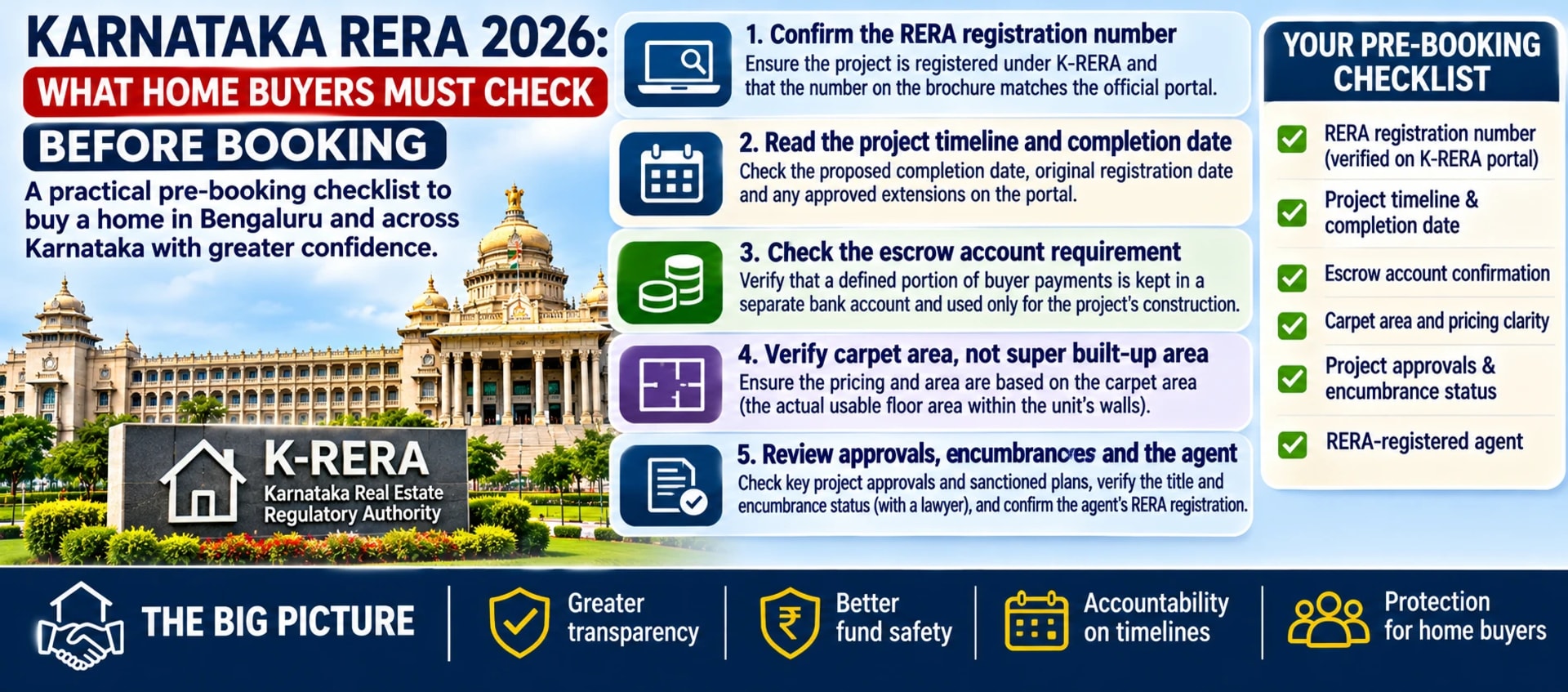
Step 1: Confirm the RERA registration number
Any project above a certain threshold of plot area or number of units is required to be registered before the developer can advertise, market or sell units in it. The registration number should be displayed on all advertisements and can be independently searched on the Karnataka RERA website. Buyers should cross-check that the number quoted in the brochure matches the entry on the portal.
Step 2: Read the project timeline and completion date
When a developer registers a project, they declare a proposed completion date to the authority. This declared date is legally significant because delays beyond it can entitle buyers to compensation or interest under the Act. The portal listing typically shows the original registration date, the proposed end date, and any extensions granted.
We would encourage buyers to pay close attention to projects that have already sought one or more timeline extensions. An extension is not automatically a red flag, but a pattern of repeated extensions, combined with slow construction updates, is worth probing with the developer before committing any booking amount.
Step 3: Check the escrow account requirement
Under RERA, a defined portion of the amounts collected from buyers for a project must be deposited in a separate bank account and used only for construction and land costs of that specific project. This provision is intended to prevent developers from diverting funds from one project to another. Buyers can ask for confirmation of the project's dedicated account in the sale documentation.
Step 4: Verify carpet area, not super built-up area
RERA mandates that pricing and area be communicated on the basis of carpet area, which is the actual usable floor area within the walls of the unit, rather than the super built-up area that includes common spaces. This is a crucial distinction because the carpet area is usually significantly smaller than the super built-up figure historically used in marketing.
Consider a hypothetical buyer comparing two apartments in the same suburb. Both are advertised as '1,200 sq ft', but one listing quotes super built-up area while the other quotes carpet area. On closer reading of the RERA disclosures, the carpet areas turn out to be meaningfully different, which changes the true per-square-foot cost of each home. This is exactly the kind of comparison the carpet-area rule is designed to make possible.
Step 5: Review approvals, encumbrances and the agent
The RERA listing often links to key approvals and the status of sanctioned plans. Buyers should also confirm the title and encumbrance position independently, ideally through a lawyer, and check whether the broker they are dealing with holds a valid RERA agent registration. Dealing with a registered agent adds a layer of accountability.
In our assessment, RERA works best when buyers treat the portal as a starting point rather than a guarantee. The regulator captures what developers declare; it does not physically inspect every claim. Pairing the online check with a site visit, a legal title review and a conversation with existing residents remains the most reliable approach to due diligence in the Karnataka market.
Looking ahead
Through 2026, regulatory scrutiny of under-construction projects in Karnataka is likely to tighten further, and digital disclosure on state RERA portals is expected to become more detailed. Buyers who build the habit of checking registration, timelines and escrow compliance now are likely to be better protected as enforcement evolves.
Note for reviewers: specific regulatory thresholds, the exact escrow percentage, naming conventions for the Karnataka authority, and current portal features should be confirmed against the latest official Karnataka RERA notifications before publication, as rules and figures may have changed.