Why the Sticker Price Is Only the Beginning
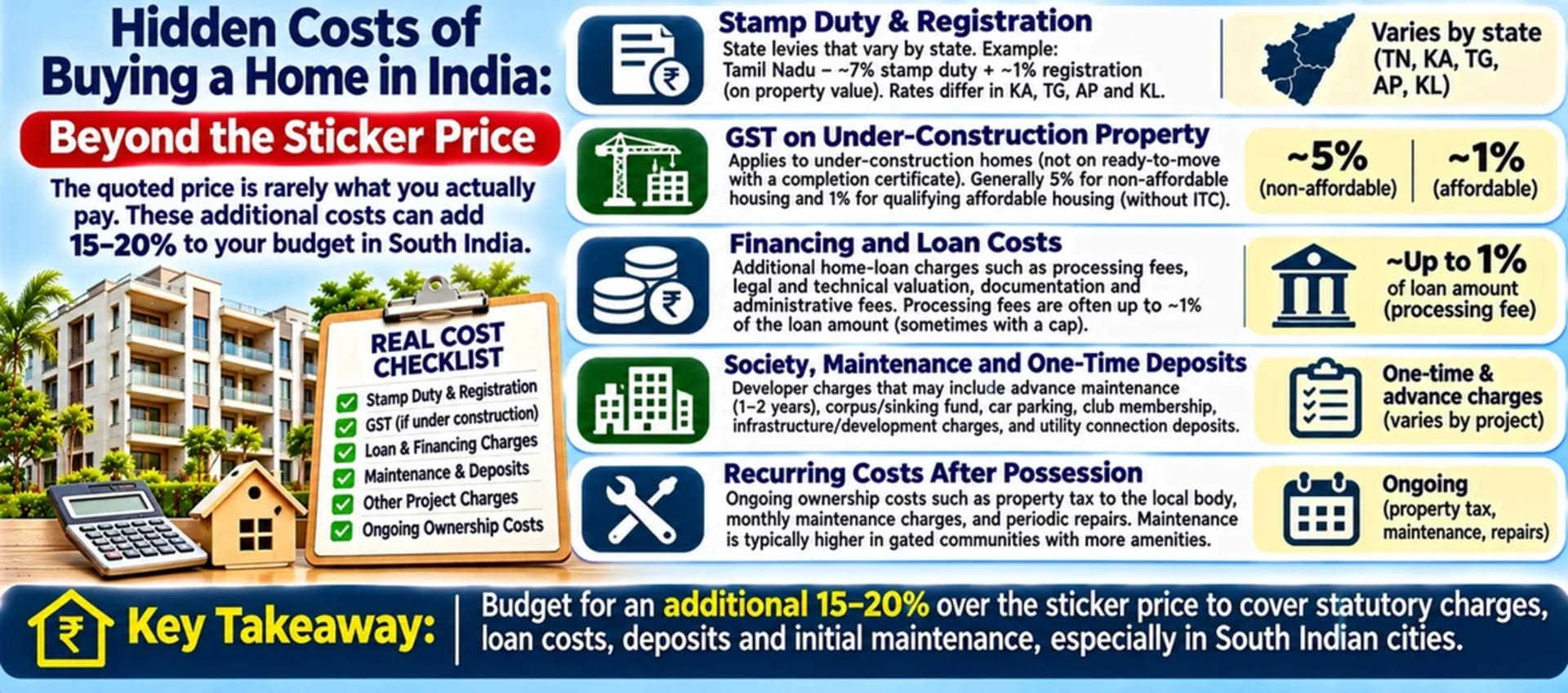
When a developer advertises a home at a particular rate per square foot, that figure covers the base cost of the apartment or plot alone. The amount a buyer actually transfers before receiving keys is usually considerably higher once statutory charges, financing costs, and one-time deposits are added.
In our experience reviewing buyer complaints, the gap between the advertised price and the final outflow is where most first-time purchasers feel blindsided. The headline number is a marketing anchor; the real cost of ownership is a stack of smaller line items that are easy to underestimate individually but significant in aggregate.
Stamp Duty and Registration
Stamp duty and registration charges are levied by state governments and vary across South India. In Tamil Nadu, buyers have typically faced stamp duty in the region of 7% plus registration charges of around 1% of the property value. Karnataka, Telangana, Andhra Pradesh, and Kerala each set their own slabs, and rates can differ by property value band, gender of the buyer, and urban versus rural location.
GST on Under-Construction Property
Goods and Services Tax applies to under-construction homes but not to ready-to-move properties where a completion certificate has been issued. Current rates have generally been cited as 5% for non-affordable housing and 1% for qualifying affordable housing, both without input tax credit. Buyers should confirm the applicable rate and the project's construction status before budgeting.
Financing and Loan Costs
A home loan carries its own set of charges beyond the interest rate: processing fees, legal and technical valuation charges, documentation fees, and in some cases login or administrative fees. Processing fees are often quoted as a percentage of the loan amount, commonly up to around 1%, sometimes subject to a cap. These are usually payable upfront and are rarely folded into the advertised cost of the home.
Society, Maintenance and One-Time Deposits
Many developers collect advance maintenance charges covering one to two years, along with a one-time corpus or sinking fund contribution for the resident welfare association. Additional charges may include car parking, club membership, infrastructure or development charges, water and electricity connection deposits, and legal documentation fees. These are frequently disclosed only in the fine print of the cost sheet.
Consider a hypothetical buyer evaluating a flat advertised at a base cost of 60 lakh. By the time stamp duty, registration, GST on the under-construction unit, a parking charge, a corpus fund, advance maintenance, and loan processing fees are added, the total outflow could plausibly cross 70 lakh. The point of this illustration is not the exact figure but the direction: the real cost sits meaningfully above the quoted price.
Our editorial view is that buyers should ask for a fully itemised cost sheet in writing before paying any booking amount, and should treat every 'nominal' or 'standard' charge as negotiable until proven otherwise. The charges most worth scrutinising are the ones bundled under vague labels like development or infrastructure fees, where the justification is often thin.
Recurring Costs After Possession
Ownership costs do not end at registration. Property tax to the local municipal body, monthly maintenance charges, and periodic repairs are ongoing. For many South Indian cities, maintenance in gated communities with extensive amenities tends to be higher per square foot than in basic apartment blocks, reflecting the cost of shared facilities.
As regulatory oversight under RERA matures, developer cost sheets are likely to become more standardised and transparent over the coming years, which could reduce the number of surprise charges buyers encounter at the final stage. Buyers are still advised, however, to verify each line item independently rather than assume disclosure is complete.
Ultimately, the discipline that protects a buyer is simple: build a budget around the total cost of acquisition and the first few years of ownership, not the rate per square foot on the brochure. The sticker price is a starting point for a conversation, never the final number.