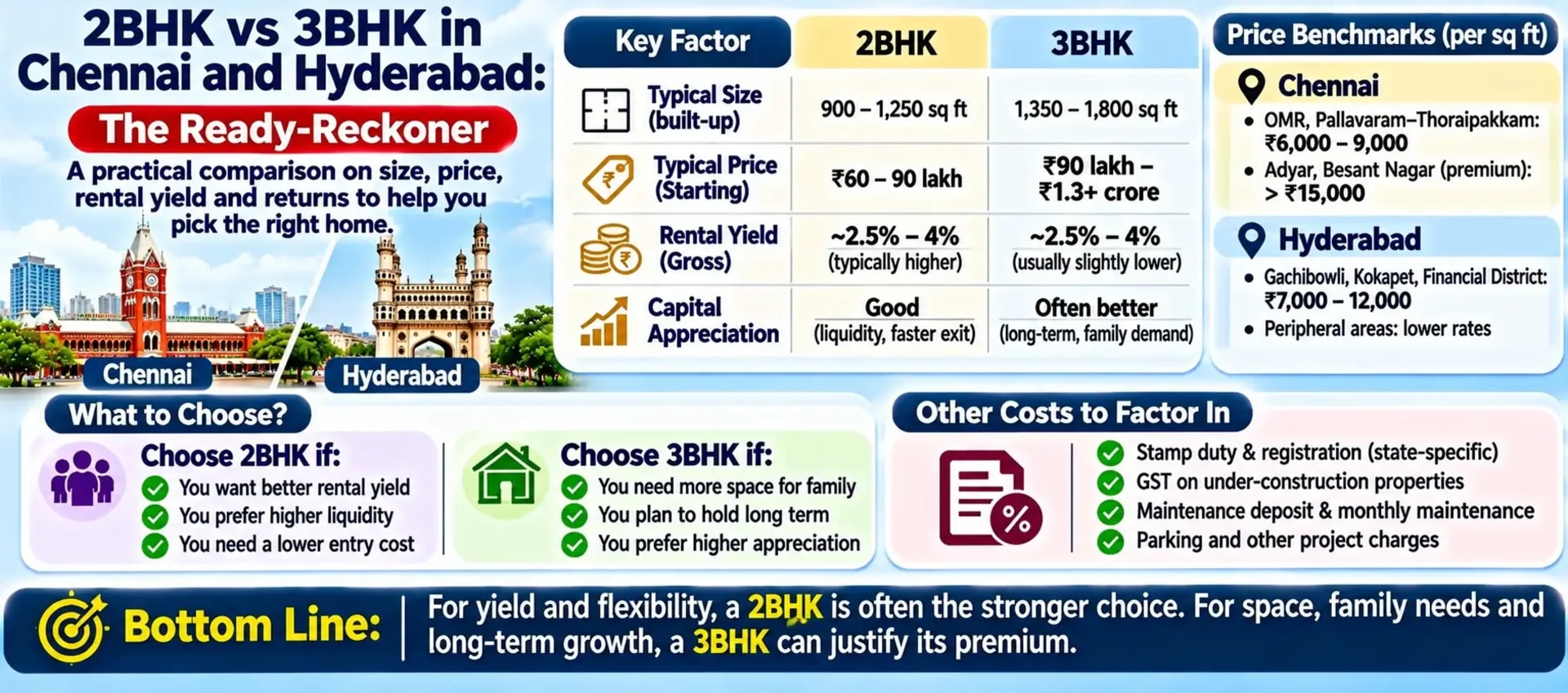
2BHK vs 3BHK in Chennai and Hyderabad: The Ready-Reckoner
Choosing between a 2BHK and a 3BHK is one of the most common decisions facing homebuyers across South India's two fastest-moving metros. The right answer depends on your budget, family size, resale horizon, and whether you intend to rent the unit out. This guide breaks down the typical trade-offs on size, price and returns in Chennai and Hyderabad.
Typical sizes
In both cities, a standard 2BHK apartment generally ranges from around 900 to 1,250 sq ft of built-up area, while a 3BHK usually falls between 1,350 and 1,800 sq ft. Hyderabad projects, particularly in the western IT corridor, tend to offer larger layouts for the same configuration than comparable Chennai projects, where land constraints often compress unit sizes.
Price benchmarks
In Chennai, per-square-foot rates vary widely by micro-market: OMR and Pallavaram-Thoraipakkam stretches command roughly ₹6,000–₹9,000 per sq ft, while central and premium localities such as Adyar or Besant Nagar can exceed ₹15,000 per sq ft. In Hyderabad, the Gachibowli, Kokapet and Financial District belt typically ranges between ₹7,000 and ₹12,000 per sq ft, with peripheral areas available at lower rates.
On these benchmarks, an entry-level 2BHK in a growing suburb of either city often sits in the ₹60 lakh to ₹90 lakh bracket, while a comparable 3BHK commonly starts around ₹90 lakh and moves well past ₹1.3 crore in sought-after corridors.
The headline price gap between the two configurations can be misleading. Because the premium per square foot is often similar within the same project, the extra cost of a 3BHK is largely a function of the additional carpet area you are buying rather than a disproportionate luxury markup. Buyers should therefore evaluate cost-per-usable-sq-ft rather than fixating on the total ticket size.
Rental yield and ROI
Residential gross rental yields in both Chennai and Hyderabad have historically hovered in the modest 2.5% to 4% range annually, which is typical for Indian metros where capital values outpace rents. 2BHK units generally post marginally higher percentage yields because their lower ticket size attracts a deeper pool of tenants.
Our reading is that 2BHKs tend to win on rental efficiency and liquidity, while 3BHKs often perform better on long-term capital appreciation in family-oriented, end-user-dominated neighbourhoods. If your primary goal is steady rental income with easy exit, the smaller unit is usually the more defensive choice; if you are an end-user planning a long hold near good schools and workplaces, the larger unit's appreciation can compensate for the thinner yield.
A simple comparison
Consider a hypothetical buyer weighing two units in the same OMR project. The 2BHK is priced lower and rents out quickly to young IT professionals, giving a slightly higher yield and faster resale. The 3BHK costs more but appeals to families seeking to settle long-term, potentially appreciating more over a decade. Neither is objectively 'better' — the choice turns entirely on whether the buyer prioritises cash flow and flexibility or space and long-horizon growth.
Costs beyond the sticker price
Buyers in both states must budget for stamp duty and registration charges, which differ between Tamil Nadu and Telangana, along with GST on under-construction properties, maintenance deposits, and parking charges. These can add a meaningful percentage to the headline price and should be factored into any ROI calculation. The exact rates are set by state governments and periodically revised.
A frequently overlooked point: maintenance and property tax scale with unit size, so a 3BHK's higher ongoing outgoings quietly erode its net yield relative to a 2BHK. We recommend running a full net-of-cost return calculation rather than relying on gross yield headlines when comparing configurations.
The outlook
With sustained IT and GCC hiring in both cities, demand for well-located 2BHK and 3BHK homes is likely to remain firm over the medium term. Hyderabad's western corridor is expected to continue seeing strong supply, which may keep price growth more balanced, while Chennai's land-constrained core is likely to sustain premium pricing. Rental demand near employment hubs is expected to stay healthy, though yields are unlikely to shift dramatically from current ranges.
Bottom line
For investors chasing yield and liquidity, a 2BHK in a high-rental micro-market usually makes the stronger case. For end-users and long-term holders in family neighbourhoods, a 3BHK can justify its premium through appreciation and livability. Verify current rates, taxes and project-specific details before committing.