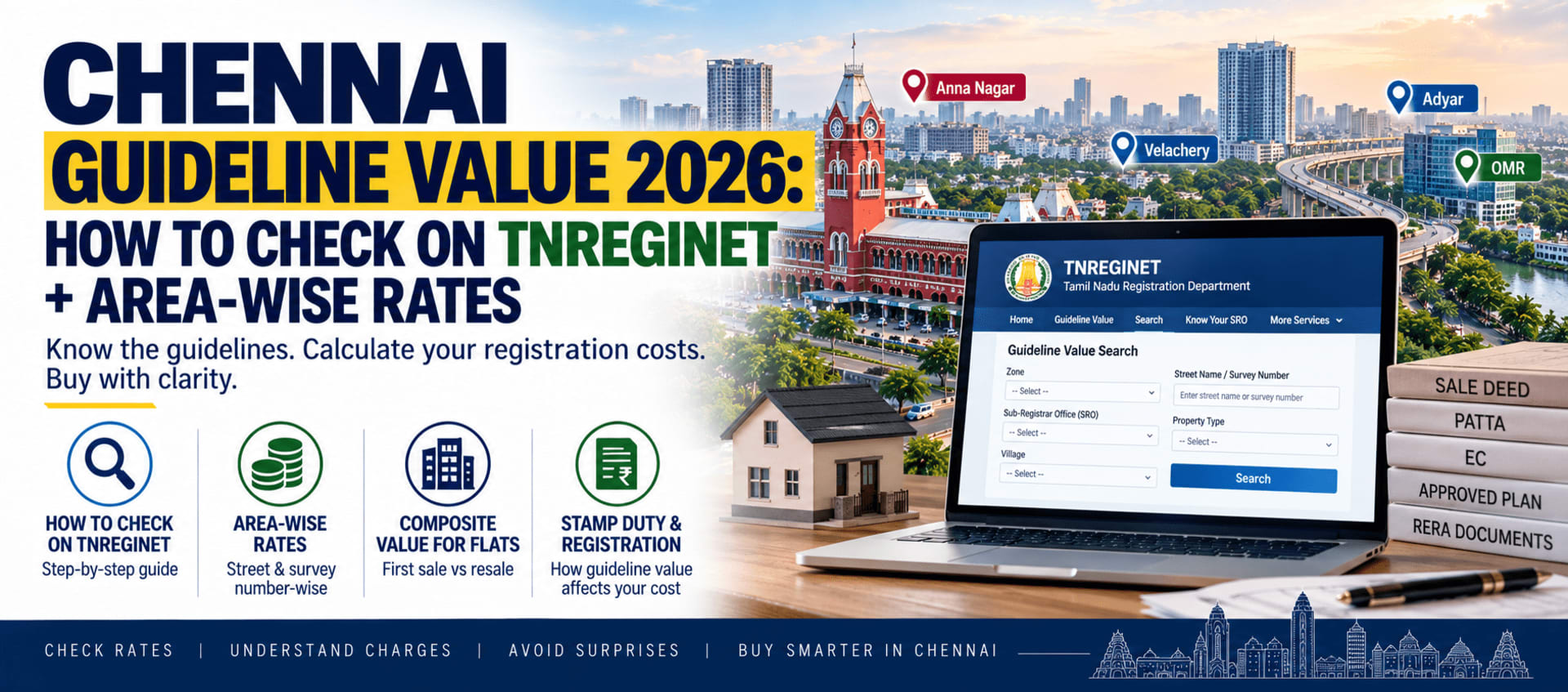
Chennai Guideline Value 2026: How to Check TNREGINET Rates, Stamp Duty & Property Registration
Last updated: September 2026
If you are buying a flat in Velachery, a plot in Avadi, an independent house in Anna Nagar or land anywhere in Chennai, one number can significantly affect your property registration cost: the guideline value.
The guideline value is the value assigned by the Tamil Nadu Registration Department to a property based on its location, street, survey number and classification. It is an important reference when determining the value on which stamp duty and registration charges are calculated.
For buyers, the important point is simple:
Do not rely only on the price quoted by the seller or broker. Check the applicable guideline value for the exact property on TNREGINET before finalising your purchase.
In this guide, we explain:
What guideline value means
Why it matters when buying property
How to check it on TNREGINET
Street-wise vs survey-number-wise guideline values
How apartment composite value works
Guideline value vs market value
What happens when the agreed price is below the applicable government valuation
How guideline value affects property registration
What buyers should check before registering a property in Chennai
What Is Guideline Value in Chennai?
Guideline value is the value assigned by the Tamil Nadu Registration Department to land or property for registration and valuation purposes.
It can vary significantly between:
Streets
Roads
Villages
Survey numbers
Property classifications
Residential and commercial areas
This means there is no single guideline value for an entire locality such as:
Velachery
Anna Nagar
Adyar
Ambattur
Avadi
Two properties in the same locality can have different applicable guideline values because they may fall under different streets, survey numbers or classifications.
Guideline value is not the same as market price
For example:
A property may have:
Guideline value: ₹5,000/sq.ft.
while the actual negotiated market price may be:
₹8,000/sq.ft.
The two numbers serve different purposes.
The guideline value is a government valuation reference used in the registration process, while the market price is the amount agreed between the buyer and seller.
Why Does Guideline Value Matter?
Guideline value matters primarily because it can affect the value used for calculating government charges associated with property registration.
It can also become relevant to tax and valuation questions when the value stated in a property transaction differs materially from the applicable stamp-duty value.
For buyers, checking the guideline value before negotiating is useful because it helps you estimate the potential registration cost and identify valuation differences before signing the sale agreement.
Guideline Value vs Market Value
These terms are often confused.
TermMeaningGuideline ValueGovernment valuation reference published for registration purposesMarket Value / Sale ConsiderationPrice agreed between buyer and sellerBank ValuationValue estimated by the lender's appointed property valuerRegistration ValueValue accepted for determining applicable registration charges
The guideline value does not automatically mean that a property is worth that amount in the open market.
Likewise, a property selling for significantly more than its guideline value does not mean the guideline value has automatically increased.
How Often Does Guideline Value Change in Tamil Nadu?
Guideline values can be revised by the Registration Department.
A major revision took effect on 1 July 2024, following changes to the state's valuation framework. Contemporary reporting described an average increase of about 10% in the revised values, although the actual change varies by property and location.
The important point for buyers is:
Guideline value is date-sensitive.
A value you find in an old property brochure, broker message, property portal or previous sale document may not be the value applicable on the date of your registration.
Always check the latest effective value
Before registering a property, verify the applicable value through the current TNREGINET system.
Do not assume that a 2024 or 2025 value remains applicable in 2026.
How to Check Guideline Value on TNREGINET
The Tamil Nadu Registration Department's online portal, TNREGINET, provides access to guideline-value information.
The exact portal interface can change, so use the current menu labels displayed on the official website.
Step 1: Open TNREGINET
Go to the Tamil Nadu Registration Department's official portal:
Step 2: Find the Guideline Value Search
Look for the portal's Guideline Value search facility.
The available search options may vary depending on the property and location.
Step 3: Select the Applicable Period
Guideline values are linked to effective periods.
For a current transaction, select the latest applicable period shown by the portal.
This is particularly important if you are comparing an old document or property advertisement with today's registration value.
Step 4: Select the Zone
Select the Registration Zone covering the property.
For Chennai and surrounding areas, the relevant zone depends on the property's jurisdiction.
Step 5: Select the Sub-Registrar Office
Select the Sub-Registrar Office (SRO) that handles registration for the property.
This is important because the same locality name can sometimes be associated with different administrative or registration jurisdictions.
Step 6: Select the Village
Select the relevant revenue village.
The revenue-village name may not always be identical to the locality name used by residents, brokers or property websites.
For example, the property may be marketed using a familiar locality name while the official records use the corresponding revenue-village name.
Step 7: Search by Street or Survey Number
Depending on the property, you may need to search using:
Street Name
Commonly useful for properties in urban areas.
Survey Number
Important for:
Plots
Agricultural land
Suburban land
Newly developed layouts
Properties without a clear street-based valuation
Your sale deed, patta and encumbrance certificate can help you identify the correct survey number and village.
Street-Wise vs Survey-Number-Wise Guideline Value
PropertyTypical Search MethodInformation to Keep ReadyFlat in Chennai cityStreet nameStreet name, SRO, property detailsIndependent houseStreet name / property detailsStreet name, door number, SROResidential plotSurvey number or streetSurvey number, subdivision, villageAgricultural landSurvey numberSurvey number, village, pattaNewly developed layoutSurvey number / streetLayout documents, survey numberSuburban landSurvey numberPatta, EC, village details
Important
Do not search only by the locality name.
For example, searching for:
"Velachery"
may not be sufficient.
The actual applicable value can depend on the specific street, village, SRO or survey number.
What Documents Should You Keep Ready?
Before checking the guideline value, keep these documents available if possible:
Sale deed / parent document
Encumbrance Certificate (EC)
Patta
Survey number
Subdivision number
Village name
Street name
Property tax receipt
Layout approval documents
RERA/project documents for applicable apartment projects
The survey number and village information in the EC and patta can be particularly useful when searching for land.
How to Read the TNREGINET Result
The portal may show a value based on the applicable property classification and location.
Depending on the property, you may encounter:
Residential land
Commercial land
Agricultural land
Other classifications
Street-wise rates
Survey-number-wise rates
Always make sure that you are looking at the correct property classification.
A mistake at this stage can result in using the wrong valuation for your calculation.
Chennai Guideline Value by Locality
There is an important SEO and accuracy point here:
Do not publish one fixed guideline value for an entire Chennai locality unless the source explicitly supports it.
Guideline values can vary from street to street.
Therefore, instead of publishing potentially misleading figures, use locality pages as navigation points and encourage users to check the exact street or survey number.
Chennai LocalityWhat to CheckVelacheryExact street / applicable SROAnna NagarExact street and property classificationAdyarExact street / revenue detailsAmbatturStreet or survey-number valuationAvadiExact survey number / street
Why we are not giving a single rate
Suppose one street in a locality has a guideline value of ₹X while another street has ₹Y.
Publishing:
"Velachery guideline value = ₹X"
could therefore be misleading.
The better approach is:
Check the exact property on TNREGINET.
This is both more accurate for the buyer and better for long-term SEO trust.
Guideline Value for Flats: What Is Composite Value?
Apartment registration in Tamil Nadu has an additional valuation concept known as composite value.
From 1 December 2023, the state introduced a composite-value framework for eligible first sales of newly developed flats and apartments.
Under the framework, the land component and building component are brought together for valuation rather than relying on the older structure in which the undivided share of land and construction agreement were handled separately.
The applicable charges depend on the type of transaction and value slab.
The government order also distinguishes eligible first sales of newly developed flats/apartments from second sales, so buyers should not assume that the same treatment applies to every apartment transaction.
How Does Composite Value Work for an Apartment?
For an eligible first-sale apartment transaction, the relevant composite valuation is used along with the applicable value/charge structure.
Before calculating your registration cost, confirm:
Whether the transaction is a first sale
Whether the property qualifies under the composite-value framework
The applicable composite value
The area used for the calculation
The property's value slab
The current stamp-duty and registration-fee schedule
Important
Do not assume that:
Composite value × carpet area
or
Composite value × super built-up area
is automatically the correct calculation for every transaction.
The applicable calculation depends on the property's registration details and the governing rules.
The exact figure should be confirmed through the current TNREGINET process or with the registering authority/document professional before registration.
First Sale vs Resale Apartment
This distinction is important.
First Sale
A newly developed apartment being sold by the developer/promoter may fall under the composite-value framework applicable to eligible first sales.
Resale
A second or subsequent sale is treated differently.
Therefore, a buyer purchasing a resale apartment should not automatically apply the first-sale composite-value calculation.
Always confirm the applicable valuation and charges for the exact transaction.
What Happens If the Sale Price Is Below the Guideline Value?
This situation can occur.
For example:
Negotiated sale price: ₹70 lakh
Applicable guideline/stamp-duty value: ₹80 lakh
The buyer and seller should not simply assume that registration can be completed using ₹70 lakh for all purposes.
The applicable registration valuation and tax consequences need to be considered.
The registration authorities can examine whether the value stated in the instrument correctly reflects the applicable valuation rules.
Section 47A and Undervaluation
Tamil Nadu has a specific statutory framework under Section 47-A of the Indian Stamp Act, as applicable in the state, dealing with suspected undervaluation.
Where the registering authority has reason to believe that the market value has not been truly stated, the matter can be referred to the Collector for determination of market value and the proper duty.
The Supreme Court has discussed the operation of Section 47-A and the Tamil Nadu Stamp (Prevention of Undervaluation of Instruments) Rules. The rules provide that the guideline register is an aid to determining whether the value stated in an instrument appears reasonable; it is not itself a substitute for market price in the statutory inquiry.
What this means for a buyer
If the negotiated price is lower than the applicable guideline value, do not try to solve the issue simply by putting a different number into the sale deed.
Instead:
Check the applicable guideline value.
Check the actual negotiated consideration.
Understand the applicable registration valuation.
Discuss the difference with the SRO/document professional.
Where necessary, obtain independent legal and tax advice.
Guideline Value and Income Tax
Guideline/stamp-duty value can also become relevant under the Income Tax Act in certain property transactions.
Sections such as Section 50C and Section 56(2)(x) can have implications where the stamp-duty value differs materially from the declared consideration, subject to the statutory conditions, thresholds and exceptions applicable to the transaction.
Because these provisions are tax-law matters, buyers and sellers should obtain professional tax advice when there is a significant difference between:
Sale consideration
and
Stamp-duty / guideline value.
Do not assume that every difference automatically produces the same tax consequence.
Guideline Value vs Bank Valuation
Another common misconception is that banks use the guideline value to decide how much they will lend.
The three numbers are different.
ValueUsed ForGuideline valueRegistration valuation referenceSale considerationBuyer-seller transactionBank valuationLender's assessment of property value
A bank's loan decision can depend on factors such as:
Agreement value
Valuation report
Borrower's income
Loan-to-value limits
Property type
Legal verification
Location
Building approval
Lender policy
Therefore:
A high guideline value does not automatically mean a higher home loan.
Likewise:
A low guideline value does not automatically mean the bank will lend more.
Example: Why Guideline Value Matters
Suppose you are buying a plot.
Scenario
Negotiated price: ₹60 lakh
Applicable guideline value: ₹70 lakh
The registration valuation may be based on the applicable value under the registration rules rather than simply the lower negotiated price.
Now consider a second property:
Negotiated price: ₹80 lakh
Applicable guideline value: ₹60 lakh
Here, the negotiated consideration is higher.
Therefore, the calculation can be materially different.
This is why buyers should check the applicable valuation before signing the final agreement.
How to Estimate Your Registration Budget
Do not calculate your registration budget using only:
Property purchase price × percentage
Instead, identify:
Sale consideration
Applicable guideline value
Applicable market/stamp-duty value
Property type
Transaction type
First sale or resale
Applicable stamp duty
Applicable registration fee
Any applicable transfer duty/concession
Other transaction/documentation costs
Important
Current online sources are not completely consistent in how they reproduce Tamil Nadu's registration-fee schedule. Some current references describe a 2% registration fee, while others reproduce a 4% figure. Because this directly affects the buyer's cash requirement, Propspedia should not publish a hard-coded percentage here unless the live TNREGINET Duty & Fees schedule has been confirmed immediately before publication.
For the same reason, use the live TNREGINET calculation rather than relying on an old blog, calculator or broker estimate.
What Buyers Should Check Before Registering a Property
1. Verify the Guideline Value
Check the exact:
Street
Survey number
Village
SRO
Property classification
Effective period
2. Verify the Sale Consideration
Confirm that the actual agreed price is correctly reflected in the transaction documents.
3. Check the EC
Make sure the property details match the:
Survey number
Subdivision
Owner
Document history
4. Check Patta
For land transactions, verify the patta details and ensure they are consistent with the property documents.
5. Check Planning Approval
For plots and developments, verify the applicable planning authority and approval.
Depending on the exact location, this may involve:
CMDA
DTCP
Local planning authority
Other applicable authorities
6. Check RERA
For applicable real-estate projects, verify the project's RERA registration and project details.
7. Check the Property Area
Make sure the area shown in:
Sale deed
Patta
EC
Approved plan
Property tax record
Builder documents
is consistent.
Common Mistakes Buyers Make
Mistake 1: Checking Only the Locality
Searching:
"Guideline value in Velachery"
may not give you the exact value applicable to your property.
Better approach
Search using the exact street or survey number.
Mistake 2: Using an Old Guideline Value
A broker may send you a screenshot from an earlier year.
Better approach
Check the current effective value immediately before registration.
Mistake 3: Confusing Guideline Value With Market Price
Guideline value is a registration valuation reference.
It is not necessarily the property's actual market price.
Mistake 4: Assuming All Streets Have the Same Value
Even neighbouring streets can have different values.
Mistake 5: Using the Wrong Survey Number
A small error in survey/subdivision information can lead to checking the wrong property valuation.
Mistake 6: Assuming First-Sale Apartment Rules Apply to Resales
Composite-value rules for eligible first-sale apartments should not automatically be applied to second sales.
Mistake 7: Depending on a Broker's Registration Estimate
Always independently verify the applicable government charges.
Chennai Guideline Value: Buyer Checklist
Before you register a property, check:
Property Information
☐ Door number
☐ Street name
☐ Survey number
☐ Subdivision number
☐ Village
☐ SRO
Valuation
☐ Current guideline value
☐ Property classification
☐ Sale consideration
☐ Applicable registration valuation
☐ Apartment composite value, where applicable
Documents
☐ Sale deed
☐ Parent documents
☐ Encumbrance Certificate
☐ Patta
☐ Approved plan
☐ Layout approval
☐ RERA details, where applicable
Financial
☐ Stamp duty
☐ Registration fee
☐ Applicable transfer duty
☐ Legal fees
☐ Documentation charges
☐ Loan-related charges
☐ Other transaction expenses
Frequently Asked Questions
What is guideline value in Chennai?
Guideline value is a government-published property valuation reference used by the Tamil Nadu Registration Department for registration and related valuation purposes. It can vary by street, survey number, village, classification and registration jurisdiction.
How can I check guideline value in Chennai?
You can use the Tamil Nadu Registration Department's TNREGINET portal and search using the relevant location information such as zone, SRO, village, street or survey number.
Is guideline value the same as market value?
No. Guideline value is a government valuation reference, while market value is the price at which the property can actually be negotiated or transacted.
Does guideline value affect stamp duty?
Yes. The applicable government valuation is an important factor in determining the value on which stamp duty and registration charges are calculated.
Can I register a property below guideline value?
A transaction where the stated consideration is below the applicable guideline/stamp-duty value can require additional scrutiny and may have registration and tax implications. The buyer and seller should obtain professional advice rather than simply declaring a lower figure without understanding the applicable rules.
What is composite value for apartments in Tamil Nadu?
Composite valuation was introduced for eligible first-sale newly developed flats and apartments from December 2023. It combines the relevant land and building components into the valuation framework used for the transaction.
Does composite value apply to resale flats?
The 2023 government order specifically distinguishes eligible first sales from second sales. Therefore, resale buyers should not automatically apply first-sale composite-value calculations.
Should I use the guideline value from a property website?
Use property websites only as a reference.
For an actual registration, verify the current value through the Tamil Nadu Registration Department's official TNREGINET system.
Can guideline value differ between two streets in the same locality?
Yes. Guideline values can be street-specific or survey-number-specific. Two properties in the same locality can therefore have different applicable values.
Does a high guideline value mean my property is worth more?
Not necessarily. Guideline value and market value serve different purposes.
Does guideline value determine my home-loan amount?
Not by itself. Banks use their own valuation process along with the agreement value, loan-to-value rules, borrower eligibility and other factors.
Before You Pay an Advance
If you are buying a property in Chennai, check the guideline value before paying a large non-refundable advance.
A simple process is:
Property shortlisted
↓
Collect survey/street/SRO details
↓
Check TNREGINET guideline value
↓
Check title + EC + patta
↓
Check approval / RERA
↓
Compare market price
↓
Calculate registration cost
↓
Negotiate
↓
Legal verification
↓
Register
This approach can help you avoid unexpected registration costs and documentation issues later.
Explore Chennai Properties on Propspedia
Looking for a property in Chennai?
Explore properties by locality and compare available options before making a decision.
Explore Chennai Properties
View Properties for Sale in Chennai
Explore Chennai Market Data
View Chennai Property Market Data
Explore Ready-to-Move Flats
View Ready-to-Move Flats in Chennai
Looking for a Specific Locality?
Explore locality pages such as:
Final Takeaway
The most important thing to remember is:
There is no single guideline value for "Chennai."
The applicable value can depend on the exact:
Property → Street / Survey Number → Village → SRO → Property Classification → Effective Date
So, before buying or registering a property:
Find the exact property details.
Check the current TNREGINET value.
Compare it with the negotiated price.
Understand the applicable valuation rules.
Calculate your registration budget.
Verify the property documents.
Obtain professional legal/tax advice where the valuation difference is significant.
Most importantly, do not rely on an old broker screenshot or an outdated online article when you are about to register a property.
Important Disclaimer
This article is intended for general property-research and educational purposes.
Guideline values, registration procedures, fees, valuation rules and tax provisions can change through government notifications, administrative instructions and court decisions.
The exact amount payable for a property transaction should be confirmed through the current Tamil Nadu Registration Department / TNREGINET system and, where appropriate, with the relevant Sub-Registrar Office, property lawyer or tax professional.
Property prices and guideline values should not be treated as investment advice or as a guarantee of market value.
Last reviewed: September 2026