Encumbrance Certificate Tamil Nadu 2026: How to Check EC Online
If you are buying a flat, plot, house or land in Tamil Nadu, the Encumbrance Certificate (EC) is one of the most important property documents to check before paying a major advance.
In Tamil Nadu, the EC is commonly called a Villangam Certificate (வில்லங்கச் சான்றிதழ்). It records registered transactions affecting a property during the search period, including sales, mortgages, settlements, gifts, releases, partitions and other registered instruments.
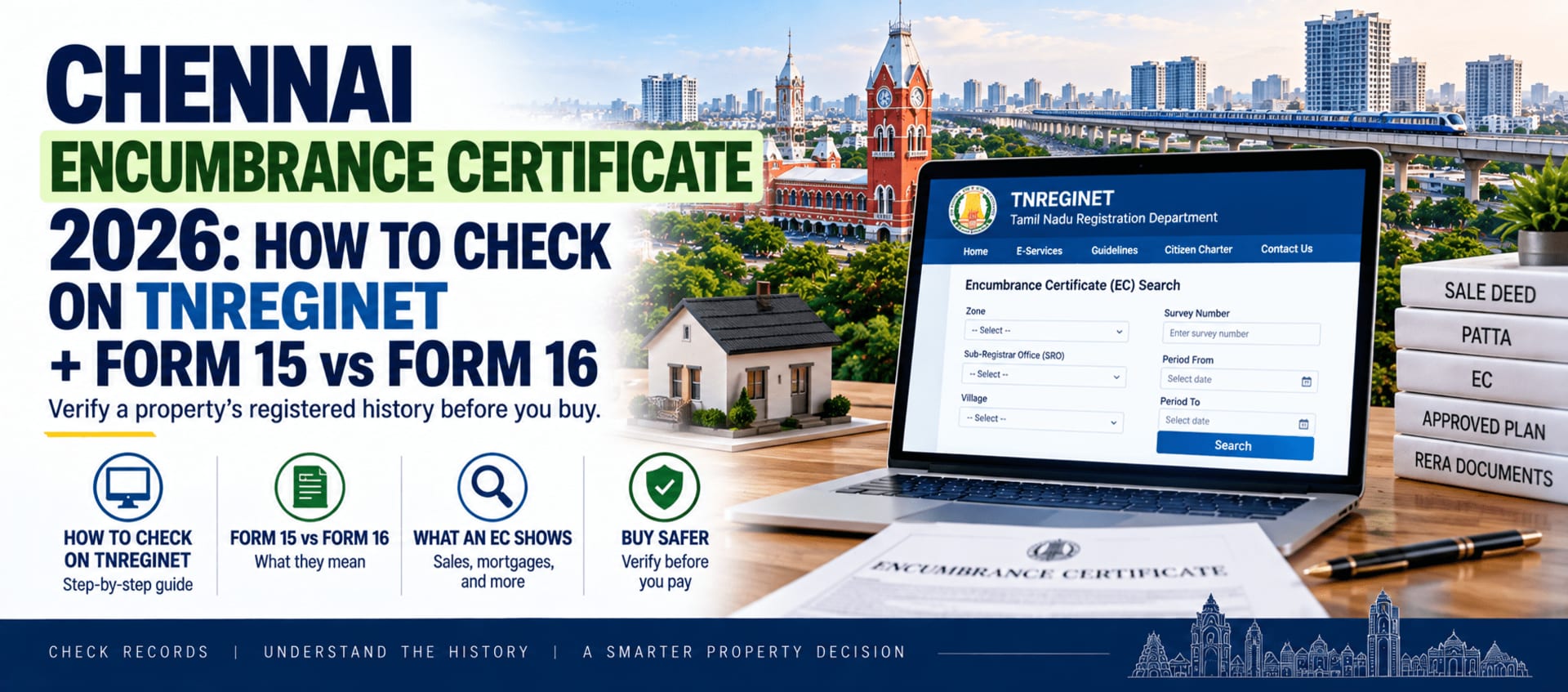
You can search for an EC online through the Tamil Nadu Registration Department's TNREGINET portal. The official online EC manual directs users to the EC service under the portal's E-Services section and allows property details such as village and survey number to be entered for the search.
But an important point is often misunderstood:
An EC is not, by itself, proof that a property has a completely clear title.
It is one part of a broader property due-diligence process.
What Is an Encumbrance Certificate in Tamil Nadu?
An Encumbrance Certificate is a record of registered transactions relating to a property for a specified search period.
Depending on the property and the records available, the EC may contain transactions such as:
Sale deeds
Mortgages
Mortgage releases
Gift deeds
Settlement deeds
Partition deeds
Release deeds
Leases
Registered powers of attorney
Other registered instruments affecting the property
For a buyer, the EC primarily helps answer two questions:
Does the registered transaction history support the seller's ownership story?
Are there registered mortgages or other encumbrances that need to be resolved?
The EC should then be compared with the property's sale deed, parent documents, patta, survey details and other records.
Why Is an EC Important When Buying Property?
Imagine a seller tells you:
"I bought this land from the previous owner and there are no loans or claims."
Instead of relying only on that statement, you can examine the registered history of the property.
The EC may help identify:
Earlier sales
Existing mortgages
Mortgage releases
Transfers between family members
Settlement transactions
Registered powers of attorney
Changes in ownership
Other registered instruments
This makes the EC an important part of the property title-verification process.
However, an EC should not be treated as a replacement for a lawyer's title search.
Form 15 vs Form 16 EC in Tamil Nadu
Tamil Nadu EC searches commonly result in either Form 15 or Form 16.
ECMeaningForm 15Registered transactions are found during the requested search periodForm 16No registered transactions are found during the requested search period
Form 15
A Form 15 EC contains registered transaction entries.
For example, it may show:
Document number
Registration year
Nature of transaction
Executant
Claimant
Survey number
Extent
Consideration/value
Form 16
Form 16 is commonly referred to as a Nil Encumbrance Certificate because no registered transactions were found for the search criteria and period.
But a Form 16 should not automatically be interpreted as:
"This property has a perfect title."
For example, if a seller says they purchased the property ten years ago but your search produces a nil EC, you need to investigate whether:
the wrong survey number was entered;
the wrong village was selected;
the wrong SRO was selected;
the search period is incorrect;
survey numbers changed after subdivision;
historical records are unavailable online.
A nil EC can therefore be a reason to investigate further.
What Does an Encumbrance Certificate Show?
The exact entries depend on the property's registered history, but an EC can contain information relating to:
1. Document number
The registration document number and year help identify the underlying registered instrument.
2. Nature of transaction
Examples include:
Sale
Mortgage
Release
Settlement
Gift
Partition
Lease
Power of attorney
3. Executant
The person or party executing the document.
4. Claimant
The person or party receiving the rights or benefit under the document.
5. Survey number
The EC may identify the survey number and, where applicable, the subdivision.
6. Extent
The area involved in the transaction.
7. Consideration/value
The registered document may contain the stated consideration or relevant value.
8. Registration details
The EC identifies the relevant registration office and transaction details.
What Does an EC NOT Show?
This is one of the most important sections of this article.
An EC is based on registered transactions. Therefore, it does not automatically reveal every possible legal or factual issue affecting a property.
Depending on the issue, an EC may not reveal:
Unregistered agreements
Oral family arrangements
Unregistered wills
Possession disputes
Some pending litigation
Unpaid property tax
EB or water dues
Patta ownership details
Layout approval
Building approval
Land-use restrictions
Physical encroachments
Waterbody restrictions
Therefore:
EC ≠ complete title verification
You should combine the EC with:
Sale deed + Parent documents + Patta + Land records + Approval + Legal search + Physical verification
How to Check Encumbrance Certificate Online in Tamil Nadu
The Tamil Nadu Registration Department provides an online EC workflow through TNREGINET.
The official EC application manual states that citizens can select the Encumbrance Certificate service under E-Services and then choose Search and Apply EC.
Step 1: Open TNREGINET
Use the official Tamil Nadu Registration Department portal.
Always make sure you are using the official government domain rather than a third-party website.
Step 2: Register or log in
Create an account or sign in as required by the portal.
Step 3: Open the EC service
Navigate to:
E-Services → Encumbrance Certificate → Search and Apply EC
The current official manual confirms this workflow.
Step 4: Select the property location
Enter the relevant:
Zone
District
Sub-Registrar Office
Village
Step 5: Enter the search period
Specify the beginning and ending dates for the EC search.
Step 6: Enter property details
Depending on the search, you may need:
Survey number
Subdivision
Village
Property details
Other identifying information
Step 7: Search and review
Review the transactions returned for the property.
Do not stop after seeing a single entry.
Follow the ownership chain through the available registered transactions.
How to Search EC by Survey Number
Searching by survey number and subdivision is particularly useful when you want to understand the registered history of the land itself.
Before searching, collect the survey details from:
Current sale deed
Parent deed
Patta
Approved layout
Revenue records
Important
Survey numbers can change because of:
Resurvey
Subdivision
Reclassification
Government survey changes
Therefore, a lawyer may need to search both the old and current survey references.
A search using only the seller's current survey number may not always reveal the complete historical chain.
How to Search EC by Document Number
If you already have a registered sale deed, you may also use its document number and year to identify the relevant registration record.
This is useful for checking a particular document.
However, for full property due diligence, a property-history search is generally more important than checking only one document.
How to Download a Certified EC Online
There is an important difference between:
Viewing an EC
and
obtaining a certified EC.
The Tamil Nadu e-Sevai service catalogue separately lists Issuance of Encumbrance Certificate and EC Download services.
For transactions involving a bank, lawyer or government authority, confirm whether they require a certified copy rather than relying on a screenshot or informal online view.
The online workflow can involve:
Selecting the EC application service
Entering property details
Selecting the search period
Providing applicant details
Paying the applicable fee
Tracking the request
Downloading the resulting document when available
Always verify the latest fee and processing information on the official portal before submitting an application.
How Much Does an EC Cost in Tamil Nadu?
The cost depends on the service and the current fee schedule.
The Tamil Nadu e-Sevai service catalogue currently lists:
Issue of Encumbrance Certificate — ₹10 service charge
EC Download — ₹2 per page
These e-Sevai service figures should not be confused with every possible Registration Department fee or charge associated with a specific EC application.
For this reason, Propspedia should avoid publishing an old fixed fee table unless the current Registration Department fee schedule has been verified.
Best practice
Before applying, check the amount displayed by the official portal.
How Many Years of EC Should You Check?
There is no single search period that applies identically to every property transaction.
The appropriate period depends on:
Property type
Age of property
Title history
Bank requirements
Lawyer's title search
Whether the property is ancestral
Whether it is agricultural land
Availability of historical registration records
For many property purchases, lawyers and lenders may ask for a substantial historical search.
Practical approach
For a normal property purchase:
Start with a 30-year search where records are available, then extend the search when the title history requires it.
For older or ancestral properties, your lawyer may recommend going further back.
Do not treat “30 years” as a universal statutory requirement.
How to Read an Encumbrance Certificate
Think of an EC as a registered transaction history.
Start with the oldest relevant transaction and move forward.
Step 1: Identify the original title
Find the earliest relevant owner/document in the available title chain.
Step 2: Follow each sale
The buyer in one transaction should normally correspond to the seller in the subsequent transfer.
Step 3: Check mortgages
If the EC contains a mortgage, identify the corresponding release or satisfaction document.
Step 4: Check the extent
Make sure the land area being transferred matches the available title documents.
Step 5: Match the survey number
Compare the EC with:
Sale deed
Patta
Parent documents
Approved layout
Step 6: Investigate unusual transactions
Pay particular attention to:
Recent settlements
Gifts
Releases
Powers of attorney
Multiple transfers
Mortgages
Missing releases
EC Red Flags Every Property Buyer Should Check
1. Mortgage without a release
If a mortgage appears in the EC, find out whether it has been discharged.
For a builder project, this is particularly important because the underlying land may have been mortgaged for construction finance.
2. Multiple sales involving the same land
Repeated transfers involving the same extent or survey number require investigation.
3. Unexpected power-of-attorney transactions
Older or repeated POA transactions should be reviewed carefully.
4. Recent settlement or gift
A recent family settlement or gift immediately before a proposed sale deserves additional title review.
5. Survey-number mismatch
If the survey number differs between the EC, sale deed and patta, stop and investigate.
6. Nil EC when transactions are expected
If the seller says the property was purchased previously but the search returns Form 16, check whether the search parameters are correct.
7. Missing mortgage release
Do not assume a mortgage disappeared simply because the seller says it was repaid.
Ask for the relevant release documentation.
Does an EC Prove Clear Property Title?
No.
This is one of the most important conclusions for a property buyer.
An EC confirms information available from registered encumbrance records for the searched property and period.
It does not replace:
Parent documents
Patta verification
Revenue records
Land classification verification
Planning approval
RERA verification where applicable
Litigation search
Physical inspection
Lawyer's title opinion
A property can therefore require further investigation even when the EC appears clean.
EC vs Patta vs Sale Deed vs RERA
DocumentWhat it primarily helps verifyECRegistered transactions/encumbrancesSale DeedThe particular registered transferParent DocumentsEarlier title chainPattaRevenue-record ownership/detailsApproved LayoutPlanning/layout approvalRERAProject-level regulatory registration where applicableLegal SearchPotential litigation and title issuesPhysical InspectionActual site condition, boundaries and access
No single document should be treated as the complete property verification process.
How to Check EC for an Apartment and UDS
For a flat, the EC search is generally connected to the underlying land and its survey details.
You may encounter:
Landowner transactions
Development agreements
Builder mortgages
Mortgage releases
Individual flat/UDS transactions
Pay particular attention to the Undivided Share (UDS).
Compare the UDS mentioned in:
Sale agreement
Sale deed
Construction agreement
EC
Parent documents
If the project has construction finance, verify how the lender's mortgage and release/NOC apply to the flat being purchased.
For a new or under-construction project, also verify the project's TNRERA registration where applicable.
EC and Home Loans
Banks commonly perform their own legal due diligence before sanctioning a property loan.
An EC may form part of the bank's document set.
However, obtaining an EC does not guarantee loan approval.
Banks may additionally examine:
Title documents
Parent documents
Patta/revenue records
Approved plan
Layout approval
RERA registration where applicable
Valuation
Existing mortgage
Legal opinion
Therefore, a property owner should not tell a buyer:
“EC is clear, so the bank will definitely approve the loan.”
Loan approval is a separate decision by the lender.
When Should You Take an EC?
A practical property-buying sequence is:
Before paying a major advance
Obtain and review an EC.
During legal due diligence
Obtain the historical EC period recommended by your lawyer.
Before registration
Ensure the title and encumbrance position has been reviewed up to the relevant date.
After registration
Obtain a fresh EC after the registration has been reflected in the registration records, where appropriate, and retain the registered sale deed and supporting documents.
Complete Property Document Checklist
Before buying a property in Tamil Nadu, consider checking:
Title
Current sale deed
Parent documents
EC
Patta
Revenue records
Survey details
Approval
CMDA/DTCP/local planning approval
Approved layout
Building approval where applicable
Project
TNRERA registration where applicable
Approved plan
Builder documents
Mortgage/NOC documentation
Financial
Guideline value
Sale consideration
Stamp duty
Registration charges
Existing loan/mortgage
Physical
Site boundaries
Road access
Actual extent
Survey verification
Waterbody proximity
Encroachments
Legal
Litigation search
Acquisition notifications
Land classification
Lawyer's title opinion
Common EC Mistakes Buyers Make
Mistake 1: Checking only one year
A one-year EC may not reveal the relevant historical chain.
Mistake 2: Searching only the current survey number
Old survey numbers and subdivisions may need to be checked.
Mistake 3: Assuming Form 16 means perfect title
A nil EC only means that no registered transaction was found for the searched parameters and period.
Mistake 4: Checking EC but ignoring patta
EC and patta serve different purposes.
Mistake 5: Checking EC but ignoring approval
A property can have a registered transaction history and still have planning or land-use issues.
Mistake 6: Accepting a broker's screenshot
Ask for the actual document and verify the details.
Mistake 7: Assuming EC catches every dispute
It does not.
Frequently Asked Questions
What is an Encumbrance Certificate in Tamil Nadu?
An Encumbrance Certificate is a record of registered transactions affecting a property for a specified period.
How can I check EC online in Tamil Nadu?
You can use the Tamil Nadu Registration Department's TNREGINET portal. The official EC manual directs users through E-Services → Encumbrance Certificate → Search and Apply EC.
Is checking EC online free?
Online viewing/search availability and certified-document charges are different. Check the current amount displayed by the official Registration Department portal before applying.
What is Form 15 EC?
Form 15 records registered transactions found during the specified search period.
What is Form 16 EC?
Form 16 is generally issued when no registered transactions are found for the requested search criteria and period.
Is a Form 16 EC proof that the property has clear title?
No. A nil EC does not replace complete title verification.
Can I search EC by survey number?
Yes. The official online EC workflow uses property details including village and survey number.
How many years of EC should I check?
The appropriate period depends on the property and title history. A 30-year search is a useful practical starting point for many purchases, but older or complicated properties may require a longer search.
Does EC show patta?
No. Patta and EC serve different purposes and should be checked separately.
Does EC show court cases?
An EC primarily reflects registered transactions. It should not be treated as a complete litigation search.
Does EC prove ownership?
No. EC is one part of property due diligence and should be checked alongside the title documents and revenue records.
Do I need EC for a flat?
Yes, EC is commonly part of apartment title verification. The underlying land and UDS should be examined along with the apartment's documents.
Can a bank ask for an EC?
Yes. Banks commonly include property title and encumbrance documentation in their legal due-diligence process, although requirements vary by lender and transaction.
Final EC Checklist Before Buying Property
Before paying a substantial property advance, ask:
Did I obtain the EC?
Did I search the correct SRO?
Did I use the correct village?
Did I verify the survey number?
Did I check subdivisions?
Did I review the historical ownership chain?
Did I check mortgages?
Did I verify mortgage releases?
Did I compare EC with the sale deed?
Did I compare it with the parent documents?
Did I verify patta?
Did I verify planning approval?
Did I check RERA where applicable?
Did I check for acquisition/restriction issues?
Did a property lawyer review the title?
An EC is an essential property document — but it is only one part of the complete due-diligence process.