Tamil Nadu's mandatory "Anywhere Registration" system for first-sale flats and plots became compulsory from August 17, 2026 (soft-launched June 7, 2026), letting buyers register online without visiting a Sub-Registrar Office. A Times of India report — not independently corroborated by Propspedia — put day-one volume at 248 deals. Applications must be processed within 24 hours, with registered documents downloadable for 60 days.
Quick answer: Tamil Nadu has made online-only registration mandatory for a specific category of transactions — first-sale flats and plots, TNHB sale documents, and connected mortgage/receipt documents — removing the in-person Sub-Registrar Office visit entirely for these. Buyers verify identity via Aadhaar with biometric authentication, and registering officers must process an application within 24 hours (with a 30-day window to resubmit corrections); the finished document carries a digital signature, QR code, and five-colour endorsement, and stays downloadable for 60 days. The reported 248-deals figure for day one (August 17, 2026) comes from a single Times of India report Propspedia could not independently verify against a second outlet or an official release. Resale transactions between individuals aren't covered by this mandate. The Registration Department expects online-only processing to cut in-person SRO footfall by roughly 30% as adoption scales.
248 Deals, One Day: What Was Reported
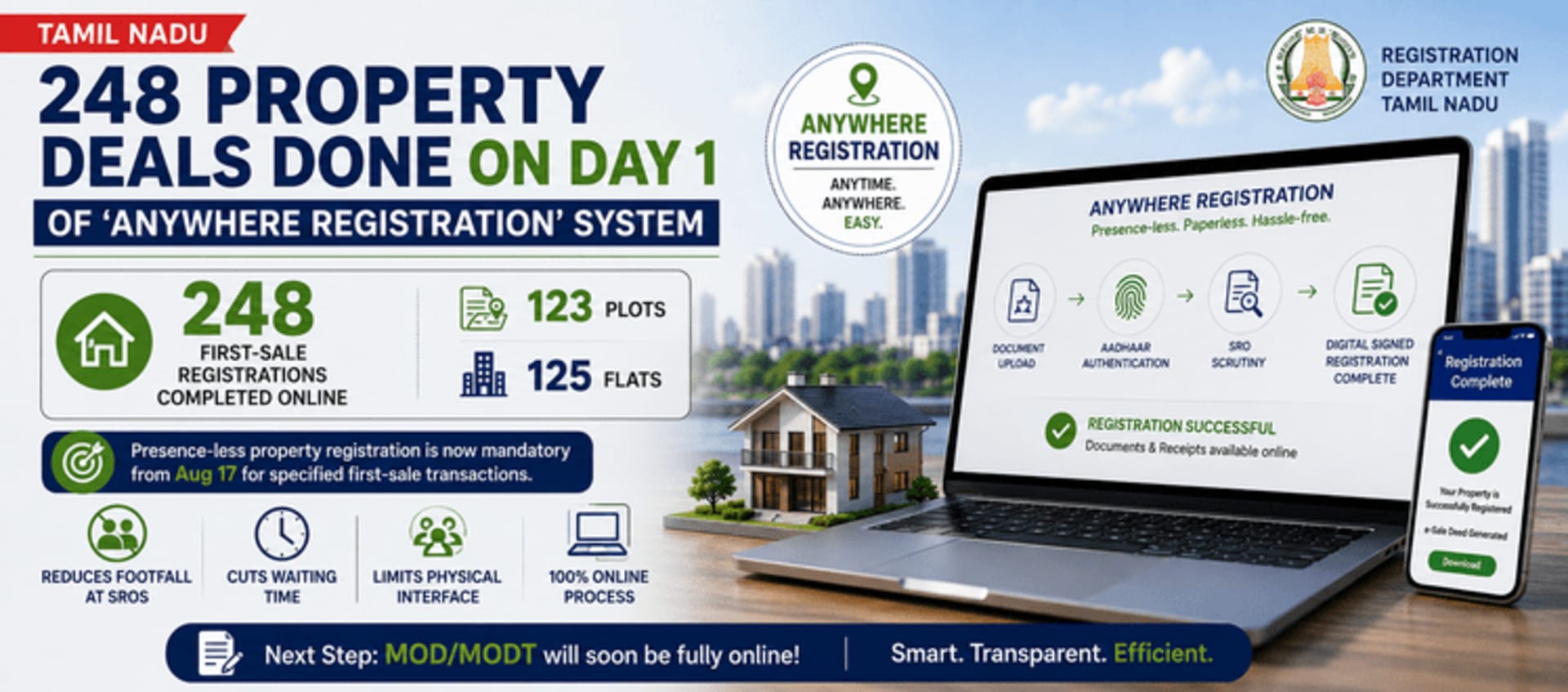
According to a Times of India Chennai report, Tamil Nadu's new "Anywhere Registration" system processed 248 property deals on its first day of mandatory operation. We weren't able to independently corroborate that exact figure against a second outlet or an official Registration Department release after several rounds of searching — TOI's own article page wasn't fetchable to quote from directly — so we're presenting it here as TOI-reported rather than a number Propspedia has separately verified. Everything else in this article, including the launch mechanics below, is independently confirmed across multiple live sources.
Worth being precise about which "Day 1" this refers to: the system technically soft-launched on June 7, 2026, but it only became mandatory for first-sale flats and plots from August 17, 2026 — the date Chief Minister C. Joseph Vijay formally inaugurated it at the Secretariat. The 248-deal figure is reported in the context of that August 17 mandatory rollout, the moment this stopped being optional.
What Is the Anywhere Registration System?
"Anywhere Registration" — also called presenceless registration — lets a buyer, seller, or builder register an eligible property document entirely online, without visiting a Sub-Registrar Office (SRO) in person. Documents can be submitted and processed 24/7 from any location, with identity verified digitally and registration charges paid online.
From August 17, 2026, this stopped being an optional convenience for a specific set of transactions and became the only way to register them.
Which Documents Are Covered
The mandate applies to a specific, limited category of transactions — not all property registrations in Tamil Nadu:
- First-sale deeds of plots in approved layouts, sold by a promoter/developer
- First-sale deeds of flats or apartments, sold by a builder
- Tamil Nadu Housing Board (TNHB) sale documents
- Connected mortgage and receipt documents tied to bank loans on these first sales
Resale transactions between private individuals aren't covered by this specific mandate — this is aimed squarely at the builder/promoter first-sale market, where the state clearly wanted to cut down in-person SRO visits first.
How the Process Actually Works
Builders, promoters, and applicants create a login on the Registration Department's portal and submit documents online, rather than presenting them physically at an SRO counter. From there:
- Identity verification is done via Aadhaar upload with biometric authentication (fingerprint or iris).
- Processing time: registering officers are expected to process an application within 24 hours — registering it, returning it for correction, or rejecting it.
- Corrections: documents sent back for correction can be resubmitted within 30 days.
- Document security: the registered document carries the sub-registrar's digital signature, a QR code with registration details on every page, and a dynamic five-colour endorsement for verification.
- Delivery: once approved, the digitally signed document is sent to the applicant's registered account and shared via WhatsApp to their registered mobile number, and stays downloadable for 60 days.
Why the Government Is Pushing This
Minister D. Logesh Tamilselvan, who oversees the Registration Department, has framed the move as being about transparency: reducing the physical interface between applicants and registering staff, which is also where discretion — and opportunities for informal payments — has traditionally crept into the registration process. The department has separately estimated that online registration could cut in-person SRO footfall by roughly 30% once adoption across eligible transaction types scales up.
What This Means If You're Buying a First-Sale Flat or Plot
- You (or your builder) can no longer register in person for these transaction types — plan for the online process, including having your Aadhaar and biometric authentication ready, rather than assuming you can walk into an SRO as before.
- Build the 24-hour-plus-correction-cycle into your timeline. A same-day in-person registration is no longer the default expectation for these documents; budget for at least a short online processing window, longer if anything needs correcting.
- Download and save your registered document within the 60-day window rather than assuming it stays accessible indefinitely on the portal.
- This mandate doesn't cover resale. If you're buying a resale flat or plot rather than a first sale from a builder or promoter, confirm with your sub-registrar which registration process actually applies to your specific transaction.
Propspedia Take
A mandatory, statewide shift to online-only registration for an entire category of property transactions is a genuinely significant operational change, not a minor tweak — and Tamil Nadu is moving on it faster than most states have. 248 deals reported on the very first day of a brand-new mandatory system is a modest number in the context of the state's overall daily property-transaction volume, which is exactly what you'd expect from any first day of a system this new: some transactions were likely already mid-process under the old workflow, and both builders and SRO staff are still working through a genuinely new process. Whether that number climbs quickly in the following weeks — rather than any single day-one figure — is the more meaningful thing to watch. We'll update this piece if the Registration Department publishes its own official day-one or week-one figures.