Stamp duty and registration charges vary sharply across South India in 2026: Tamil Nadu totals ~11% (7% stamp duty + 4% registration, among the highest in India), Kerala ~8%, Karnataka ~6.6% for properties above ₹45 lakh, and Telangana the lowest at ~6%. On an ₹80 lakh property, these one-time charges can amount to ₹5–7 lakh depending on the state.
Quick answer: Tamil Nadu carries the heaviest one-time registration burden in South India at roughly 11% of guideline value (7% stamp duty + 4% registration fee), compared with about 8% in Kerala, 6.6% in Karnataka for properties above ₹45 lakh, and just 6% in Telangana. Women buyers get a partial concession in most states — 2% off stamp duty in Tamil Nadu, 0.5% in Telangana — and registering jointly with a woman as first holder can save another 1–2% in TN and Telangana. Under-construction buyers can lower their stamp duty base by paying on the agreement value rather than possession-time market value, and anyone facing an inflated guideline value can apply for revision through the Sub-Registrar before registering. Under-registering to dodge stamp duty is illegal and risky: discovered cases can mean property attachment, a penalty of 200% of the evaded duty plus interest, and banks refusing to lend against the property.
Why This Matters
Stamp duty and registration charges are one-time costs that buyers must budget for upfront. On a ₹80 lakh property, these charges can amount to ₹5–7 lakh depending on the state.
Tamil Nadu (2026)
- Stamp duty: 7% of guideline value (or agreement value, whichever is higher)
- Registration fee: 4% of guideline value
- Total: approximately 11% of guideline value
- Concession for women buyers: 2% discount on stamp duty (i.e., 5% instead of 7%)
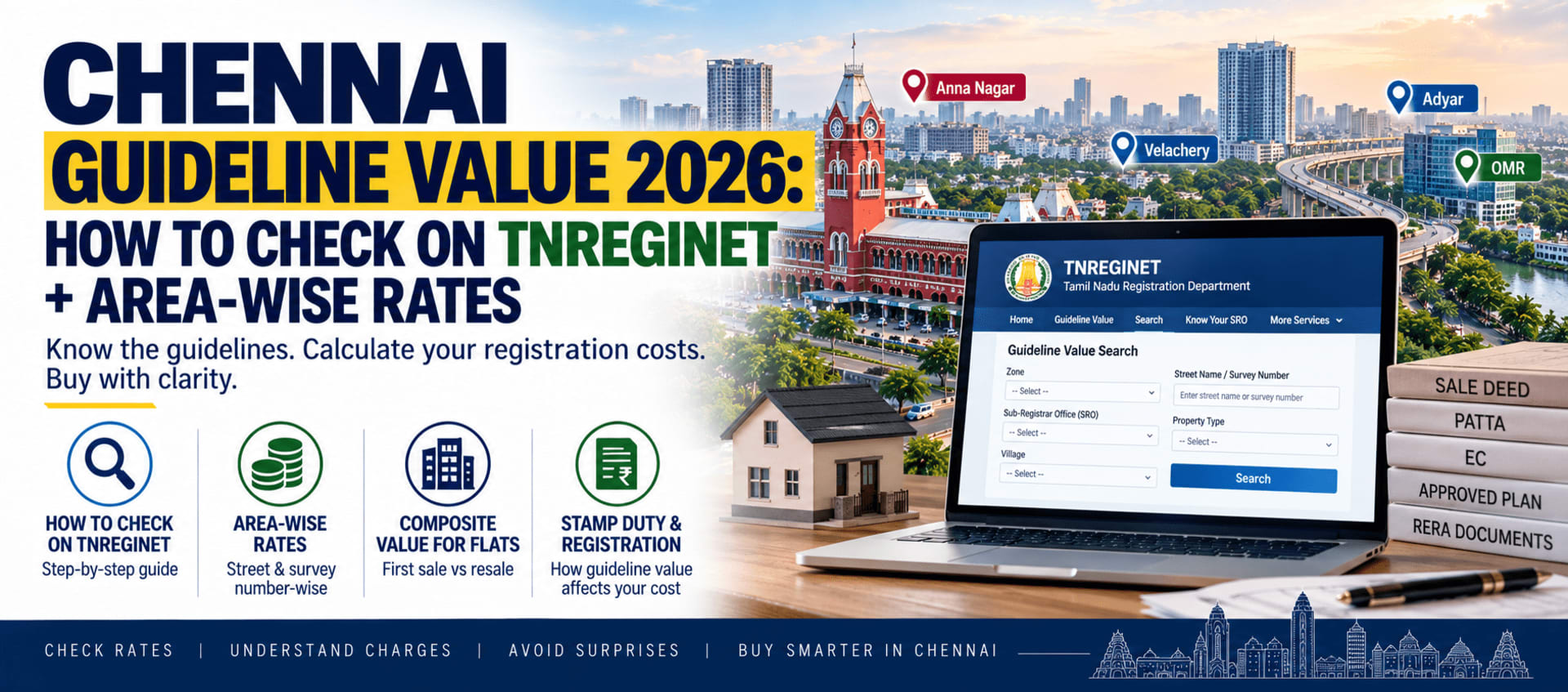
- Guideline value: Set by the State Government; check on the TNREGINET portal
Note: Tamil Nadu has among the highest stamp duty rates in India. Buyers of properties where guideline value significantly exceeds market value can apply for revision.
Telangana (2026)
- Stamp duty: 4% of market value
- Transfer duty: 1.5%
- Registration fee: 0.5% (max ₹20,000 for residential)
- Total effective rate: ~6% of market value
- Concession for women: 0.5% stamp duty discount
Karnataka (2026)
- Stamp duty: 5.6% for properties above ₹45 lakh (3% for ₹21–45 lakh; 5% for ₹35–45 lakh slab applies in some jurisdictions)
- Registration fee: 1% of market value
- Total: ~6.6% for properties above ₹45 lakh
- BBMP jurisdiction: Same rates apply within Bengaluru
Kerala (2026)
- Stamp duty: 6% of market value
- Registration fee: 2% of market value
- Total: 8% — among the steepest in South India
Legal Ways to Reduce Outgo
- Joint registration (women as first holder): Saves 1–2% in TN and Telangana
- Under-construction booking: Pay stamp duty on the agreement value (typically lower than market value at possession)
- Accurate guideline value: If guideline value is too high, apply for revision through the Sub-Registrar before registration
The Consequences of Under-Registration
Under-registering to save stamp duty is illegal. If discovered, the property can be attached by the state government, and you face penalties of 200% of the evaded stamp duty plus interest. Banks also will not release loans on under-registered properties.