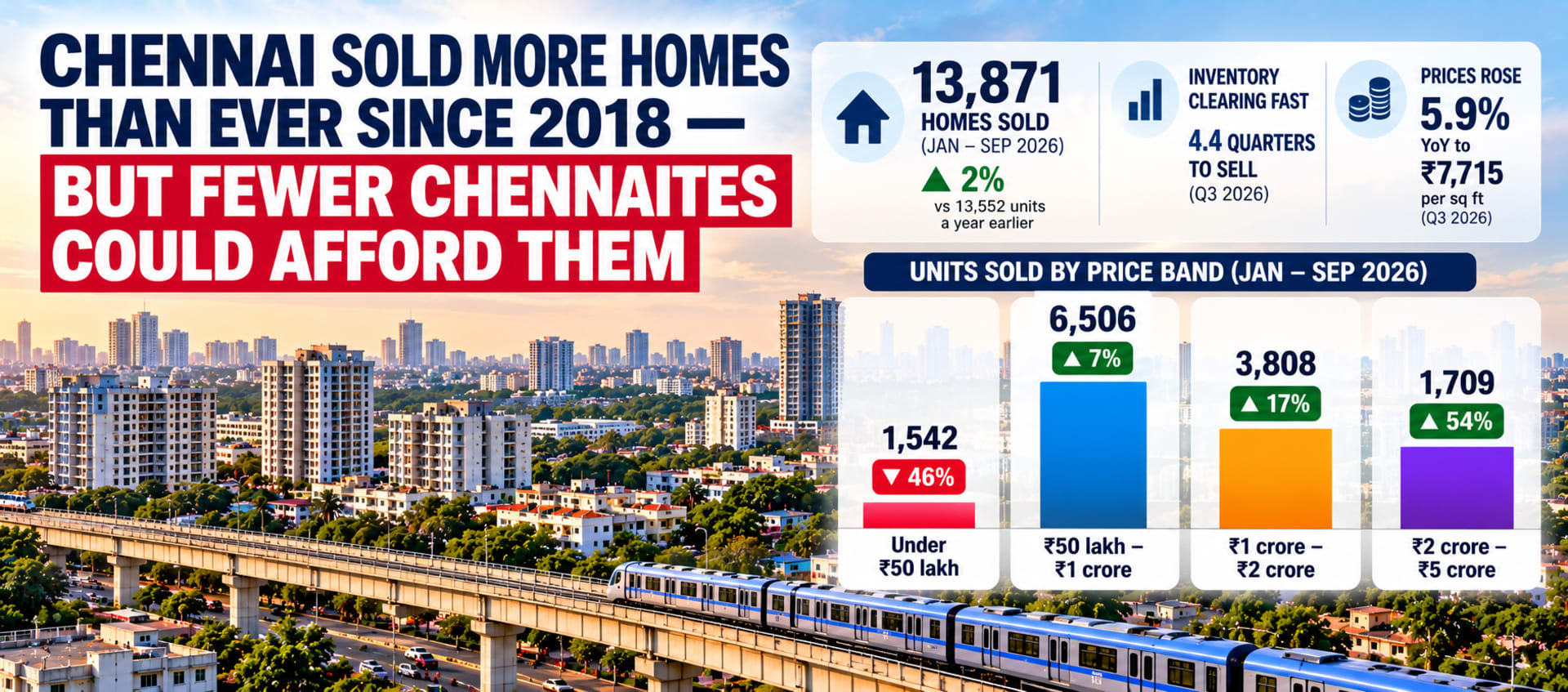
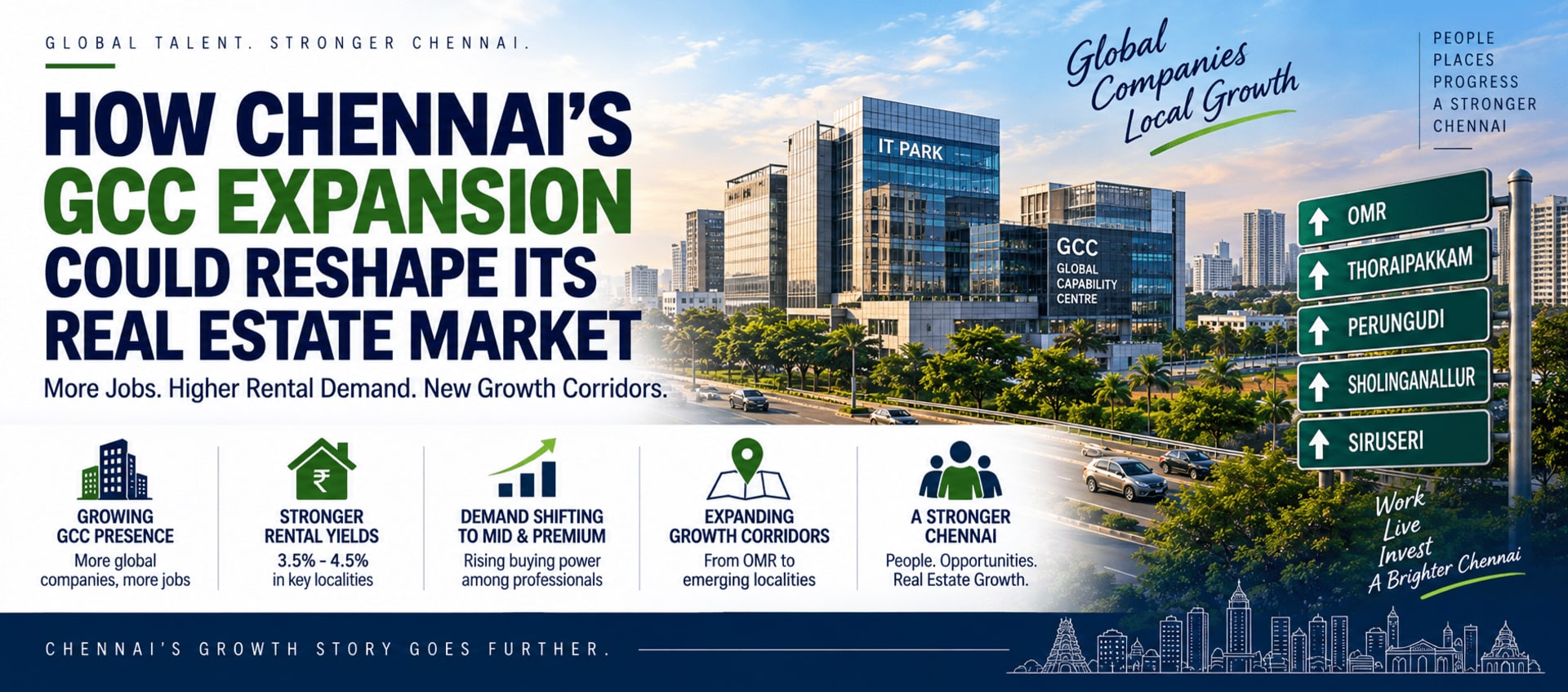
South India's residential launches accelerated sharply in Q1 2026: Coimbatore led with +52% growth (2,100 to 3,200 units), followed by Bengaluru (+32%), Hyderabad (+31%) and Chennai (+29%). Price growth was strongest in Hyderabad's Financial District (+18.2% YoY) and Chennai's OMR corridor (+14.8%). Coimbatore has the tightest inventory at just 11 months of unsold stock.
Quick answer: Residential launches across Chennai, Hyderabad, Bengaluru and Coimbatore all grew strongly in Q1 2026 versus Q1 2025, driven by sustained end-user demand and improved construction financing. Coimbatore's 52% jump in launches (to 3,200 units) reflects its emergence as a mainstream Tier-1 IT city, and it also has the tightest unsold inventory at 11 months — well below Hyderabad's 22 months. Price growth ranged from Bengaluru's 10.8% to Hyderabad's 12.6% citywide, with hotspot corridors like Hyderabad's Financial District (+18.2%) and Chennai's OMR (+14.8%) outperforming. The ₹50 lakh–₹1.2 crore mid-segment is outperforming both affordable and luxury tiers, while rising cement (+8%) and steel (+11%) costs are squeezing sub-₹45 lakh pricing. Interest rates are expected to stay stable through mid-2026, and REIT access for smaller developers may improve liquidity.
Launch Activity — Q1 2026 vs Q1 2025
Residential project launches across the big three South Indian metros accelerated in Q1 2026, driven by sustained end-user demand and improved construction financing conditions.
| City | Q1 2025 Launches | Q1 2026 Launches | Change |
|---|---|---|---|
| Chennai | 8,420 units | 10,900 units | +29% |
| Hyderabad | 14,200 units | 18,600 units | +31% |
| Bengaluru | 16,800 units | 22,100 units | +32% |
| Coimbatore | 2,100 units | 3,200 units | +52% |
Coimbatore's outsized growth reflects its emergence as a mainstream IT city, with buyers and investors increasingly treating it as a Tier-1 market.
Unsold Inventory
Despite strong launches, inventory buildup has been controlled by robust absorption:
- Chennai: 18 months of unsold inventory (healthy range: 12–24 months)
- Hyderabad: 22 months (slightly elevated in the luxury segment)
- Bengaluru: 19 months
- Coimbatore: 11 months (extremely tight — undersupplied market)
Price Growth (Y-o-Y)
Chennai overall: +11.2%
- OMR corridor: +14.8%
- North Chennai: +7.3%
Hyderabad overall: +12.6%
- Financial District: +18.2%
- Secunderabad: +6.4%
Bengaluru overall: +10.8%
- North Bengaluru: +14.6%
- Whitefield: +13.1%
Segment Analysis
The mid-segment (₹50 lakh–₹1.2 Cr) continues to outperform both the affordable segment (below ₹45 lakh) and luxury segment (above ₹3 Cr) in terms of both launch volumes and absorption velocity.
The affordable segment faces cost pressures as construction material costs (cement up 8%, steel up 11% Y-o-Y) make sub-₹45 lakh pricing increasingly difficult to maintain.
Outlook for Q2–Q3 2026
- Interest rates are expected to remain stable through mid-2026 (RBI guidance)
- The implementation of REITs for smaller developers (announced in the Union Budget) may improve liquidity in the market
- General infrastructure spending (metro expansions, expressway completions) continues to be the single biggest driver of localised price appreciation