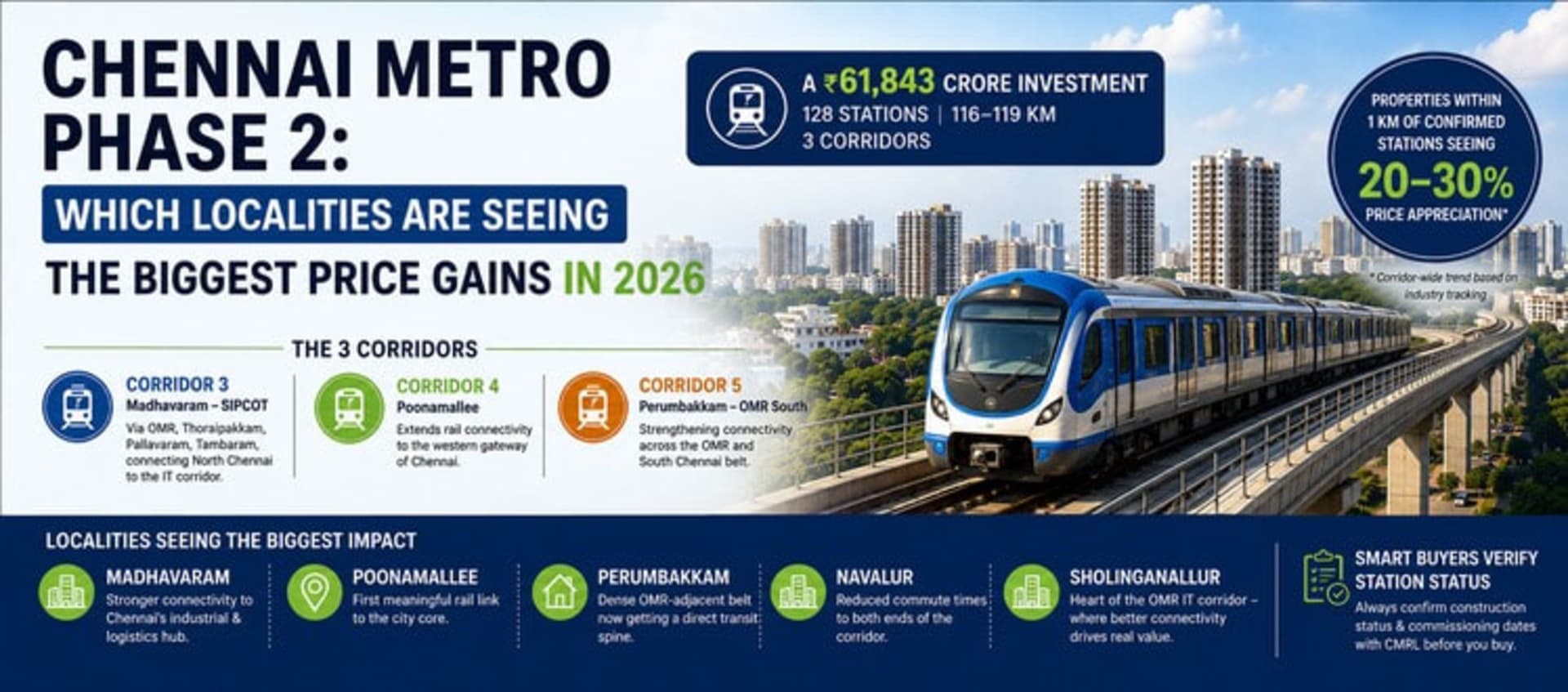
Chennai Metro Phase 2 is a ₹61,843 crore project spanning ~116–119 km across three corridors and 128 stations, with 2026 marking the start of partial, corridor-by-corridor operations. Industry tracking shows properties within roughly 1 km of a confirmed station appreciating 20–30% versus comparable properties further away — a corridor-wide pattern, not a locality-specific guarantee.
Quick answer: Metro Phase 2 is real, funded and partially operational in 2026 — not a speculative announcement — which makes its price effect more credible than most infrastructure stories. Corridor 3 (Madhavaram–SIPCOT, via Thoraipakkam, Pallavaram and Tambaram) links North Chennai's industrial belt to the South Chennai IT corridor, while Corridors 4 and 5 extend coverage to Poonamallee and the Perumbakkam/OMR-South stretch. Localities most cited as beneficiaries include Madhavaram, Poonamallee, Perumbakkam, Navalur and Sholinganallur, where properties near confirmed stations have seen 20–30% appreciation versus comparable properties further away. That figure is a corridor-wide pattern, though, not an independently verified number for each named locality. The "buy before announcement" window has generally closed; before paying a metro-proximity premium, confirm a station's construction status directly with Chennai Metro Rail Limited (CMRL) rather than a builder's marketing claim.
A ₹61,843 Crore Bet on Chennai's Outer Corridors
Chennai Metro Rail Limited's Phase 2 expansion — spanning roughly 116-119 km across three corridors and 128 new stations — is one of the largest single infrastructure investments in the city's history, budgeted at approximately ₹61,843 crore. Construction has been underway for several years, and 2026 is the year parts of the network begin partial operations, corridor by corridor rather than all at once.
For property buyers, this matters because Chennai's metro effect is well documented: land and apartment prices near confirmed, under-construction stations tend to move well before the trains actually start running, and continue moving as completion nears.
The Three Corridors, in Brief
- Corridor 3 (Madhavaram – SIPCOT): Runs along the OMR/GST axis via Thoraipakkam, Pallavaram, Tambaram, and links into the existing Velachery corridor — connecting North Chennai industrial areas to the South Chennai IT belt in one continuous line.
- Corridors 4 and 5: Extend coverage into Poonamallee in the west and the Perumbakkam/OMR-South stretch, filling gaps the Phase 1 network never reached.
Together, the three corridors are designed to bring rail-based transit within reach of large swathes of Chennai that have historically depended entirely on road transport — a meaningful shift for daily commuters and, by extension, for where residential demand concentrates.
Where Prices Are Already Moving
Industry tracking of the corridor shows that properties within roughly 1 km of a confirmed Phase 2 station are seeing 20-30% price appreciation relative to comparable properties further away — a pattern consistent with what Chennai saw around Phase 1 stations in the years before they opened. The localities most frequently named as beneficiaries of this specific round of expansion are:
- Madhavaram — anchor of the northern end of Corridor 3, benefiting from renewed connectivity into the city's traditional wholesale and logistics hub.
- Poonamallee — a western gateway locality gaining its first meaningful rail link into the city core.
- Perumbakkam — already a dense OMR-adjacent residential belt, now gaining a direct transit spine rather than relying solely on OMR road traffic.
- Navalur — an established OMR IT-corridor locality that stands to gain reduced commute times to both ends of the corridor.
- Sholinganallur — the traditional heart of the OMR IT corridor, where even incremental transit improvements carry outsized weight given existing traffic density.
It's worth being precise about what "20-30% appreciation" means here: this is a corridor-wide pattern reported around Phase 2 stations generally, not a guaranteed, locality-specific number Propspedia has independently verified for each name above. Treat it as a directional signal — a reason to look more closely at these micro-markets — not a promised return.
What This Means If You're Buying in 2026
Metro-adjacent premiums are usually priced in well before a line opens, which means the "buy before it's announced" window has generally already closed for Phase 2. What's still live is the gap between stations that are fully funded and under active construction versus those still on paper — the former carries much more certainty than the latter. Before paying a premium for "metro proximity," confirm the specific station's construction status and expected commissioning date directly with Chennai Metro Rail Limited (CMRL) rather than relying on a builder's marketing claim alone.
Propspedia Take
Metro Phase 2 is real, funded, and partially live in 2026 — not a speculative announcement. That makes it a genuinely different category of "infrastructure story" than the kind that never materializes. But the price-appreciation numbers being quoted across the industry are corridor-level averages, and any specific project's proximity claim deserves independent verification before it factors into your budget.