Property registration is the only legally valid transfer of ownership in Tamil Nadu, governed by the Registration Act 1908 and handled via the IGRS Sub-Registrar network. Tamil Nadu charges 7% stamp duty plus 1% registration charges (capped at ₹4 lakhs for high-value transactions), with transfer duty abolished. Women buyers get a 1% stamp duty concession. The state's STAR 2.0 e-registration system enables single-visit registration.
Quick answer: In Tamil Nadu, you don't legally own a property — even after full payment, a signed Agreement for Sale, and physical possession — until the sale deed is registered, since registration is the only proof of ownership recognized under the Transfer of Property Act 1882 and Registration Act 1908. The process runs through seven steps: obtaining an Encumbrance Certificate, verifying the guideline value, preparing the sale deed with a licensed document writer, paying stamp duty (7%, plus 1% registration charges, capped at ₹4 lakhs for high-value deals — 6% stamp duty for women buyers as first holder), booking a STAR 2.0 appointment, attending the Sub-Registrar office for document verification and biometrics, and finally updating the Patta for land and independent houses. STAR 2.0's single-visit design has cut what used to be a 2–3 day process down significantly, but skipping steps like EC verification or reading the sale deed carefully remains the most common — and costliest — buyer mistake.
Property Registration in Tamil Nadu: Why It Is the Most Important Legal Step
Property registration is the act that legally transfers ownership of a property from the seller to the buyer. Until registration happens, you do not legally own the property — even if you have paid the full purchase price, signed an Agreement for Sale, and obtained possession. The Transfer of Property Act 1882 and the Registration Act 1908 both mandate registration as the only valid proof of property ownership in India.
In Tamil Nadu, property registration is handled by the Inspector General of Registration (IGRS) and its network of Sub-Registrar offices. In 2026, Tamil Nadu's e-registration system (STAR 2.0) allows buyers to pre-book appointments, upload documents, and complete the registration process in a single visit to the Sub-Registrar office — significantly reducing the 2–3 day process of earlier years.
Stamp Duty and Registration Charges in Tamil Nadu 2026
| Charge | Rate | Basis |
|---|---|---|
| Stamp Duty | 7% | Guideline value or market value (whichever is higher) |
| Registration Charges | 1% | Same as above (capped at ₹4 lakhs for high-value transactions) |
| Transfer Duty | Nil | Abolished in Tamil Nadu for residential property |
Calculation example: Property market value = ₹75 lakhs, guideline value = ₹68 lakhs. Registration uses the higher value (₹75 lakhs).
Stamp Duty: ₹75 L × 7% = ₹5,25,000
Registration charges: ₹75 L × 1% = ₹75,000
Total government charges: ₹6,00,000
Note: Women buyers in Tamil Nadu receive a 1% concession on stamp duty — effective stamp duty is 6% instead of 7% when the property is registered solely or jointly in a woman's name as the first buyer.
Step-by-Step Property Registration Process in Tamil Nadu
Step 1: Get the Encumbrance Certificate (EC)
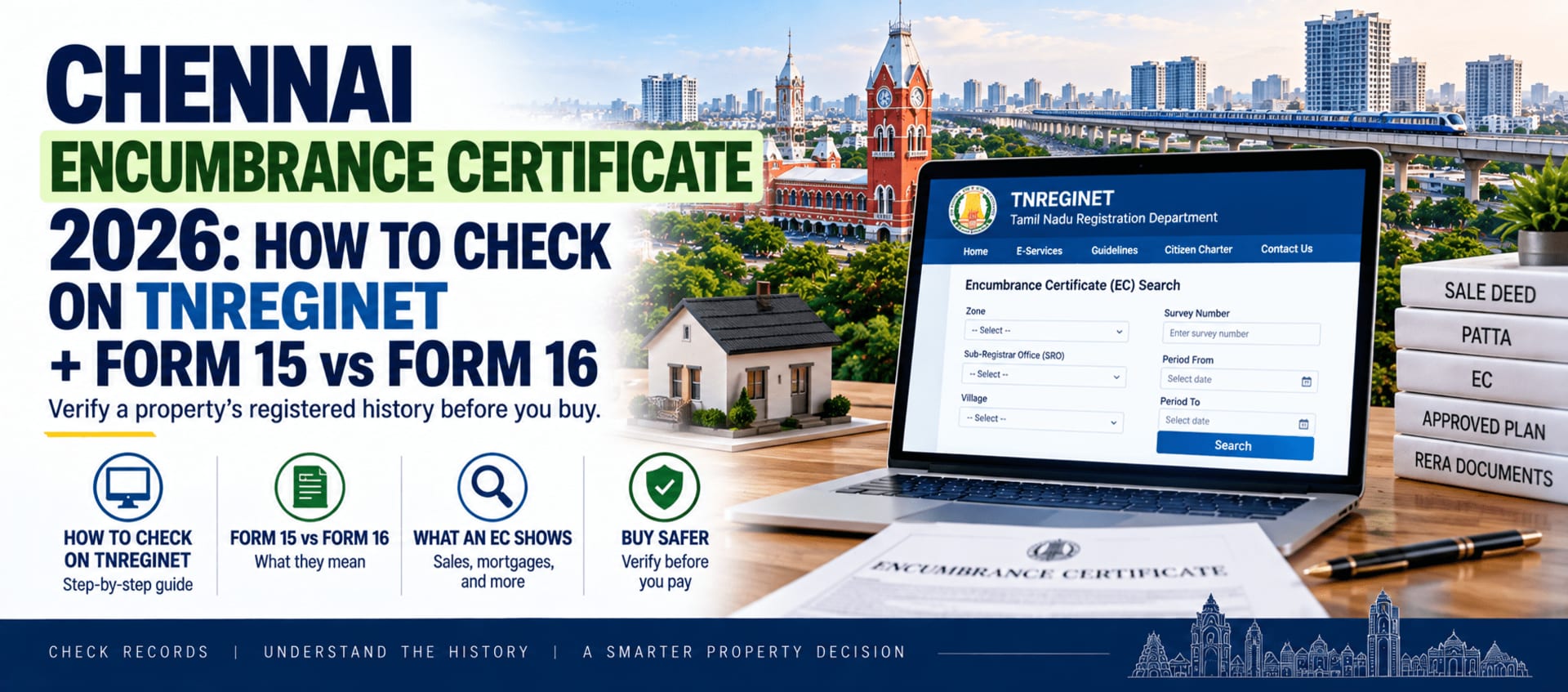
An Encumbrance Certificate proves the property has no pending loans, liens, or legal disputes recorded at the Sub-Registrar's office. Apply for EC online at tnreginet.gov.in or at the Sub-Registrar's office covering the property's area. Request EC for the past 15–30 years. The EC typically takes 2–3 working days to issue.
Why this matters: If the property has an existing bank mortgage (Registered Mortgage shown in EC), it must be cleared and the mortgage must be discharged before you register. Banks will not disburse a home loan on a property with an undischarged mortgage.
Step 2: Verify the Guideline Value
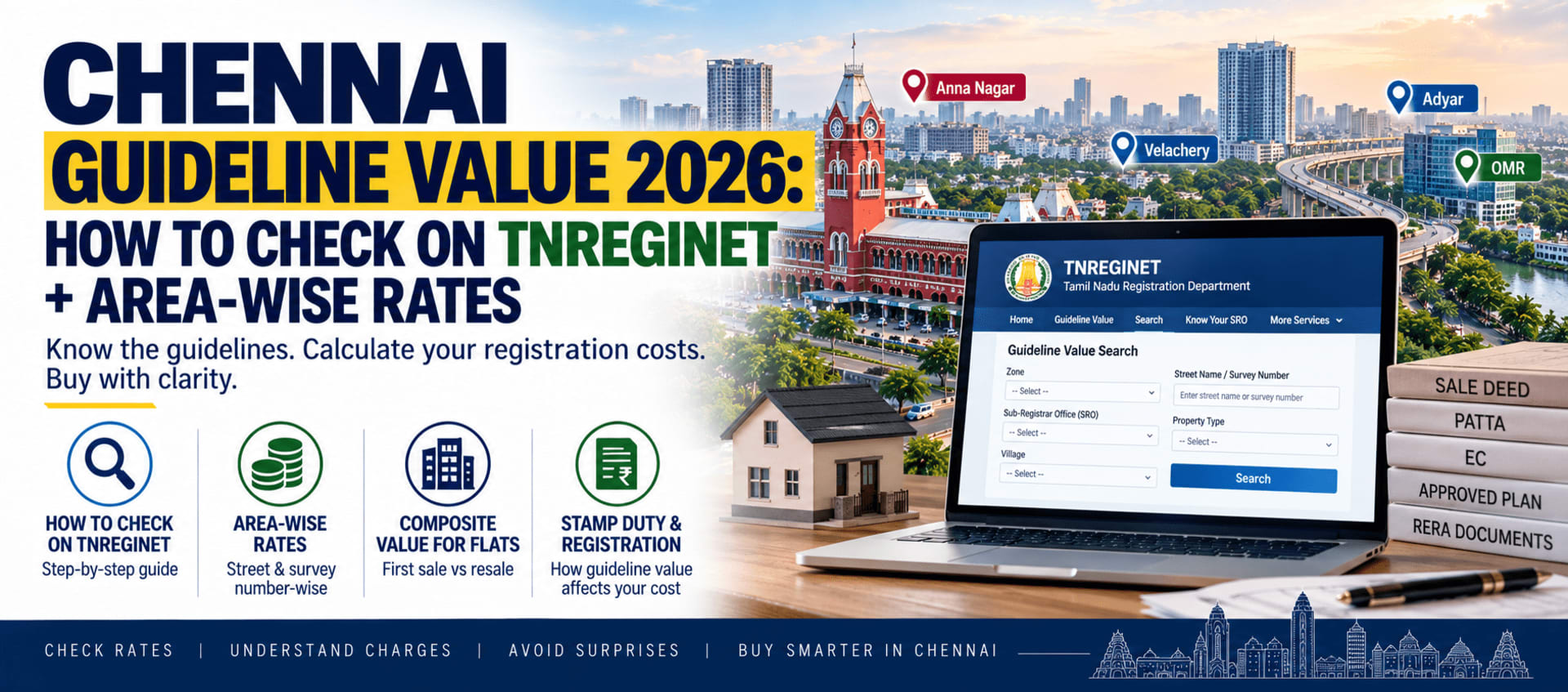
The Guideline Value (also called Circle Rate) is the minimum value at which a property must be registered as per the Tamil Nadu government's annual valuation. Find the guideline value for the specific street and zone at tnreginet.gov.in under "Guideline Value Search." If you are paying less than the guideline value, registration must still happen at the guideline value — and stamp duty is calculated on that higher amount.
Step 3: Prepare the Sale Deed
The Sale Deed is the primary legal document that transfers ownership. It must be prepared by a licensed document writer (notary or vakil registered with IGRS) and must include: full names and addresses of buyer and seller, complete property description with survey number and boundaries, purchase consideration (amount paid), declaration of clear title, and specific possession date. Review the draft Sale Deed with your own lawyer before signing — never rely only on the builder's or seller's lawyer.
Step 4: Pay Stamp Duty
Stamp duty in Tamil Nadu must be paid as a Demand Draft (DD) from a scheduled bank payable to the Inspector General of Registration (IGRS), Tamil Nadu. Alternatively, e-stamping is available through authorised banks and the SHCIL e-stamping portal — this is faster and reduces the risk of stamp paper fraud. The stamp duty payment must be completed before the registration appointment.
Step 5: Book an Appointment via STAR 2.0
Tamil Nadu's property registration system (STAR 2.0) at tnreginet.gov.in allows buyers to book a registration appointment at the relevant Sub-Registrar office. Upload scanned copies of all required documents during appointment booking. The system assigns a time slot, reducing waiting time at the office to 30–60 minutes for pre-submitted documents.
Step 6: Attend the Sub-Registrar Office
Bring on the registration day:
- Original Sale Deed (2 copies — one for registration, one returned to buyer)
- All parent documents (original chain of title documents)
- Original EC
- Stamp duty Demand Draft
- Registration fee DD (1% of value)
- Identity proof of buyer, seller, and 2 witnesses (Aadhaar + PAN)
- Recent passport-size photographs of buyer and seller
- Building approval plan (for apartments: CMDA approval copy)
- TNRERA certificate (for new launch apartments)
The Sub-Registrar captures biometrics (fingerprint + photograph) of buyer and seller during registration. After document verification and biometric capture, the Sale Deed is registered and a receipt is issued. The original registered deed is returned within 7–15 working days.
Step 7: Update Patta (for Land and Independent Houses)
After registration, apply for a Patta transfer — the revenue record that shows your name as the new land owner. Patta transfer is done at the local Taluk office (not the Sub-Registrar's office). Submit the registered Sale Deed along with a Patta transfer application. Tamil Nadu's Patta system is online via tneportal.tn.gov.in. For apartment buyers, Patta applies only to the land portion — your primary ownership document is the registered Sale Deed.
Common Property Registration Mistakes in Tamil Nadu (and How to Avoid Them)
- Registering at undervalued guideline value: Illegal. Registration at below guideline value is a criminal offence. Always pay stamp duty on the actual market value or guideline value, whichever is higher.
- Skipping EC verification: A property with an undisclosed registered mortgage means you inherit the seller's debt. Always get EC before registration.
- Signing without reading the Sale Deed: The Sale Deed is permanent and legally binding. Errors in boundary descriptions, floor numbers, or ownership names are very difficult and expensive to correct post-registration.
- Cash payment of purchase consideration: All payments above ₹20,000 must be by banking channels. Cash transactions may be questioned by IT authorities and complicate future resale.
- Missing parent documents: If the chain of title is incomplete (missing a previous sale deed), the registration will be rejected. Ensure you have documents going back at least 30 years or to the original grant.
Post-Registration Steps After Buying Property in Tamil Nadu
- Collect the registered Sale Deed from the Sub-Registrar office (7–15 days after registration)
- Apply for Patta transfer at the Taluk office (land and independent house buyers)
- Inform the local corporation/municipality for name transfer in property tax records
- Notify your housing society or builder's association for share certificate transfer (apartments)
- Update your home loan lender with the registered Sale Deed number for their records
Propspedia's RERA-verified listings in Chennai, Coimbatore, Bengaluru, Hyderabad and Kochi come with complete documentation transparency — RERA numbers, legal status, builder compliance history, and PropScore™ trust ratings visible before you visit the property. Zero buyer brokerage on every listing.