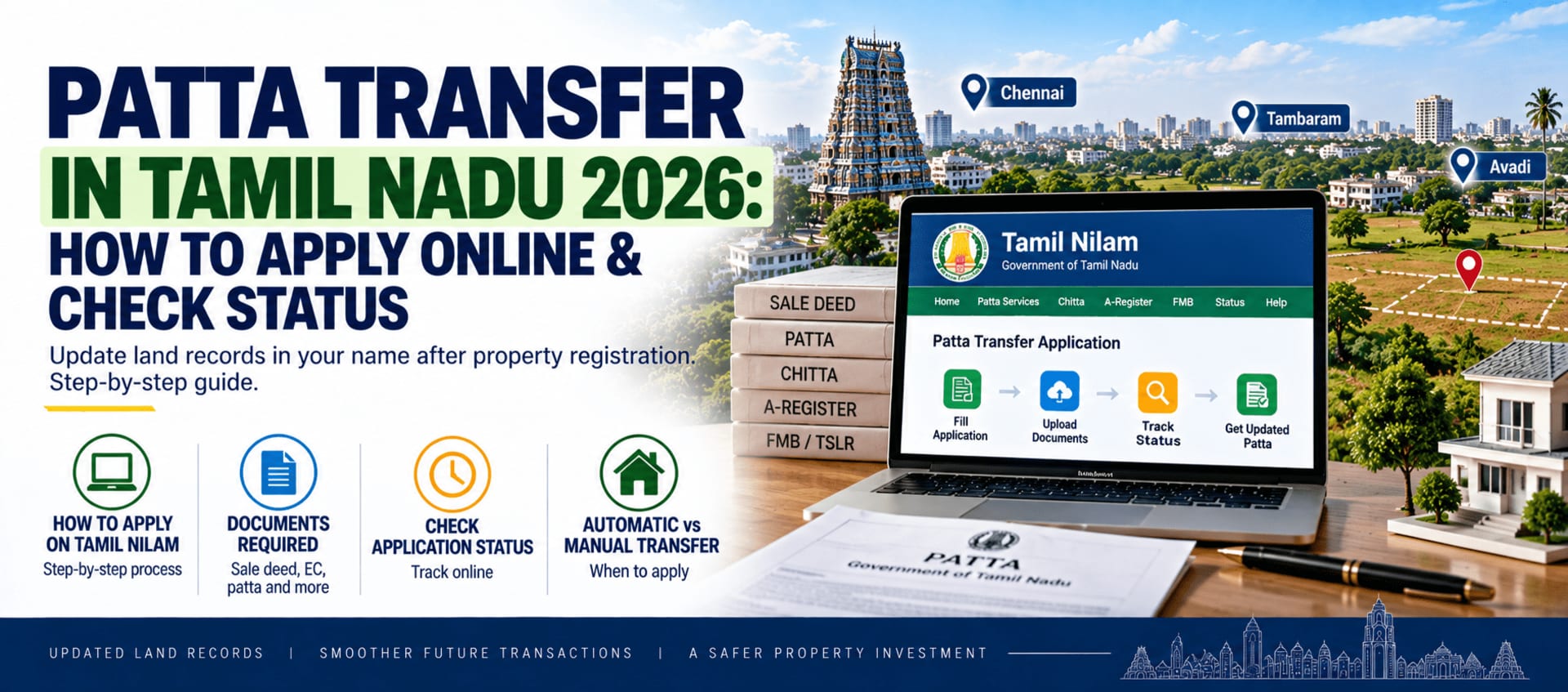
Patta Transfer Online Tamil Nadu 2026: How to Apply & Check Status
If you have recently purchased land, a plot or a house in Tamil Nadu, patta transfer is an important step in updating the Revenue Department's land records in your name.
Registration of your sale deed and transfer of patta are related but separate processes. The registered deed records the transaction with the Registration Department, while patta is part of the Revenue Department's land-record system.
Tamil Nadu provides Tamil Nilam services for patta transfer, including full-field transfer, joint patta transfer and subdivision-related applications. The government also provides online and e-Sevai channels for accessing these services.
In some transactions, the patta record may be updated automatically after registration. In other cases, particularly where subdivision or other revenue action is required, an application may be necessary.
This guide explains:
What patta transfer means
When patta transfer happens automatically
How to apply online
What NISD and ISD mean
Documents required
Fees
How to check patta transfer status
Rural vs urban/Town Survey records
Common rejection reasons
What buyers should verify after registration
What Is Patta in Tamil Nadu?
Patta is a Revenue Department land record associated with a parcel of land.
It can contain information such as:
Pattadar name
District
Taluk
Village
Survey number
Subdivision number
Extent
Land classification
Patta should not be confused with the registered sale deed.
Sale deed vs Patta
The sale deed records the registered transfer of property rights between parties.
The patta is a revenue record maintained through the state's land-record system.
For a property buyer, both should be checked as part of the overall document-verification process.
Patta, Chitta, A-Register and TSLR: What Is the Difference?
Tamil Nadu property records can contain several related records.
RecordWhat it generally containsPattaPattadar/land-record details associated with the propertyChittaLand extent and classification informationA-RegisterVillage-level land-record informationFMBField Measurement Book/sketch informationTSLRTown Survey Land Register used in town-survey areas
Tamil Nadu's land-record systems also provide access to A-Register, FMB and Patta information through digital land-record initiatives.
For urban properties, particularly areas covered by town surveys, the relevant identifiers may include:
Ward
Block
Town Survey Number
Therefore, do not assume that every Chennai property will use exactly the same rural survey-number format.
Why Should You Transfer Patta After Property Registration?
After purchasing property, buyers should make sure that the relevant revenue records are consistent with the registered transaction.
A mismatch can create problems during future transactions or document verification.
Patta-related records may be relevant when dealing with:
Property resale
Bank/legal due diligence
Land development
Building-related processes
Revenue records
Property disputes
Future ownership transfers
However, patta should not be treated as a substitute for the registered title documents.
A good property-document chain is:
Sale Deed → Parent Documents → EC → Patta/Revenue Records → Approval → Physical Verification
Each document serves a different purpose.
Does Patta Transfer Happen Automatically After Registration?
In some cases, the land-record update can be integrated with the registration process.
The practical question is whether the particular transaction can be processed without a separate subdivision or revenue application.
The source material for this guide identifies automatic transfer particularly for cases where:
The seller has an individual patta, and
The buyer acquires the whole survey/subdivision, so a new subdivision is not required.
However, buyers should verify the actual updated record after registration rather than assuming that the name has changed automatically.
What should you do after registration?
A practical approach is:
Register sale deed → wait for the record to update → check the patta → apply if the name has not changed or subdivision is required.
When Do You Need to Apply for Patta Transfer?
A separate application may be required when the transaction cannot be completed through an automatic update.
Examples include:
Purchase of only part of a larger survey number
Subdivision required
Joint patta situations
Inheritance
Gift
Settlement
Partition
Court order
Other transfers requiring revenue-record action
The Tamil Nilam service structure includes separate services for Full Field Patta Transfer, Joint Patta Transfer and Subdivision.
What Is NISD and ISD in Patta Transfer?
One of the most important terms buyers will encounter is NISD vs ISD.
NISD — Not Involving Subdivision
This applies where the transfer does not require the land parcel to be divided into a new subdivision.
Example:
You purchase the entire existing survey/subdivision that belongs to the seller.
ISD — Involving Subdivision
This applies when the transaction requires the existing land parcel to be divided.
Example:
A seller owns a large survey/subdivision and sells only a portion of it.
The revenue records may therefore require a new subdivision before the buyer's ownership can be reflected correctly.
Tamil Nadu's official Tamil Nilam documentation confirms that the system supports both ISD and NISD workflows.
Patta Transfer Online Tamil Nadu: Step-by-Step
Tamil Nadu provides Revenue Department services through its digital/e-Sevai ecosystem, while Tamil Nilam is the land-record system used for patta-related processing. The government currently lists Tamil Nilam patta transfer services among its Revenue services.
Step 1: Collect your property documents
Before applying, keep the relevant documents ready.
Typically this may include:
Registered sale deed
Previous patta
Encumbrance Certificate
Applicant identity details
Survey/subdivision details
Relevant revenue documents
Supporting documents depending on the transaction
The exact document requirement can vary according to the application type.
Step 2: Identify the correct property details
Keep the following information ready:
District
Taluk
Village
Survey number
Subdivision number
Patta number, where available
For town-survey properties, you may need:
Ward
Block
Town Survey Number
Always compare these details against the registered deed.
Step 3: Select the appropriate patta-transfer service
Depending on the transaction, the application may fall under:
Full Field Patta Transfer
Joint Patta Transfer
Subdivision
Tamil Nadu's official e-Sevai service list identifies these as separate Tamil Nilam Revenue services.
Step 4: Enter the property details
Enter the relevant:
District
Taluk
Village
Survey number
Subdivision
Other property information requested by the portal
For urban properties, use the applicable town-survey identifiers.
Step 5: Enter the registered deed details
Depending on the service, you may need:
Document number
Registration year
Sub-Registrar Office
Transaction details
Make sure these match the registered sale deed.
Step 6: Upload the required documents
Upload clear copies of the documents requested for your application.
Avoid:
Blurred scans
Cropped documents
Incorrect files
Mismatched names
Missing pages
Step 7: Pay the applicable service charge
Tamil Nadu's published e-Sevai service list currently shows a ₹60 service charge for:
Tamil Nilam Full Field Patta Transfer
Tamil Nilam Joint Patta Transfer
Tamil Nilam Subdivision
The listed department charge for these services is ₹0 and the service charge is ₹60.
Fees can change, so check the amount displayed by the official service when submitting an application.
Step 8: Save the application number
This is extremely important.
Keep the:
Application number
Acknowledgement
Payment reference
Submitted documents
You will need the application reference to track the status.
Tamil Nadu's Tamil Nilam documentation confirms that applicants can use the application ID to check the status of their application.
How to Check Patta Transfer Status Online
After submitting the application, retain your application/reference number.
The Tamil Nilam system supports status tracking for submitted applications.
The exact portal menu labels can change, so use the current status option displayed by the official Tamil Nilam/e-Sevai system.
Keep checking for:
Application received
Revenue processing
Field verification, where applicable
Subdivision processing
Approval/rejection
Patta transfer order
If your application remains pending beyond the expected processing period, contact the relevant revenue office with your application number.
What Documents Are Required for Patta Transfer?
The exact documents depend on the transaction.
A property purchase may require some combination of:
For a sale
Registered sale deed
Existing patta
EC
Applicant identity details
Property details
For gift or settlement
Registered gift/settlement deed
Existing revenue records
Supporting identity documents
For inheritance
Depending on the circumstances:
Death certificate
Legal-heir documentation
Relevant title/revenue documents
Other supporting records
For court-ordered transfer
Relevant court order/decree
Existing title/revenue records
Do not assume that the same document list applies to every patta application.
How Much Does Patta Transfer Cost in Tamil Nadu?
The Tamil Nadu Information Technology Department's current published e-Sevai service list shows a ₹60 service charge for:
Full Field Patta Transfer
Joint Patta Transfer
Subdivision
with a department charge of ₹0 in the listed service table.
Important
Do not publish old third-party fee figures as permanent government fees.
Before applying, verify the amount shown by the current official service.
How Long Does Patta Transfer Take?
Processing time can depend on the type of application.
A simple transfer that does not require subdivision can involve a different workflow from an application requiring subdivision and field verification.
NISD
A transfer without subdivision is generally simpler.
ISD
A subdivision-related application can require additional survey/field work.
Tamil Nadu's official documentation confirms that ISD and NISD are different workflows.
Therefore, Propspedia should avoid promising an exact number of days unless the current government service standard is verified.
Practical advice
If the application has remained pending for an unusually long period:
Check the online status.
Keep your application number ready.
Contact the relevant Taluk/revenue office.
Ask whether any document, survey or objection is pending.
Rural vs Urban Patta Records
Patta-related verification differs depending on the type of land and survey system.
Rural properties
Rural land commonly uses:
Survey number
Subdivision
Patta
Chitta
A-Register
FMB
Urban properties
Town-survey areas may use:
Ward
Block
Town Survey Number
TSLR
This distinction is especially important when dealing with Chennai and other urbanised areas.
Before applying
Check your:
Sale Deed + EC + Patta/Revenue Record
and identify the correct survey reference.
What About Natham Land?
Natham/village residential land can have different revenue-record characteristics from ordinary ryotwari agricultural land.
The availability and digitisation of records can vary by location.
Therefore, if you are purchasing or transferring patta for Natham land, verify the applicable record and process with the relevant Taluk/revenue office rather than assuming that the standard workflow applies identically.
Common Reasons Patta Transfer Applications Are Rejected
1. Name mismatch
The name on the:
Sale deed
Existing patta
Identity document
may not match.
2. Survey-number mismatch
The survey number in the sale deed may differ from the revenue record.
3. Subdivision mismatch
The sale may involve a portion of a larger survey number but the required subdivision has not been created or correctly referenced.
4. Seller's patta problem
The seller may not be recorded as the pattadar.
5. Joint-patta issue
Multiple pattadars may be recorded, requiring appropriate processing.
6. Missing documents
A required supporting document may not have been uploaded.
7. Revenue objection
The application may encounter an objection or require field verification.
8. Existing dispute
A pending dispute or inconsistent record can delay processing.
What Should You Do If Patta Transfer Is Rejected?
Do not immediately submit the same application again.
First identify the reason for rejection.
Check:
Application status → rejection reason → document mismatch → survey details → existing patta → supporting records
For example, if the problem is a name mismatch caused by an error in a registered document, the appropriate solution may involve correcting the underlying document rather than simply filing another patta application.
For a title or ownership dispute, obtain legal advice before proceeding.
Patta Transfer vs EC: What Is the Difference?
These two documents are frequently confused.
DocumentPrimary purposeECShows registered transactions/encumbrances for the searched periodPattaRevenue land-record informationSale DeedRegistered property transactionParent DeedEarlier title chainA-RegisterRevenue land-record informationFMBField measurement/sketch informationTSLRTown-survey land record
A buyer should ideally compare these records rather than relying on one document.
Read the complete [Encumbrance Certificate Tamil Nadu guide] for the EC verification process.
Does Patta Prove Ownership?
Patta is an important revenue record, but it should not be treated as the only proof of legal title.
For property due diligence, compare:
Sale Deed + Parent Documents + EC + Patta + Revenue Records + Approvals
If there is a conflict between documents, get a property lawyer to review the title before proceeding with a purchase.
Patta Transfer for Plots in a Layout
This is particularly important for Propspedia users.
Suppose a developer owns a large survey number and creates a residential layout.
You purchase:
Plot No. 27
The plot may represent only a portion of the original survey/subdivision.
Therefore, the buyer should check:
Approved layout
Original survey number
Subdivision
Plot number
Sale deed
EC
Patta/revenue record
Road access
OSR/public-purpose areas
Do not assume that a plot number alone is sufficient for revenue verification.
For planning approval, also see the [DTCP vs CMDA approved plots guide].
Patta Transfer and Home Loans
Patta can form part of the documentation considered during property and loan due diligence.
However, a bank's legal verification normally considers a wider set of documents.
A lender may examine:
Sale deed
Parent documents
EC
Patta/revenue records
Approval documents
Legal opinion
Property valuation
Existing mortgage
Therefore:
Patta transfer does not guarantee home-loan approval.
What Should You Do Immediately After Property Registration?
Use this checklist.
Within the first few days
1. Keep the registered sale deed safely.
2. Check whether the patta record has updated.
3. If not updated, identify whether the transaction requires NISD or ISD processing.
4. Submit the appropriate application if required.
5. Save the application number.
6. Track the status.
7. Download/retain the updated revenue record when available.
8. Update other records such as property tax and utilities where applicable.
Complete Property Document Checklist
Before considering the property fully documented, review:
Ownership
Sale deed
Parent documents
EC
Patta
A-Register/Chitta where applicable
FMB where relevant
Approval
CMDA approval where applicable
DTCP approval where applicable
Local planning approval
Approved layout
Building approval
Project
RERA registration where applicable
Builder documents
Mortgage/NOC
Physical verification
Survey boundaries
Plot extent
Road access
Actual location
Encroachments
Waterbody proximity
Legal verification
Acquisition notifications
Land classification
Litigation search
Lawyer's title opinion
Frequently Asked Questions
How can I transfer patta online in Tamil Nadu?
Tamil Nadu provides Tamil Nilam patta-transfer services through its digital/e-Sevai ecosystem. The government currently lists Full Field Patta Transfer, Joint Patta Transfer and Subdivision services.
What is Tamil Nilam?
Tamil Nilam is the Tamil Nadu land-record system used for services including patta transfer and related revenue-record processing.
Can patta transfer happen automatically after registration?
In certain eligible transactions, particularly where no new subdivision is required, the record may be updated through the integrated registration/revenue workflow. The updated record should still be checked after registration.
What is NISD?
NISD means Not Involving Subdivision.
What is ISD?
ISD means Involving Subdivision.
How much is patta transfer?
The current Tamil Nadu e-Sevai service list shows a ₹60 service charge for Full Field Patta Transfer, Joint Patta Transfer and Subdivision services.
How can I check patta transfer status?
Use the application/reference number through the applicable Tamil Nilam/e-Sevai status facility. Tamil Nadu's official documentation confirms application-ID based status tracking.
Can I transfer patta for a plot purchased from a layout?
Yes, but the process depends on the underlying survey/subdivision and whether subdivision is required.
Do I need an EC for patta transfer?
The exact document requirements depend on the service and transaction. Keep the EC and registered title documents available because they are important parts of property verification.
What happens if the seller has joint patta?
The application may require the appropriate Joint Patta Transfer process and supporting documentation.
Does patta prove ownership?
Patta is an important revenue record but should not be treated as the sole proof of legal title.
Is patta the same as chitta?
No. They are related revenue records with different purposes, although online systems may present them together in certain services.
What is TSLR?
TSLR stands for Town Survey Land Register and is used for land records in town-survey areas.
Patta Transfer Checklist for Property Buyers
Before considering your post-registration documentation complete:
Sale deed registered
EC checked
Patta checked
Seller's patta verified
Survey number matched
Subdivision matched
Layout approval checked
Patta name updated
Application submitted if required
Application number saved
Status checked
Updated record downloaded
Property tax records checked
Utility records updated where applicable
Final Takeaway
Registering a property and updating the patta are not necessarily the same step.
After purchasing property in Tamil Nadu, check whether the revenue record has been updated and determine whether your transaction requires a separate Tamil Nilam application.
For transactions involving a full existing survey/subdivision, an automatic or simpler transfer route may apply. Where a portion of land is purchased and subdivision is required, the application can follow the ISD route.
Tamil Nadu officially provides separate Tamil Nilam services for Full Field Patta Transfer, Joint Patta Transfer and Subdivision.
For a complete property purchase, do not rely on patta alone.
Verify:
Sale Deed → EC → Patta → Revenue Records → Approval → Physical Property → Legal Title
before making a major property commitment.
Looking for a property in Chennai?
After checking the legal and revenue documents, compare available properties by locality, property type and price before making a decision.
Explore Chennai properties on Propspedia.