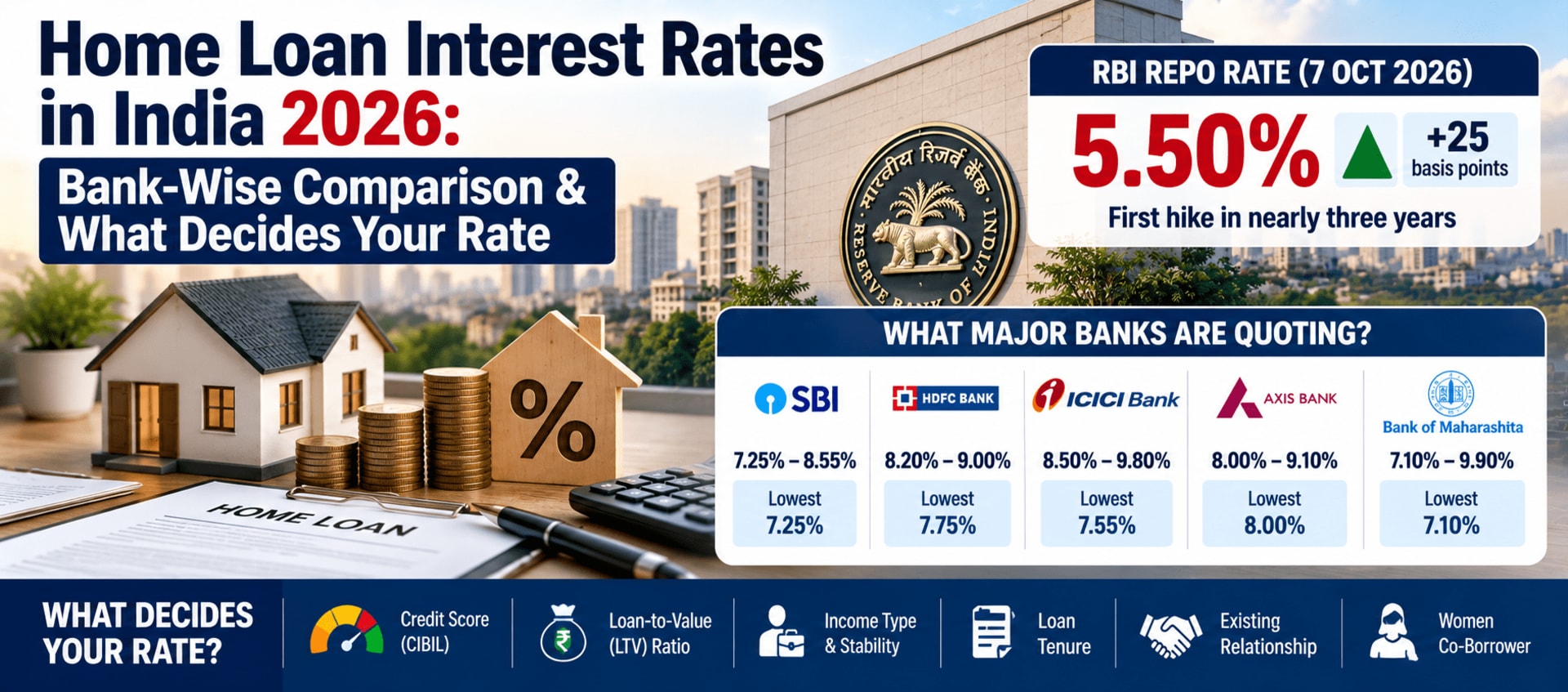
<p>In 2026, home loan interest rates for salaried borrowers with a CIBIL score above 750 range from roughly 8.35% to 9.1%, following the RBI's repo rate cuts in H2 2025. SBI, Bank of Baroda and HDFC Bank offer the lowest starting rates (8.35–8.40%), with government and defence employees getting a further 15–25 bps concession. Buyers can claim up to ₹2 lakh under Section 24(b) and ₹1.5 lakh under Section 80C in tax deductions.</p>
<p><strong>Quick answer:</strong> With home loan rates settled between 8.35% and 9.1% in 2026 and further rate cuts expected through 2026–27, floating-rate loans are the better choice for most borrowers over fixed rates. To get approved faster and at the lowest rates, keep your CIBIL score above 750, keep credit utilisation under 30%, avoid applying to more than 2–3 lenders at once, and declare all income sources, including rental income and FD interest. Adding a co-applicant such as a spouse can raise your eligible loan amount by 40–60%. Combined with Section 24(b) and 80C deductions — plus an extra ₹50,000 under Section 80EEA for first-time buyers — and a balance transfer if your existing rate is above 9%, most salaried borrowers can meaningfully cut their effective borrowing cost this year.</p>
Where Do Rates Stand in 2026?
Following the RBI's repo rate cuts in H2 2025, home loan rates have settled in the 8.35–9.1% range for salaried borrowers with CIBIL scores above 750. Floating rate loans are currently more attractive than fixed rates, given the expectation of further rate cuts in 2026–27.
Top Lenders and Their Rates (Q1 2026)
| Lender | Rate Range | Max Tenure | Processing Fee |
|---|---|---|---|
| SBI (RLLR-linked) | 8.35–8.65% | 30 years | 0.35% (max ₹10,000) |
| HDFC Bank | 8.40–8.90% | 30 years | 0.5% |
| ICICI Bank | 8.45–8.95% | 30 years | 0.5% |
| Kotak Mahindra | 8.50–9.10% | 20 years | 0.5% |
| Bank of Baroda | 8.35–8.75% | 30 years | 0.25% (min ₹8,500) |
Government employees and defence personnel typically get 15–25 bps concession.
Documents Required
For salaried applicants:
- Last 3 months' salary slips
- Form 16 for last 2 years
- Bank statements (last 6 months)
- Identity and address proof (Aadhaar, PAN)
- Property documents (sale agreement, builder NOC, RERA registration copy)
For self-employed applicants:
- ITR for last 3 years (with CA attestation)
- Business proof (GST registration, partnership deed, or incorporation certificate)
- Balance sheet and P&L for last 2 years
- Business bank statements (last 12 months)
How to Improve Your Approval Chances
- Maintain CIBIL above 750: Pay all EMIs and credit card bills on time for at least 12 months before applying
- Keep credit utilisation below 30%: High utilisation reduces your score
- Avoid multiple loan applications: Each hard enquiry slightly reduces your CIBIL score; shortlist 2–3 lenders and apply to them only
- Declare all income: Include rental income, dividends, and FD interest — it improves your eligibility
- Co-apply with a spouse: Adding a co-applicant with income can increase the eligible loan amount by 40–60%
Tax Benefits on Home Loans
- Section 24(b): Deduct up to ₹2 lakh per year on home loan interest for self-occupied property
- Section 80C: Deduct up to ₹1.5 lakh per year on principal repayment (within the overall 80C limit)
- First-time buyers: Additional ₹50,000 deduction under Section 80EEA (subject to conditions)
Transferring Your Existing Loan (Balance Transfer)
If your current rate is above 9%, consider a balance transfer. Most lenders waive processing fees for balance transfers. The break-even on transfer costs is typically 18–24 months, so it makes sense if you have more than 5 years of EMIs remaining.