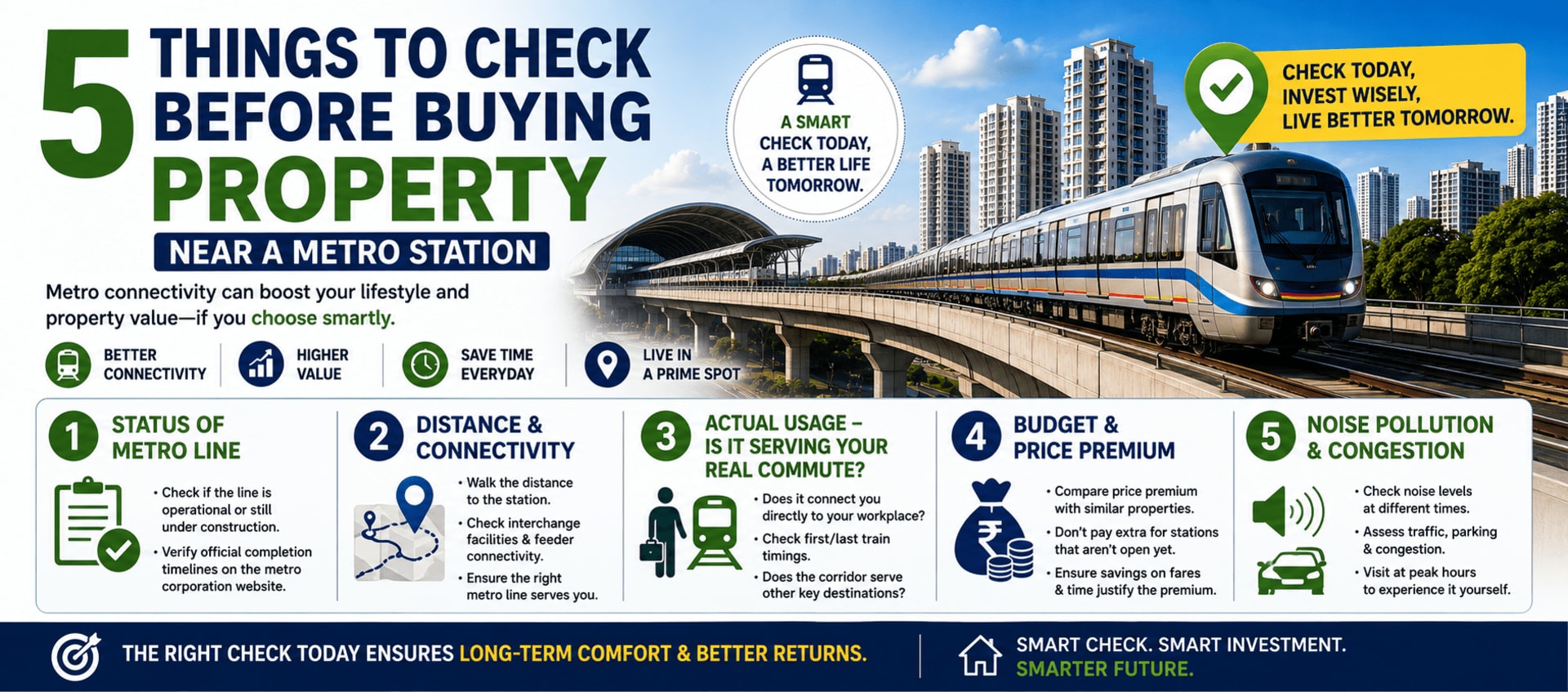
Before paying a premium for "metro-adjacent" property, verify the walking distance to the actual station entrance (the 500 m–1 km range is the sweet spot), check noise exposure if you're within 100–200 m of an elevated viaduct, and compare pricing against similar projects 2–3 km away — a 10–15% metro premium is defensible, 25%+ is not. Also confirm RERA registration, land-acquisition history on the parcel, and whether the line actually serves your commute.
Quick answer: Metro proximity is a genuine, repeatable property premium — Bengaluru's Yellow Line corridor has already seen prices firm up by an estimated 8–19% since opening in August 2025 — but it only pays off when the fundamentals are real. Walk the route yourself at the time you'd actually commute, since brochure distances are measured in a straight line, not along an actual walkable path. Prefer units with bedrooms facing away from the corridor and at least 100–200 m from an elevated viaduct. Much of the appreciation is typically priced in by the time a line is commissioned, so the bigger upside sits in approved, under-construction corridors — with the matching risk of timeline delays. Always verify RERA registration, any land-acquisition disputes on the parcel, and confirm the line's official government timeline rather than a brochure one before paying a premium.
Why "Near the Metro" Needs a Closer Look
Metro rail is the single biggest infrastructure story in South Indian real estate right now. Chennai Metro's Phase 2 Corridor 4 began passenger operations on the Poonamallee Bypass–Vadapalani stretch in early 2026, with the full 118.9 km Phase 2 network targeted closer to 2030. In Bengaluru, the Yellow Line from RV Road to Bommasandra opened in August 2025 and already records over one lakh boardings a day, with industry trackers reporting property prices along the corridor firming up by an estimated 8–19%.
Builders know this — which is why "2 minutes from the upcoming metro station" appears in nearly every project brochure. Some of those claims are genuinely valuable. Others are marketing. These five checks separate the two.
1. Measure the Real Walking Distance — to the Station Entrance, Not the Station
Brochures quote straight-line ("as the crow flies") distances. What matters is the actual walking route to the station entry gate, including road crossings, footpath quality, and which side of the road the entrance sits on. A project "400 m from the station" can be a 15-minute walk if a six-lane arterial road with no pedestrian crossing sits in between.
- Walk it yourself at 9 AM on a weekday — the time you would actually use it.
- The sweet spot is roughly 500 m to 1 km: close enough to walk daily, far enough to escape crowd, hawker, and parking chaos at the station mouth.
- For under-construction corridors, check the official station layout for entry/exit positions — a station "opposite" your project may have its only entrance on the far side.
2. Check Noise, Vibration and What Your Windows Actually Face
Elevated metro corridors run on viaducts 8–12 metres above the road, often at the same height as 2nd–4th floor apartments. A bedroom window 30 metres from a viaduct means train noise roughly every 5 minutes from ~5 AM to ~11 PM — plus station announcements if you're beside a platform.
- Prefer units where bedrooms face away from the corridor; living areas tolerate the noise far better.
- A 100–200 m buffer from an elevated line typically balances convenience against noise. Underground stretches (like Chennai Corridor 4's city-centre section, slated for late 2027) largely avoid the issue.
- Visit the site when trains are running. In a launched corridor like Bengaluru's Yellow Line, what you hear on a Tuesday evening is what you'll live with.
3. Ask Whether the Metro Premium Is Already in the Price
Metro-driven appreciation happens in stages: a bump at announcement, another during visible construction, and a final one at commissioning. By the time a line is operational, much of the premium is usually already priced in — buyers on Bengaluru's Yellow Line corridor in 2025–26 largely paid for the appreciation that early buyers earned.
- Compare the project's rate with similar projects 2–3 km away from the corridor. A 10–15% premium for genuine walk-to-metro access is defensible; 25%+ deserves hard questions.
- The bigger upside sits on corridors that are approved and under construction but not yet running — with the matching risk that timelines slip. Chennai's Phase 2 completion has moved before; buy on official CMRL timelines, not brochure ones.
- If the pitch is a "proposed" line with no sanctioned funding or tenders, treat the metro as a bonus, not a reason to pay more.
4. Run the Legal and Planning Checks Specific to Metro Corridors
Metro corridors bring planning changes that cut both ways:
- RERA first, always — verify the project registration on TNRERA / Karnataka RERA and match the approved plan with what's being sold.
- Land acquisition history: plots abutting the alignment may have lost frontage or carry pending acquisition compensation disputes. Ask for the parent document trail and check whether any portion of the survey number was acquired for the metro.
- Transit-Oriented Development (TOD) zones: areas around stations often get higher FSI and mixed-use permissions. That can mean better long-term value — and also a 15-storey commercial building coming up beside your "quiet residential" project. Ask the builder what the adjacent parcels are zoned for.
- Setbacks from the corridor: construction near the alignment needs metro-authority NOCs. A project genuinely hugging the line should be able to show that NOC.
5. Do the Commute Math — Does This Line Go Where You Actually Go?
A metro station at your doorstep is worthless if the line doesn't serve your office, your children's school, or an interchange that does. Before paying a metro premium:
- Trace your actual door-to-desk journey: walk + wait + ride + interchange + last mile. If it isn't meaningfully faster than driving at peak hour, the premium is emotional, not financial.
- Interchange stations carry the strongest long-term value — they stay relevant as the network grows. On new corridors, check the official network map for which stations are planned as interchanges.
- Check frequency and operating hours on the specific line, not the network. New lines often start with 8–15 minute headways that tighten over time.
- Look at where the line is headed next: extensions under construction (like Chennai Phase 2's remaining corridors, or approved extensions in Bengaluru) tell you whether your station becomes more central or stays peripheral.
The Quick Checklist
| Check | Green Flag | Red Flag |
|---|---|---|
| Walking distance | 500 m – 1 km to the actual entrance | "400 m" across an uncrossable arterial road |
| Noise & facing | Bedrooms face away; 100–200 m from viaduct | Bedroom window at viaduct height, 30 m away |
| Price premium | ~10–15% over comparable non-metro projects | 25%+ premium on an already-operational line |
| Legal & planning | RERA verified, metro NOC shown, TOD zoning known | Acquisition disputes on the parent land |
| Commute value | Line serves your job hub or an interchange | "Proposed" line with no tenders floated |
Propspedia Verdict
Metro proximity is one of the few property premiums backed by genuine, repeatable demand — tenants pay for it, resale buyers pay for it, and operational lines like Bengaluru's Yellow Line show the effect in real numbers. But the premium only works when the fundamentals behind it are real: a walkable entrance, a livable facing, a price that hasn't already eaten the upside, clean title on corridor-adjacent land, and a line that actually goes where you need it. Run all five checks — and verify every shortlisted project's RERA registration and PropScore™ on Propspedia before booking.