Home Loan Guide 2026 for South India Buyers
For buyers eyeing apartments in Chennai, Bangalore, Hyderabad, Coimbatore, or Kochi, a home loan is usually the largest financial commitment they will make. This guide walks through the lenders worth shortlisting, how rates are structured in 2026, and the concrete steps to strengthen your CIBIL score before you apply.
How home loan rates are set in 2026
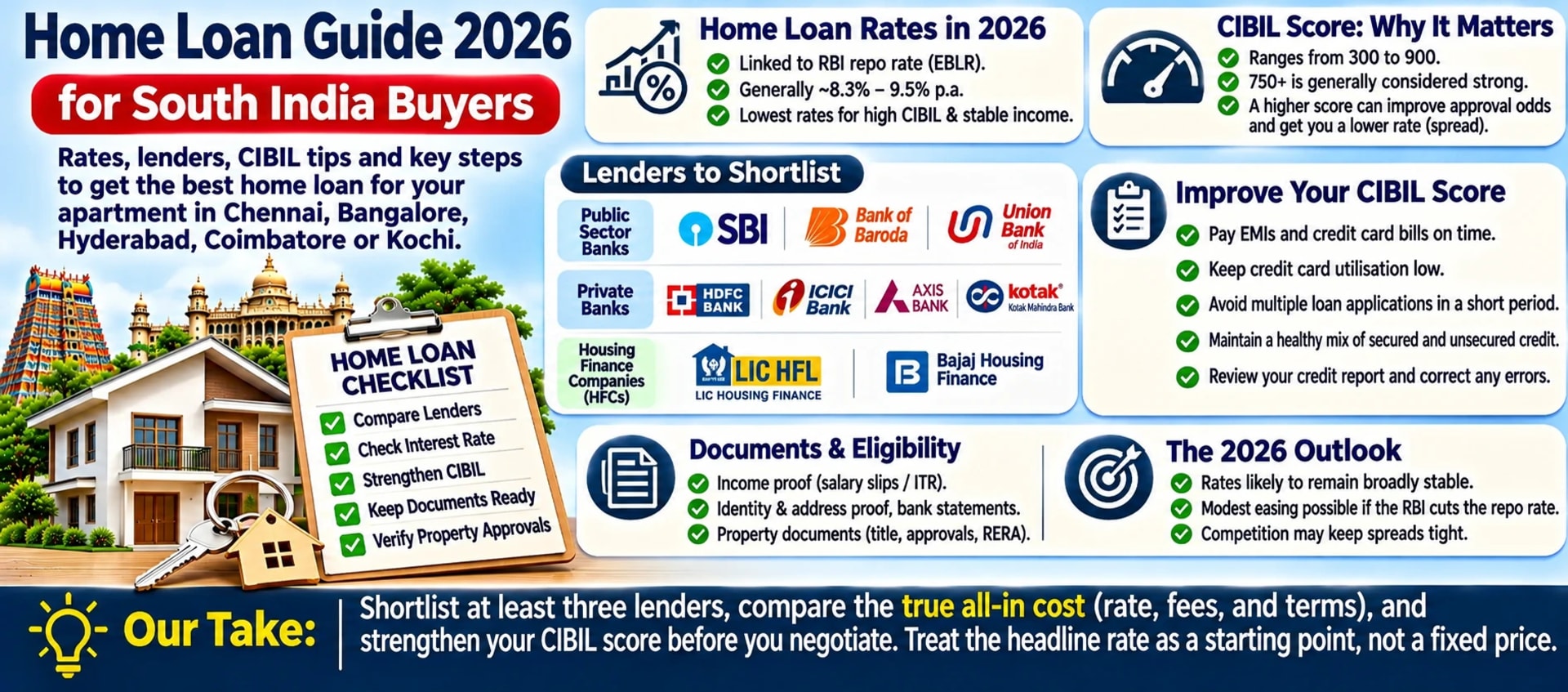
Most floating-rate home loans in India are linked to an external benchmark, commonly the RBI repo rate, under the RBI's external benchmark lending rate (EBLR) framework. Your effective rate is typically the benchmark plus a spread that varies by lender, loan amount, and borrower profile.
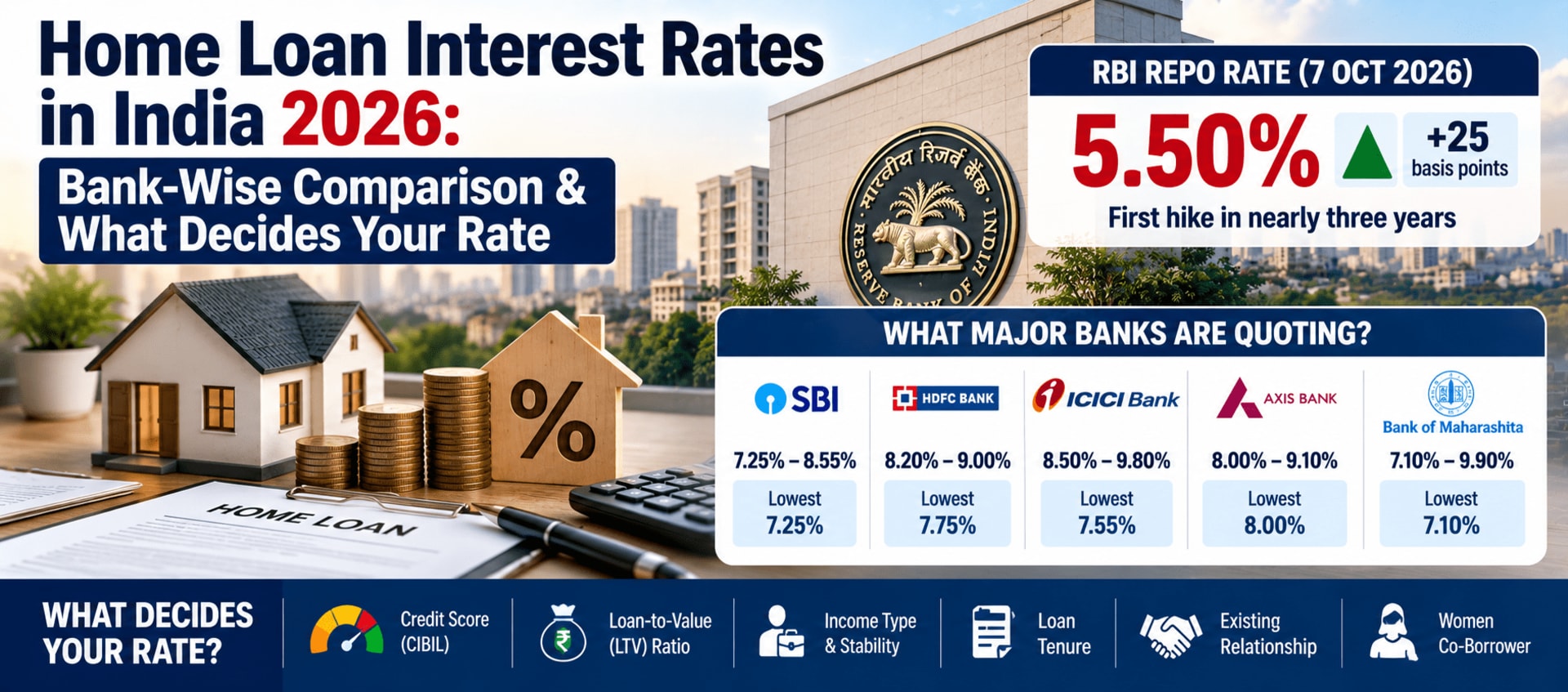
As a general guide, home loan interest rates in early 2026 are reported to sit broadly in the 8.3% to 9.5% per annum range for most salaried borrowers, with the lowest rates reserved for applicants holding strong credit scores and stable income. Exact figures differ by lender and should be confirmed directly.
Banks and lenders to shortlist
Large public sector banks such as State Bank of India, Bank of Baroda, and Union Bank of India remain popular for competitive floating rates and wide branch networks across South India. Among private lenders, HDFC Bank, ICICI Bank, Axis Bank, and Kotak Mahindra Bank are frequently compared. Housing finance companies like LIC Housing Finance and Bajaj Housing Finance are also active in this market.
In our assessment, the 'best bank' is rarely a universal answer. Public sector banks often edge ahead on headline rates and lower processing fees, while private banks and HFCs tend to win on digital speed and flexibility for self-employed applicants. The right choice depends on your profile, the developer's existing tie-ups, and how much you value turnaround time over a marginally lower rate.
We also encourage buyers to look beyond the advertised interest rate. Processing fees, legal and valuation charges, prepayment terms, and the frequency at which a lender resets your rate to the live benchmark can collectively matter more over a 20-year tenure than a 0.1% difference on paper.
Why your CIBIL score matters
CIBIL scores range from 300 to 900, and lenders generally treat a score of 750 and above as a strong indicator of creditworthiness. A higher score can improve both your approval odds and the spread you are offered, which directly affects your EMI.
How to improve your CIBIL score before applying
Practical steps include paying all EMIs and credit card bills on time, keeping credit card utilisation low relative to your limit, avoiding multiple loan applications in a short window, and maintaining a healthy mix of secured and unsecured credit. Reviewing your credit report for errors and getting them corrected can also help.
Our editorial view is that score-building is best treated as a six-to-twelve-month project rather than a last-minute fix. Buyers who clean up utilisation and settle any overdue accounts well ahead of applying tend to negotiate from a far stronger position than those who apply reactively once they have found a property.
Consider a hypothetical couple evaluating a two-bedroom apartment along a growth corridor such as OMR in Chennai. Suppose one partner has a score near 690 and the other near 790. Applying jointly, or applying primarily under the stronger profile after a few months of improving the weaker score, could meaningfully change the rate on offer. This scenario is illustrative only and not based on any real borrower.
Documents and eligibility basics
Lenders typically assess income stability, existing obligations, the loan-to-value ratio, and the property's legal standing. Commonly requested documents include identity and address proof, income proof such as salary slips or ITRs, bank statements, and the property's title and approval documents. South Indian buyers should pay particular attention to local approvals and RERA registration of the project.
The outlook for 2026
If inflation stays within the RBI's comfort band, home loan rates are likely to remain broadly stable through 2026, with the possibility of modest easing should the repo rate be cut. Competition among banks and HFCs is expected to keep spreads tight for high-credit-score borrowers, so applicants who improve their profiles now may be well placed to benefit.
Our bottom line: shortlist at least three lenders, request formal sanction letters to compare true all-in costs, and strengthen your CIBIL score before you negotiate. Treat the headline rate as a starting point for discussion, not a fixed price.