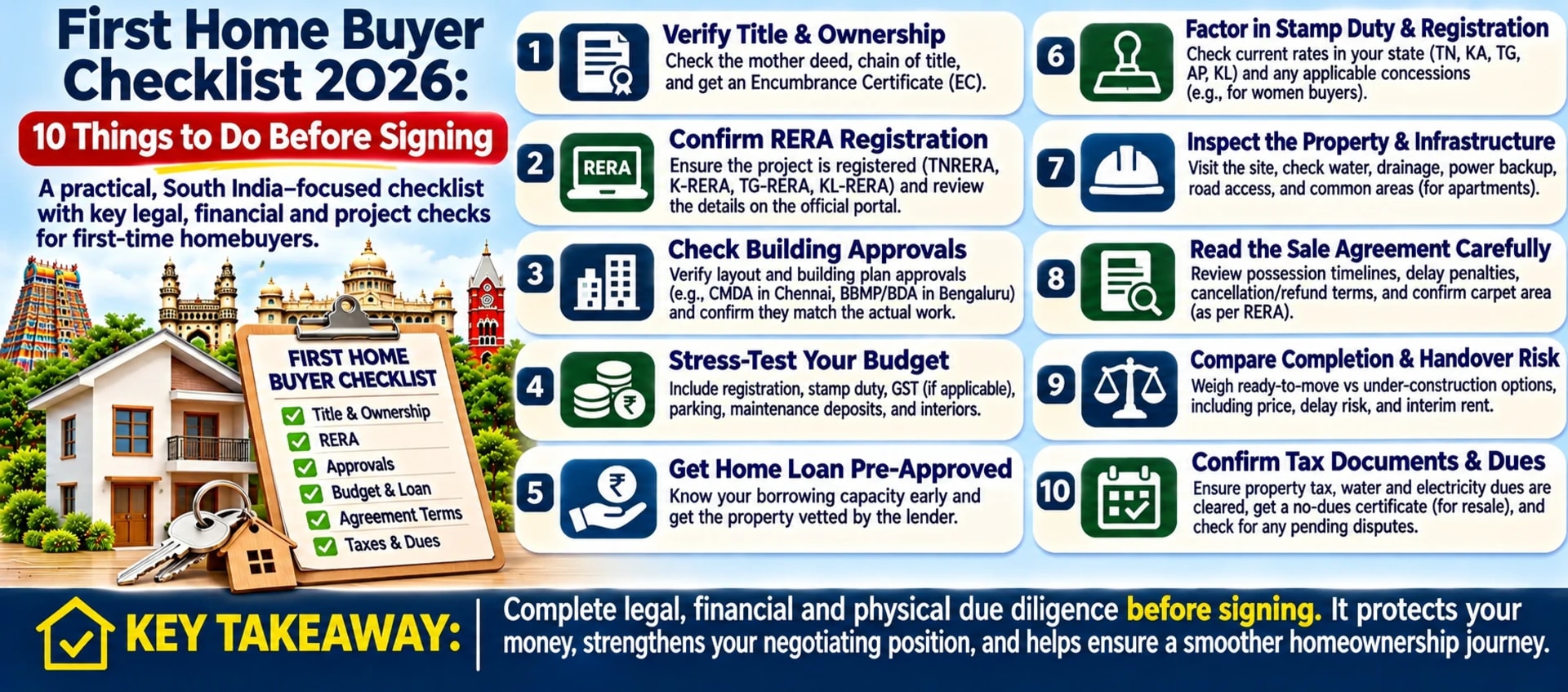
First Home Buyer Checklist 2026: 10 Things to Do Before Signing
Buying a first home is one of the largest financial decisions most households make, and the steps you take before signing the sale agreement matter more than anything that comes after. This checklist walks first-time buyers across South India through the practical due-diligence process for 2026.
In our view, the single biggest mistake first-time buyers make is treating the signing as the finish line rather than the midpoint. The real work — verifying ownership, approvals and affordability — should be largely complete before a pen touches paper.
1. Verify the title and the chain of ownership
Ask for the mother deed and a continuous chain of title documents, ideally covering the previous few decades, and have a property lawyer examine them. An Encumbrance Certificate (EC) from the sub-registrar's office helps confirm the property is free of undisclosed loans or liens.
2. Confirm RERA registration
For under-construction projects, check whether the project is registered with the relevant state Real Estate Regulatory Authority — such as TNRERA in Tamil Nadu, K-RERA in Karnataka, TG-RERA in Telangana or K-RERA in Kerala. Registration details, approved plans and promoter track records are typically listed on the authority's official portal.
3. Check building approvals and layout sanction
Verify that the plan is approved by the competent local body — for example the CMDA or local municipality in Chennai, or the BBMP/BDA in Bengaluru. Confirm the sanctioned plan matches what is actually being built, including the number of floors and setbacks.
4. Stress-test your budget beyond the sticker price
We'd encourage buyers to look past the quoted price and build a full cost picture: registration, stamp duty, GST where applicable, parking, maintenance deposits, and interiors. The headline price is rarely what actually leaves your bank account.
5. Get your home loan pre-approved
Securing an in-principle loan sanction before you commit tells you your realistic borrowing capacity and gives the lender an early look at the property's legal papers. Lenders run their own legal and technical valuation, which adds an extra layer of scrutiny on the property.
6. Factor in stamp duty and registration costs
Stamp duty and registration charges vary by state and are a significant upfront cost. Rates differ across Tamil Nadu, Karnataka, Telangana, Andhra Pradesh and Kerala, and some states offer concessions for women buyers, so confirm the current applicable rate for your state and buyer category.
7. Inspect the physical property and infrastructure
Visit the site more than once and at different times of day. Check water availability, drainage, power backup, road access, and the status of surrounding infrastructure. For apartments, review the common areas, lifts and the quality of completed units if any are ready.
8. Read the sale agreement and builder-buyer terms carefully
Scrutinise clauses on possession timelines, penalty for delay, cancellation and refund terms, and the exact carpet area versus super built-up area. RERA requires pricing to be based on carpet area, so confirm how the area and price are defined.
9. Compare completion and handover risk
Consider a hypothetical buyer weighing two similar apartments at comparable prices — one ready-to-move and one under construction with a promised handover two years out. The ready unit carries little delay risk but may cost more, while the under-construction unit may be cheaper but exposes the buyer to possession delays and interim rent. Mapping out this trade-off before signing clarifies which risk you can actually absorb.
10. Confirm tax documents and dues are clear
Check that property tax, water and electricity dues are fully paid and that receipts are in order. For resale homes, obtain a no-dues certificate from the housing society or association and confirm there are no pending legal disputes attached to the property.
The road ahead for 2026 buyers
Digitisation of land records and registration across several South Indian states is likely to continue through 2026, which is expected to make title verification and encumbrance checks somewhat faster for diligent buyers. Interest rate movements remain uncertain, so affordability is likely to stay sensitive to lending conditions.
Ultimately, a disciplined checklist does not slow a purchase down — it protects it. Buyers who complete legal, financial and physical due diligence before signing tend to negotiate from a position of strength and sleep better once the keys are handed over.