An Encumbrance Certificate (EC) is an official Sub-Registrar's Office record of every registered transaction — sales, mortgages, gifts, court orders — against a property, confirming whether it's free of legal or financial liability. It costs ₹50–₹200 for a physical copy (2–3 days) or is free online via tnreginet.gov.in in Tamil Nadu. Resale buyers should request at least 30 years of EC history.
Quick answer: An EC is the single most important document in a property purchase because it's the only way to confirm a seller hasn't taken an undisclosed loan against the property or left it entangled in a legal dispute — buying without checking one risks a bank later claiming superior title and auctioning the property out from under you. Request a Form 15 EC (not the nil Form 16) covering at least 30 years for resale property, or from the date of land acquisition for a new apartment; NRI buyers should ask for a minimum 13-year EC since many banks require it. But an EC alone isn't complete verification — it only covers registered transactions, so pair it with a Patta check, a court search, and RERA verification before you commit.
What is an Encumbrance Certificate?
An Encumbrance Certificate (EC) is an official document issued by the Sub-Registrar's Office that lists all the transactions registered against a property over a specified period. It shows whether a property is free from any legal or financial liabilities.
The document includes: sale deeds, mortgage or hypothecation deeds, gift deeds, court orders affecting the property, lease deeds above 12 months, and any partition deeds.
Why You Must Demand an EC
Without checking the EC, you cannot know if:
- The seller has an unpaid home loan (mortgage) on the property
- A previous owner has taken a loan and not repaid it
- There are legal disputes or attachments on the property
- The property was gifted or is part of an undivided estate
Purchasing a property with an undisclosed loan can result in the bank having superior title and the right to auction the property — leaving you without recourse.
How to Obtain an EC
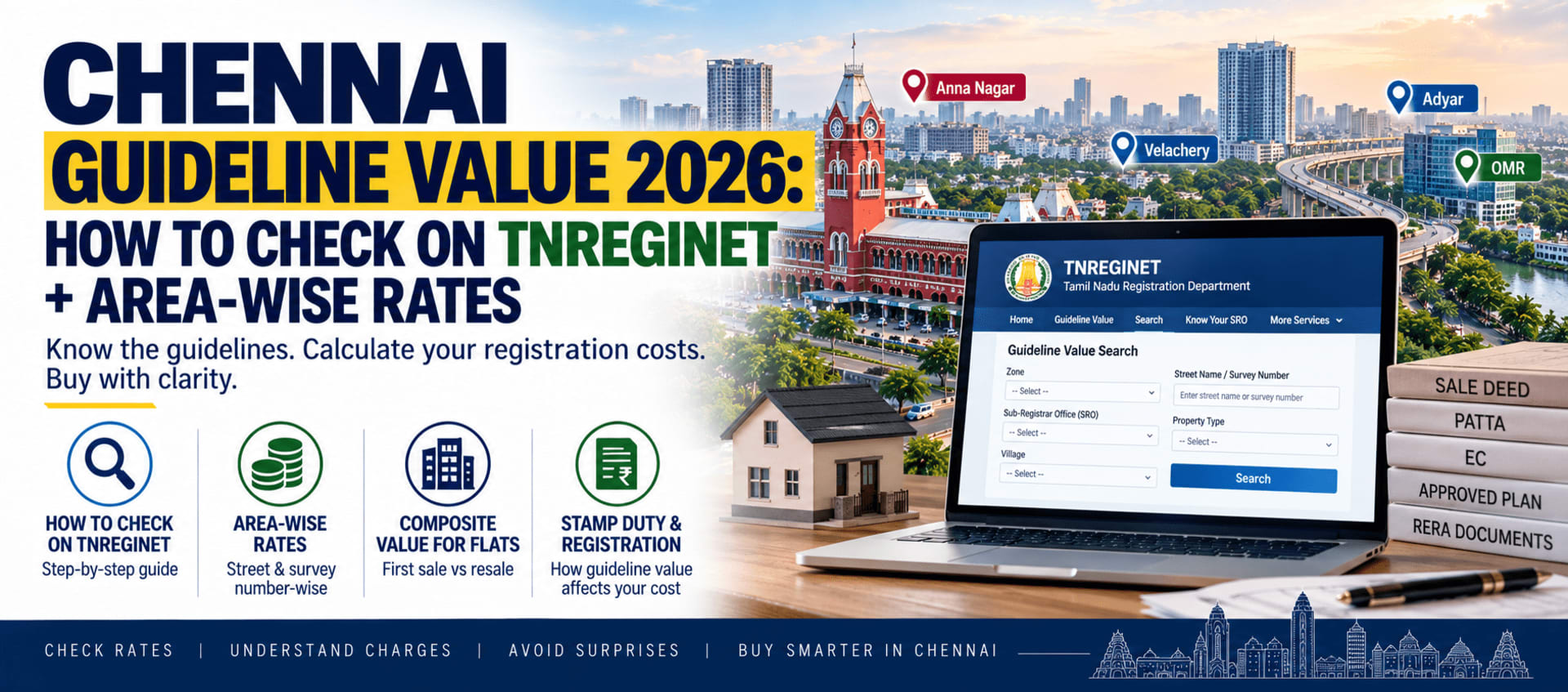
Online (Tamil Nadu): Visit tnreginet.gov.in → Encumbrance Search. Free of charge. You can search by document number or survey number.
Online (Telangana): Visit registration.telangana.gov.in → Encumbrance Certificate. Free.
Online (Karnataka): Visit kaverionline.kar.nic.in → Encumbrance Certificate.
For physical copies: visit the Sub-Registrar's office with the property survey number, pay ₹50–₹200 fee, and collect within 2–3 working days.
Reading the EC: What Each Column Means
A Form 15 EC (with transactions) is more useful than a Form 16 (nil encumbrance certificate for a specified period). In Form 15:
- Column 1–2: Nature of document and date of registration
- Column 3: Parties to the transaction (seller and buyer names)
- Column 4: Value of transaction
- Column 5: Property description
If Column 5 shows a "Memorandum of Deposit of Title Deed" or "Equitable Mortgage" — that means the property has been used as loan collateral and you must verify the loan is fully discharged.
Red Flags in an EC
- Any entry within the last 3 years that is not a sale deed (suggests ongoing mortgage or dispute)
- Discrepancy between the property area in the EC and what the seller claims
- Multiple transactions in quick succession (may indicate property is being shuffled to avoid scrutiny)
- Any court-registered order (suggests litigation)
How Far Back Should You Check?
For resale properties: request EC for at least 30 years. For new apartments: request EC from the date the land was acquired by the builder. For NRI buyers specifically: many banks insist on a 13-year EC minimum before approving loans.
What an EC Does Not Cover
The EC only shows transactions registered at the Sub-Registrar's office. It does not show: oral agreements, government acquisition proceedings, income tax or GST departmental dues, or disputes pending before civil courts (which may not be registered).
This is why a combined verification — EC + Patta (land ownership document) + court search + RERA check — is the complete title verification process.