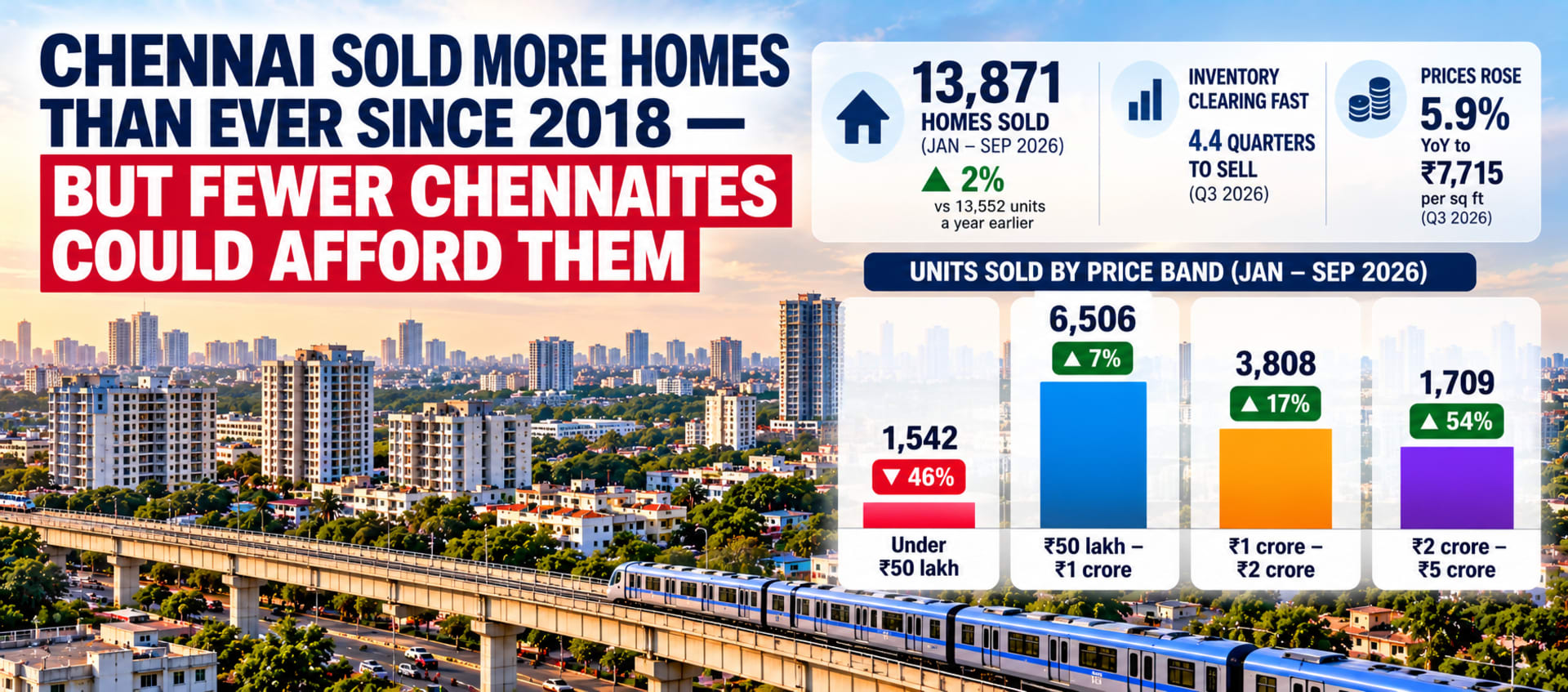
Chennai recorded 13,871 residential property sales between January and September 2026 — up 2% from 13,552 units a year earlier, and the highest nine-month total the city has posted since 2018, according to Knight Frank India's tracking of primary (developer) sales. Read as a single number, that's an unambiguously strong market.
Read by price band instead, and it's a different story: the city that's buying more homes than it has in eight years is, at the same time, becoming a harder place for a large share of its own residents to buy one.
The number everyone will quote
Start with the parts that sound good, because they're real:
- 13,871 units sold, January–September 2026 — Chennai's best nine-month showing since 2018.
- Inventory is moving fast. Chennai's quarters-to-sell (QTS) — how long it would take to clear existing unsold stock at the current sales pace — stood at 4.4 quarters in Q3 2026, the second-lowest among India's eight major residential markets. That's a healthy, not oversupplied, market by this measure.
- Prices rose too, with the weighted average residential price up 5.9% year-on-year to ₹7,715 per sq ft in Q3 2026.
None of that is misleading on its own. It's also not the whole picture.
The number that tells you what actually happened
Split the same 13,871 sales by price band, and the composition has shifted hard toward the top:
| Price band | Units sold (9M 2026) | YoY change |
|---|---|---|
| Under ₹50 lakh | 1,542 | −46% |
| ₹50 lakh – ₹1 crore | 6,506 (47% of all sales — the single largest band) | +7% |
| ₹1 crore – ₹2 crore | 3,808 | +17% |
| ₹2 crore – ₹5 crore | 1,709 | +54% |
Two things to notice. First, the ₹50L–1Cr band is still, by a wide margin, where most Chennai home sales actually happen — this isn't purely a luxury story. Second, the two ends of the table are moving in opposite directions at a pace that can't be explained by rounding: the cheapest homes are selling nearly half as often as a year ago, while the ₹2–5 crore band grew by more than half. Homes priced above ₹1 crore now account for roughly 42% of everything Chennai sold this year, a share that itself grew about 26% year-on-year.
(These sub-totals, as independently reported, don't sum exactly to 13,871 — a common gap between press summaries of a research report and the report's own full breakdown, which we haven't independently verified against Knight Frank's primary release. Treat each band figure as directionally accurate, not to the last unit.)
Why — and it isn't that Chennai stopped wanting ₹40 lakh flats
The simplest explanation isn't that demand for affordable homes vanished. It's that builders launched fewer of them. Developers brought just 14,639 new homes to market in the same nine months, 7% fewer than the 15,793 launched a year earlier — and separate, broader reporting on India's residential sector describes sub-₹50-lakh housing supply contracting nationally, not just in Chennai, as developers skew new launches toward higher-margin price points. If that national pattern holds locally, fewer affordable options reaching the market would show up exactly as falling sales in that band, even with buyers still wanting to be there.
What's commonly cited — though we're presenting this as the generally-understood backdrop rather than a figure we've independently traced to one dated source — is GCC and IT-led employment growth and progress on Chennai Metro Phase II as factors pulling demand toward higher price points in well-connected corridors, which lines up with where the ₹1Cr+ growth is concentrated.
What this means depending on your budget
If you're looking under ₹50 lakh: this is genuinely the toughest segment right now — fewer new launches, and what exists is selling at a slower pace in relative terms than the rest of the market. It's worth widening your search to peripheral and emerging corridors where land cost still supports this price point; browse flats under ₹50 lakh in Chennai to see current live inventory rather than going by last year's assumptions about where affordable stock exists.
If your budget is ₹50 lakh–1 crore: you're in the segment builders are still building the most for, and where you'll find the widest real choice today — see ₹50–75 lakh and ₹75 lakh–1 crore listings.
If you're buying ₹1 crore and above: you're in the fastest-growing part of the market, which cuts both ways — more genuine new-launch choice, but also more competition from other buyers chasing the same well-located projects. See ₹1–1.5 crore and above ₹1.5 crore listings.
A caveat worth keeping in mind
Every figure above traces back to press coverage of a Knight Frank India update, not a primary report we've read in full — we were not able to independently verify these numbers against Knight Frank's original release line by line. The figures also cover primary (developer) sales only; resale transactions, which make up a meaningful share of real activity in a market like Chennai, aren't counted here. Other research firms covering the same nine months have reported different totals for Chennai, reflecting different city-coverage definitions and methodologies rather than a factual disagreement — a reminder to treat any single quarter's headline number as one firm's read, not an agreed-upon fact.
Sources: Chennai housing sales rise 2% in 2026: Frank India, Rs 2-5 cr segment records 54% growth — NewsTodayNet (6 Oct 2026) · Chennai home sales Jan–Sep 2026, launches fall — PropNewz (16 Oct 2026) · India Real Estate Office and Residential Market H1 2026 — Knight Frank · Affordable housing dries up across India: 31% drop in sub-₹50 lakh supply — Outlook Money · Housing Sales Steady at 2.58 Lakh, Premium Homes Gain — Free Press Journal
[VERIFY: all price-band figures and the QTS statistic are drawn from secondary press coverage of a Knight Frank India update, not the primary report itself — before citing these numbers elsewhere as confirmed facts, try to locate and cross-check against Knight Frank's own published 9M-2026 Chennai release.]