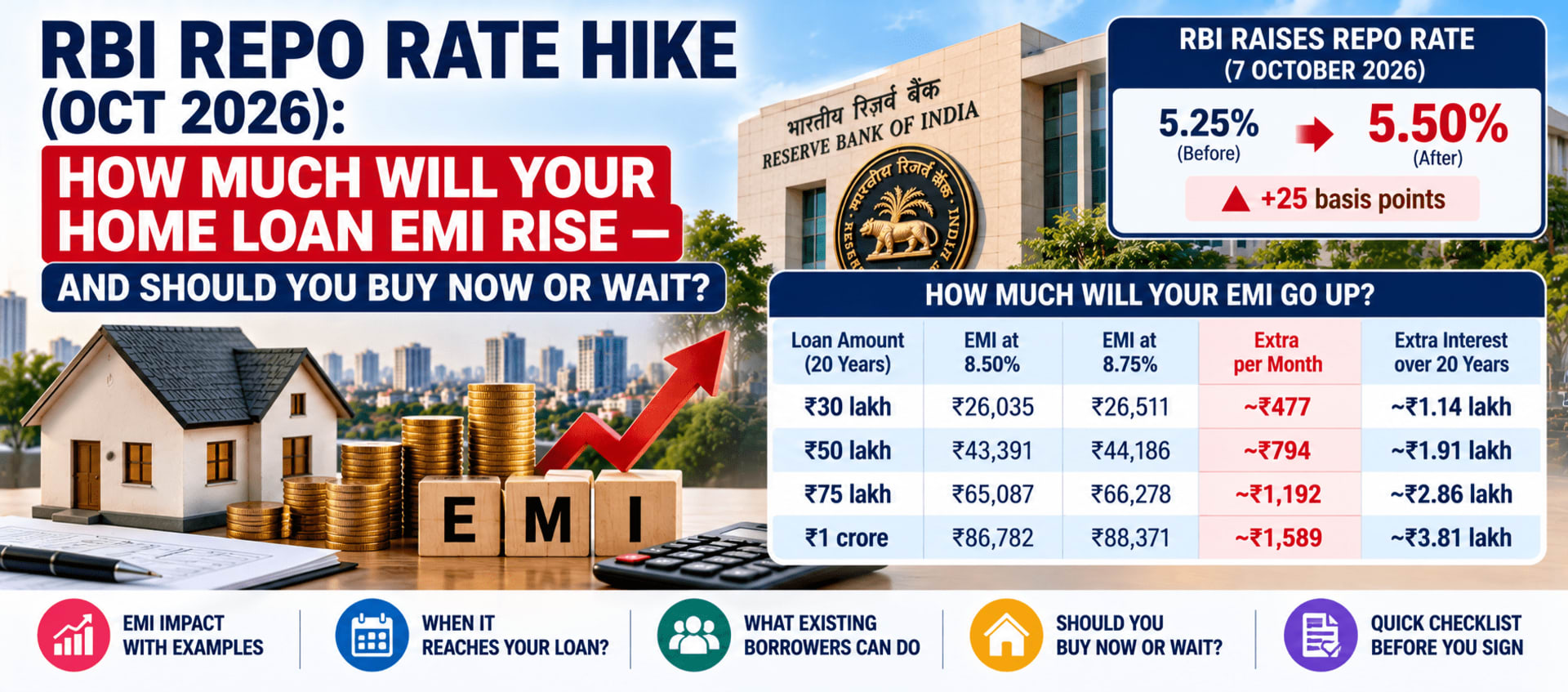
On 7 October 2026, the RBI's Monetary Policy Committee raised the repo rate by 25 basis points, from 5.25% to 5.50% — the first rate increase in several years — and shifted its stance from "neutral" to "calibrated tightening". If you have a floating-rate home loan, or you are about to take one, the question is simple: what does this do to my EMI, and should I act?
This guide answers that with numbers you can check yourself. For lender-by-lender rates, see our home loan interest rate comparison.
> What is confirmed vs not (as of 26 October 2026): The 25 bps hike, the new 5.50% repo rate and the stance change are reported consistently across multiple outlets. We could not open the RBI's own press release while writing this, so check the figures at rbi.org.in. How much each bank passes on, and when, is not the same across lenders — see below. [VERIFY: confirm repo 5.50% / stance wording against the RBI Monetary Policy Statement of 7 Oct 2026 before publishing.]
What exactly changed
| Rate | Before | After |
|---|---|---|
| Repo rate | 5.25% | 5.50% |
| Standing Deposit Facility (SDF) | 5.00% | 5.25% |
| MSF rate / Bank Rate | 5.50% | 5.75% |
The vote on the rate hike was reported as unanimous; the change in stance was reportedly a split decision (two members preferred to keep "neutral"). The next MPC decision is due on 4 December 2026. [VERIFY: SDF/MSF "before" values come from one secondary summary.]
How much will your EMI go up?
Since 2019, floating-rate home loans are linked to an external benchmark — usually the repo rate — plus your bank's spread. When the repo rate rises 0.25%, your rate rises about 0.25% at your next reset date.
The table below assumes a 20-year loan and an illustrative move from 8.50% to 8.75%. These are example rates, not any bank's quote — your own rate will differ.
| Loan amount | EMI at 8.50% | EMI at 8.75% | Extra per month | Extra interest over 20 years |
|---|---|---|---|---|
| ₹30 lakh | ₹26,035 | ₹26,511 | ~₹477 | ~₹1.14 lakh |
| ₹50 lakh | ₹43,391 | ₹44,186 | ~₹794 | ~₹1.91 lakh |
| ₹75 lakh | ₹65,087 | ₹66,278 | ~₹1,192 | ~₹2.86 lakh |
| ₹1 crore | ₹86,782 | ₹88,371 | ~₹1,589 | ~₹3.81 lakh |
Rule of thumb: about ₹16 extra EMI per month for every ₹1 lakh borrowed per 0.25% rise, on a 20-year loan.
If your bank keeps the EMI unchanged instead, your tenure stretches. On a ₹50 lakh loan that is roughly 12 extra months at 8.75% (our calculation: ~252 months instead of 240). Banks often default to extending tenure rather than raising EMI — check which one your lender chose.
When does it reach your loan?
- New loans: priced off the new benchmark almost immediately. Reports say banks' external-benchmark rates were revised from 7–8 October 2026. [VERIFY: effective date varies by bank — confirm with your lender.]
- Existing floating-rate loans: the change applies from your next scheduled reset date (commonly every 3 months, as per your loan agreement), not on the day of the RBI announcement.
- Fixed-rate loans: unaffected until the fixed period ends.
What should existing borrowers do?
- Read your reset date in the sanction letter or loan portal — that's when the new rate bites.
- Check whether the bank raised your EMI or your tenure. Longer tenure feels painless but costs more interest.
- Make part-prepayments. For floating-rate home loans taken by individuals, banks cannot charge prepayment penalties [VERIFY: confirm against the current RBI prepayment-charges directions and effective date]. Even one extra EMI a year shortens a 20-year loan noticeably.
- Ask for a spread review. If your credit score has improved since you took the loan, many lenders will lower your spread on request — a bigger lever than the 0.25% the RBI moved.
- Don't panic-switch. Balance transfers carry processing fees; the gain has to beat them. Run the numbers for the remaining tenure first.
Should you buy now or wait?
The honest answer: a 0.25% move should not decide a home purchase — your budget and the right property should. Some points to weigh:
- EMI is small relative to price. On a ₹75 lakh loan the hike adds about ₹1,200 a month. A 3–5% price rise in your target locality costs more than that in a year.
- Prices are firm in Chennai. NoBroker's Q3 2026 report (as covered by BusinessToday) puts Chennai price growth at about 10.2% year-on-year, with housing demand up 7% across six metros. [VERIFY: confirm Chennai figure against the NoBroker report.] Waiting for cheaper loans may mean paying more for the same flat.
- Further moves are uncertain. Commentary after the meeting suggested more rate cuts were unlikely in the near term, but a pause at 5.50% or another hike are both possible — nobody knows. Don't time the rate cycle.
- Check your own limit. Banks lend based on your EMI-to-income ratio. A higher rate lowers the loan you qualify for. Get a fresh eligibility quote before you fall in love with a flat.
Practical middle path: shortlist now, get a sanctioned loan limit (valid for months), negotiate the builder's price and payment schedule, and decide on the property — not on the next MPC date.
Quick checklist before you sign
- Get two or three written rate quotes and the exact spread over the repo rate.
- Ask for the reset frequency and whether it is EMI-up or tenure-up.
- Confirm there is no processing-fee or conversion-fee trap if rates fall later.
- If buying under construction, understand how GST affects your total cost.
- Browse flats for sale in Chennai within the budget your new EMI allows.
This article is general information, not financial advice. Loan rates change often and differ by borrower — confirm with your lender before deciding.