For ₹1 crore in 2026, Mumbai's Thane suburbs buy a compact 2BHK renting for ₹28,000–₹32,000/month at 2.8–3.4% yield, while the same budget in Bengaluru's Sarjapur belt or Chennai's OMR buys a larger unit renting ₹35,000–₹42,000/month at 3.5–4.5% yield. Chennai's OMR/Pallavaram-Thoraipakkam corridor (₹6,500–₹9,500/sqft) offers the best entry value among South India's three major metros.
Quick answer: For rental cash flow, affordability and balanced growth, South India's metros — particularly Chennai's OMR corridor (₹6,500–₹9,500/sqft, yields 3.8–4.5%) and Hyderabad's western belt (Kokapet, Financial District, Gachibowli: ₹9,000–₹14,000/sqft, ~3.6% yield) — offer 2026's strongest risk-adjusted returns, backed by deep regulated project pipelines (Karnataka 6,200+, Telangana ~5,400, Tamil Nadu ~4,100 active RERA projects). Bengaluru's Sarjapur Road and Whitefield (₹8,500–₹12,500/sqft) yield 3.5–4.2%. Mumbai's suburbs remain the choice for investors prioritising liquidity and capital preservation: Thane/Navi Mumbai (₹14,500–₹19,000/sqft) and prime Andheri/Goregaon (₹28,000–₹35,000/sqft) offer 6–8% annual appreciation but lower yields (2.8–3.4%) and steeper stamp duty. South India's key risk is micro-market concentration tied to IT-sector health; Mumbai's is oversupply in select luxury pockets.
The 2026 investment debate is no longer just about prestige addresses. With capital values in Mumbai's suburbs stretching household budgets and South India's metros posting steady end-user demand, investors are re-running the numbers. Here's a facts-first comparison to help you decide where your money grows fastest.
The Mumbai Suburbs Story
Mumbai's western and central suburbs remain India's most liquid residential market, but liquidity comes at a premium. Entry points are steep, and rental yields have historically lagged behind capital appreciation.
- Thane and Navi Mumbai average ₹14,500–₹19,000 per sqft for mid-segment stock in 2026.
- Prime suburbs like Andheri and Goregaon cross ₹28,000–₹35,000 per sqft.
- Gross rental yields sit at a modest 2.8%–3.4%, typical of a mature, high-capital-value market.
- Infrastructure catalysts — the extended Metro network, the Coastal Road, and the Navi Mumbai International Airport nearing operations — support long-term appreciation of 6%–8% annually.
The suburbs suit investors seeking capital preservation and slow, steady growth rather than high cash flow. Ticket sizes below ₹1.2 crore are increasingly rare for quality 2BHK inventory.
Why South India Metros Are Gaining Ground
Bengaluru, Hyderabad, and Chennai combine strong IT-led employment, transparent RERA governance, and more accessible pricing. The result is a healthier balance between rental income and appreciation.
- Bengaluru mid-segment corridors like Sarjapur Road and Whitefield range ₹8,500–₹12,500 per sqft, with yields of 3.5%–4.2%.
- Hyderabad's western belt (Kokapet, Financial District, Gachibowli) sits at ₹9,000–₹14,000 per sqft, buoyed by new office absorption; yields near 3.6%.
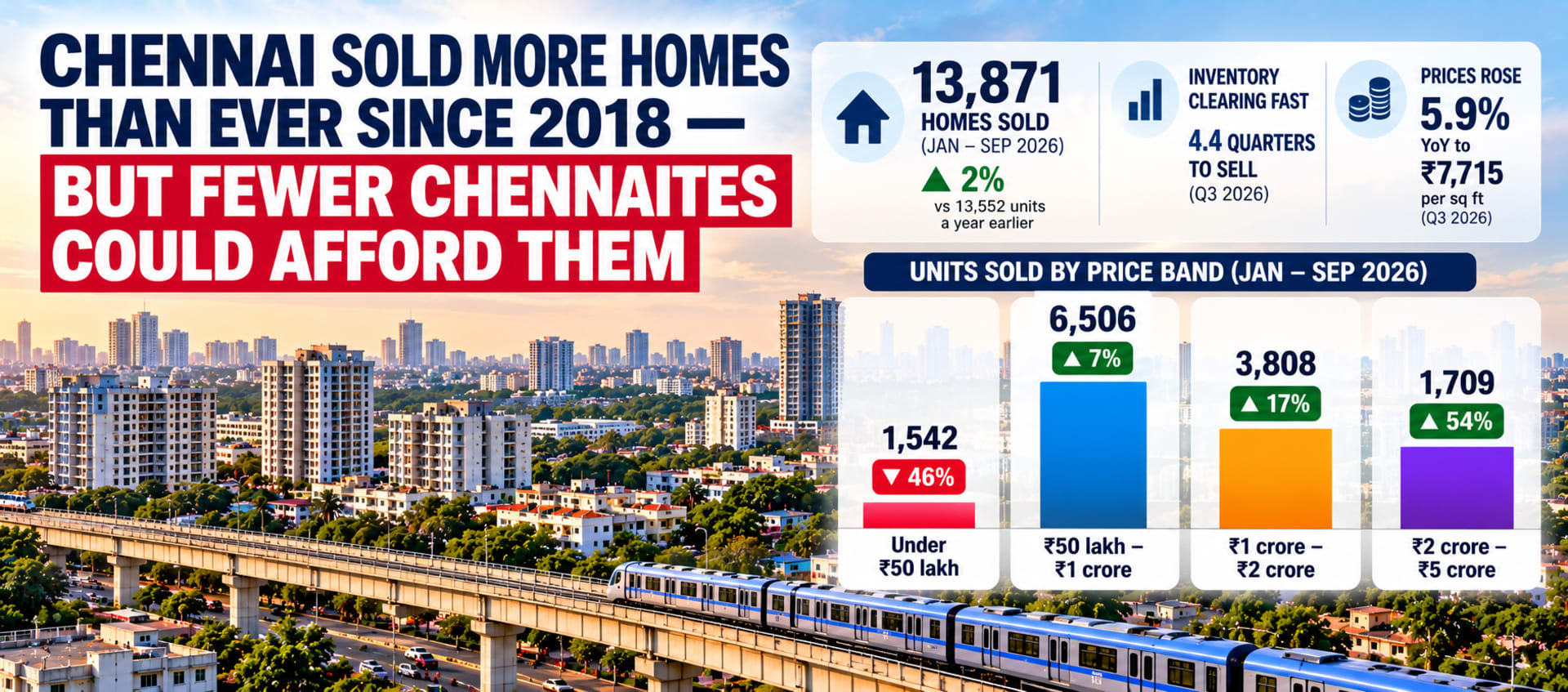
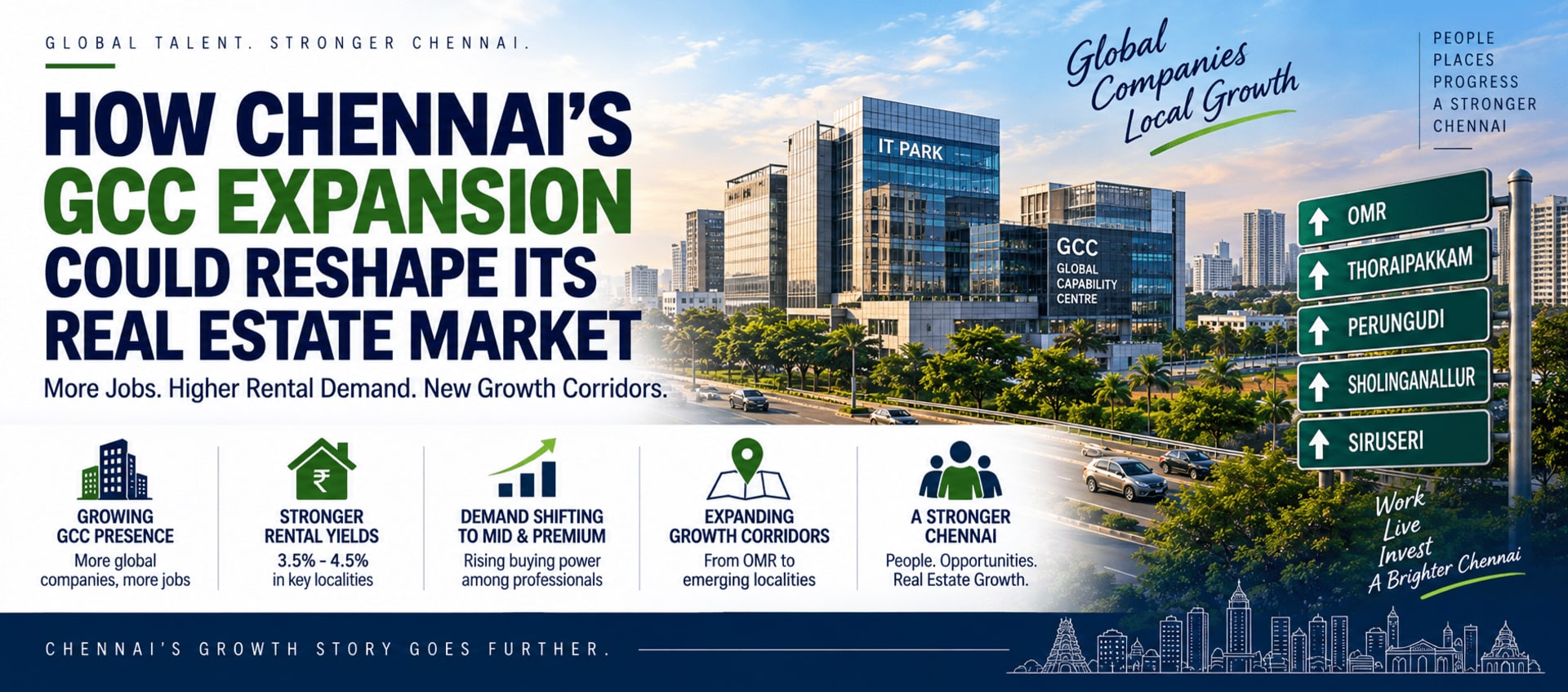
- Chennai's OMR and Pallavaram-Thoraipakkam stretch offers ₹6,500–₹9,500 per sqft — arguably the best entry value among the three — with yields of 3.8%–4.5%.
By early 2026, Karnataka RERA had over 6,200 active registered projects, Telangana around 5,400, and Tamil Nadu roughly 4,100, signalling a deep, regulated supply pipeline that protects buyers.
Yield vs Appreciation: The Core Trade-off
Mumbai suburbs win on absolute appreciation potential and resale liquidity but tie up more capital for lower income. South India metros deliver superior rental returns and lower entry barriers, making them attractive for buy-to-let investors and first-time property buyers.
Consider a ₹1 crore budget:
- In Thane, you secure a compact 2BHK generating roughly ₹28,000–₹32,000 monthly rent.
- In Bengaluru's Sarjapur belt or Chennai's OMR, the same budget buys a larger unit yielding ₹35,000–₹42,000 monthly, with comparable or better appreciation prospects driven by IT hiring.
Infrastructure and Demand Drivers for 2026
Each market has its own growth engine:
- Bengaluru: Phase 2 Metro expansion and the Peripheral Ring Road are unlocking eastern and northern micro-markets.
- Hyderabad: Regional Ring Road progress and sustained Grade-A office leasing (over 12 million sqft absorbed in 2025) anchor demand.
- Chennai: Metro Phase 2, the growing GCC and manufacturing ecosystem along GST Road, and affordable land keep the market grounded and end-user driven.
- Mumbai suburbs: transport megaprojects justify premiums but the appreciation is largely priced in.
Risk Factors to Weigh
- Mumbai suburbs carry oversupply risk in select luxury pockets and high stamp-duty and maintenance costs.
- South India metros face micro-market concentration risk — returns hinge heavily on IT-sector health and specific corridor infrastructure delivery.
- Always verify RERA registration, clear title, and completion timelines regardless of city.
The 2026 Verdict
For investors prioritising rental cash flow, affordability, and balanced growth, South India metros — particularly Chennai's OMR and Hyderabad's western corridor — offer the strongest risk-adjusted returns in 2026. For those with larger capital seeking liquidity and blue-chip stability, Mumbai's suburbs remain a defensible, if expensive, choice.
The smart play for many portfolios is diversification: anchor stability in a Mumbai suburb if budget allows, but channel yield-focused capital into South India's growth metros where the rupee simply works harder.