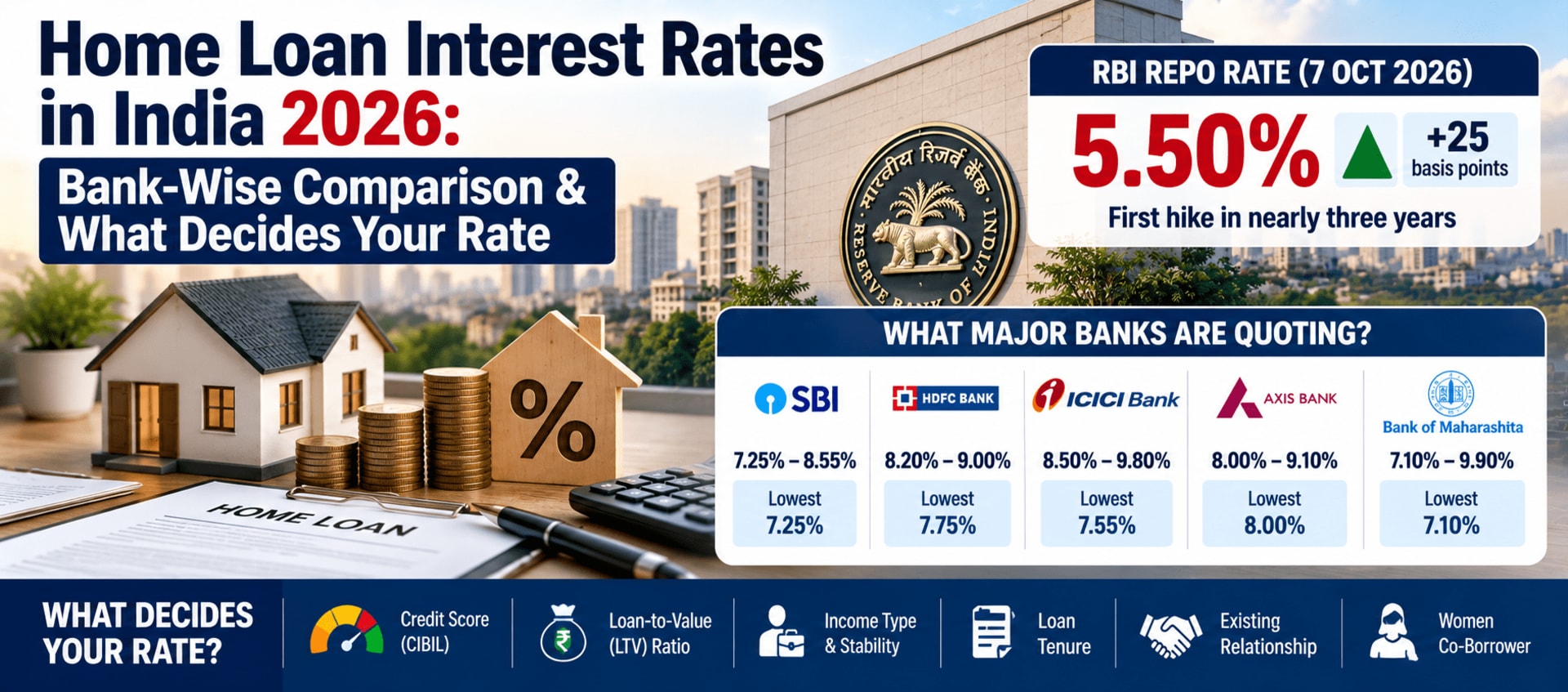
Home loan interest rates across major Indian banks in 2026 start from 8.50% (SBI, LIC Housing Finance) up to 15% at the high end for self-employed borrowers via NBFCs like Bajaj Housing Finance. Banks generally cap the maximum loan at around 60 times net monthly income, with EMI obligations capped at 40–55% of income. Eligible first-time buyers can claim tax benefits of up to ₹5 lakh a year combining Sections 80C, 24(b) and 80EEA.
Quick answer: For most buyers in 2026, floating-rate loans are the better choice, since RBI is expected to cut the repo rate as inflation moderates, which would lower EMIs automatically — fixed rates only make sense if you need EMI certainty on a tight budget. To improve eligibility, a credit score above 750, adding a co-applicant's income, clearing existing EMIs, and having 2+ years at your current employer all help. The maximum combined annual tax benefit across Section 80C (₹1.5 lakh), Section 24(b) (₹2 lakh) and Section 80EEA (₹1.5 lakh, for first-time buyers on properties up to ₹45 lakh) is ₹5 lakh under the old tax regime. Always compare offers from at least three lenders and check the CIBIL score requirement (750+ for the best rates) before applying.
Understanding Home Loans in India — 2026 Complete Guide
Buying a home is the largest financial decision most Indians make. A home loan spreads this cost over 20–30 years — but understanding the interest rate, eligibility criteria, processing fees, and tax benefits can save you lakhs of rupees over the loan tenure. This guide covers everything you need to know about home loans in India in 2026.
Current Home Loan Interest Rates — Major Banks (2026)
| Lender | Starting Rate | Up to Rate | Best For |
|---|---|---|---|
| SBI (State Bank of India) | 8.50% | 9.65% | Salaried government employees |
| HDFC Bank | 8.75% | 9.65% | Private sector salaried |
| ICICI Bank | 8.75% | 9.80% | NRI home loans |
| Axis Bank | 8.75% | 9.15% | Self-employed professionals |
| Kotak Mahindra Bank | 8.75% | 9.50% | Balance transfer |
| LIC Housing Finance | 8.50% | 10.50% | Government employees |
| Bajaj Housing Finance | 8.50% | 15.00% | Self-employed, MSME |
Note: These are indicative rates subject to change. Your actual rate depends on credit score, income, loan amount, and lender policy. Always compare offers from at least 3 lenders before applying.
How Much Home Loan Can You Get?
Banks use your net monthly income, credit score, age, and existing EMIs to calculate maximum loan eligibility. The standard formula:
- Maximum EMI = 40–55% of net monthly income (after all deductions)
- Maximum loan = approximately 60× your net monthly income
Eligibility Examples (2026)
| Net Monthly Income | Approx. Max Loan (20 yrs @ 9%) | Property Budget |
|---|---|---|
| ₹30,000 | ₹18–20 lakhs | ₹22–25 lakhs |
| ₹50,000 | ₹30–35 lakhs | ₹38–45 lakhs |
| ₹75,000 | ₹45–50 lakhs | ₹58–65 lakhs |
| ₹1,00,000 | ₹60–65 lakhs | ₹75–85 lakhs |
| ₹1,50,000 | ₹90–95 lakhs | ₹1.1–1.2 Cr |
| ₹2,00,000 | ₹1.2–1.3 Cr | ₹1.5–1.6 Cr |
Factors That Improve Your Home Loan Eligibility
- Credit score 750+ — banks offer best rates to high scorers
- Add a co-applicant — spouse's income increases combined eligibility significantly
- Clear existing EMIs — lower debt-to-income ratio = higher loan amount
- Longer employment tenure — 2+ years at current employer preferred
- Avoid multiple loan inquiries — each inquiry slightly reduces credit score
Documents Required for Home Loan
Salaried Employees
- Last 3 months salary slips
- Last 2 years Form 16 / IT returns
- Last 6 months bank statements
- Employment letter / appointment letter
- PAN and Aadhaar card
- Property documents (after selection)
Self-Employed
- Last 3 years IT returns with computation
- Last 3 years profit & loss statements and balance sheet
- Last 12 months business bank statements
- GST registration and returns
- Business registration proof
Tax Benefits on Home Loan — Section 80C and 24B
| Section | What You Can Claim | Annual Limit |
|---|---|---|
| Section 80C | Principal repayment + stamp duty in year of payment | ₹1.5 lakhs |
| Section 24(b) | Interest paid (self-occupied property) | ₹2 lakhs |
| Section 80EEA | Additional interest deduction (first-time buyer, property ≤₹45L) | ₹1.5 lakhs |
Total maximum tax benefit per year: ₹5 lakhs (for eligible first-time buyers under old tax regime).
Fixed vs Floating Interest Rate — Which to Choose in 2026?
In 2026, with RBI expected to cut the repo rate as inflation moderates, floating rate loans are generally more advantageous. When RBI cuts rates, your floating EMI decreases automatically.
| Type | 2026 Recommendation | Best For |
|---|---|---|
| Floating Rate | ✅ Recommended | Most buyers — benefits from rate cuts |
| Fixed Rate | Only if you need EMI certainty | Tight budget, cannot absorb any EMI increase |
Home Loan Process — Step by Step
- Check your CIBIL score — target 750+ for best rates (cibil.com)
- Compare rates from at least 3 lenders
- Get pre-approval letter — helps negotiate with builders
- Select property and verify RERA registration
- Submit property documents to bank for legal and technical verification
- Bank disbursement — directly to builder's account (for under-construction)
- Register property at Sub-Registrar's office
- Begin EMI payments from next month
Looking for RERA-verified properties that banks readily finance? Browse verified listings on Propspedia →