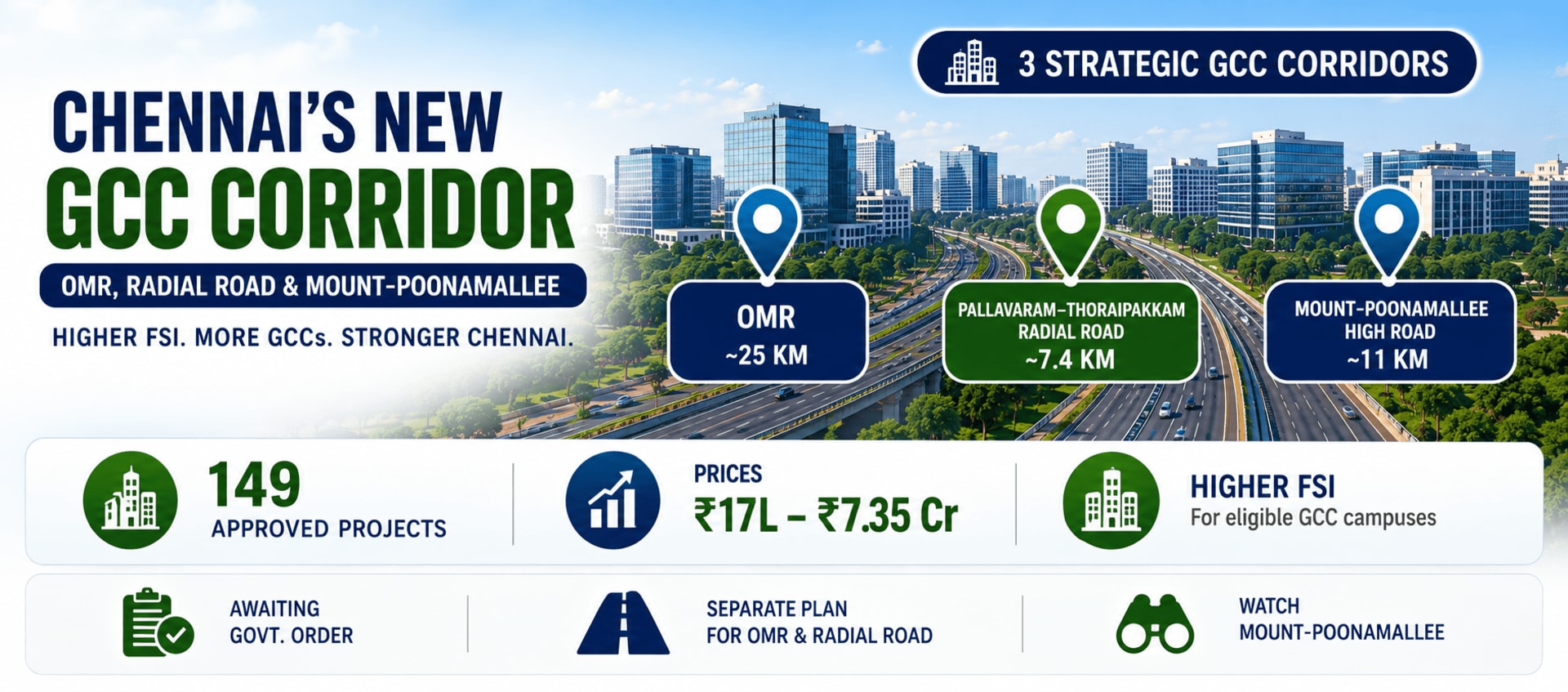
Tamil Nadu's Industries Minister announced a Global Capability Centres Corridor along OMR, the Pallavaram-Thoraipakkam Radial Road, and Mount-Poonamallee High Road in the Assembly on 25 August 2026, promising higher Floor Space Index for eligible GCC campuses — but no FSI figure, eligibility criteria, or Government Order has been released yet. Propspedia's own price-trend data across 149 live listings on these corridors shows no clear price movement tied to the announcement so far.
Quick answer: This is a genuine Assembly announcement, not a rumour, but it's still a policy direction rather than an enforceable rule — without a published FSI figure, eligibility criteria, or gazette notification, no developer can use it yet. It's also easy to confuse with a separate, more concrete CUMTA road-and-transit redesign already at tender stage for the same OMR and Radial Road stretches (DPR due January 2027), which has nothing to do with FSI. On pricing, Propspedia's own trend data across 149 live projects on these three corridors shows several localities like Thoraipakkam, Manapakkam, Porur and Kelambakkam flat or declining, while the standout gainers (Poonamallee, Iyyappanthangal) predate the announcement and trace to existing office parks. Bottom line: worth watching, not yet worth pricing into a purchase decision.
"GCC" in this story means Global Capability Centre — a multinational's captive offshore unit, the kind Chennai has been steadily attracting in banking, engineering and technology. It does not mean Greater Chennai Corporation, which is what the same three letters mean in most Chennai civic news (including elsewhere on this site). Worth being precise about, because the two stories are unrelated.
Tamil Nadu's Industries Minister S. Keerthana told the Assembly on 25 August 2026 that the state is developing a Global Capability Centres Corridor and Development Programme along three roads: Rajiv Gandhi Salai (OMR), the Pallavaram-Thoraipakkam Radial Road, and Mount-Poonamallee High Road. The headline element is higher Floor Space Index for "eligible GCC campuses" — more built-up area allowed on the same plot, which is what lets an office park add towers instead of buying more land.
What's Actually Confirmed — and What Isn't
This is a real announcement, made in the Assembly, not a rumour. But it is currently a policy proposal and direction, not an operative rule. The government has not released the actual FSI figure — how much higher, from what baseline — nor the eligibility criteria that would define which campuses qualify as GCC space. There is no Government Order, no gazette notification, no stated investment or job target, and no implementation date. A developer cannot use this FSI increase today because it does not yet legally exist.
That gap matters for a buyer trying to price in the news. "Higher FSI planned for GCC corridors" is a real signal about direction of travel — Tamil Nadu clearly wants more Global Capability Centre floor space on these three roads — but it is not yet a fact you can build a valuation on.
A Separate, More Concrete Project on the Same Roads
Confusingly, OMR and the Radial Road are also the subject of a second, unrelated government initiative that is further along. The Chennai Unified Metropolitan Transport Authority has floated a tender for a detailed project report covering 32.4 km of road redesign: 25 km of OMR from Madhya Kailash to Kelambakkam, plus the 7.4 km Pallavaram-Thoraipakkam Radial Road from Pallavaram bridge to Thoraipakkam junction. This is executed by the State Highways Department, not the Industries department, and it is not about FSI at all — it is exclusive bus lanes, Metro Rail integration at multimodal hubs, pedestrian and cycling infrastructure, underground utilities, and stormwater drainage.
CUMTA member-secretary I Jeyakumar has given actual dates: the DPR is expected by January 2027, with contract award targeted for June 2027, and the intent is to execute the work alongside the ongoing Metro Rail construction so both finish around the time CMRL begins operations on that stretch. That is a real timeline with a named official attached to it — more concrete than the FSI announcement, even though it will get less attention.
So there are two different stories layered on the same two roads: an office-development policy that is still just an announcement, and a transit-and-road redesign that is already at tender stage with dates attached. Mount-Poonamallee High Road only has the first of these; it is not part of the CUMTA mobility project.
What 149 Live Projects Say About Prices Right Now
Here is where the headline question gets an honest answer rather than a hopeful one. Propspedia currently lists 149 live approved projects across the three corridors — 84 on OMR, 24 on the Radial Road, 41 on Mount-Poonamallee — and the price-trend data behind them does not yet show the GCC corridor story showing up as a price mover.
Thoraipakkam is down 5.5% on Propspedia's own locality trend, despite being squarely on the OMR IT corridor and inside the proposed GCC zone. Manapakkam is down 1%, Porur down 1.3%, Kelambakkam down 1.9%. The localities that are actually moving are Poonamallee (+11.2%) and Iyyappanthangal (+10.6%) — both on Mount-Poonamallee, but that momentum predates this announcement and is more plausibly tied to existing office parks (RMZ Infinity, L&T Innovation Campus) than to an FSI change that isn't in force yet.
That is not a reason to dismiss the story. It is a reason to be precise about sequencing: an FSI increase that is announced but not gazetted has not yet changed what anyone can legally build, and prices generally move on what is buildable, not on what a minister said in the Assembly. If the FSI figure and eligibility rules are published and turn out to be generous, that is the point at which this becomes a pricing story rather than a policy one.
Where the Live Inventory Sits Today
OMR — 84 projects, ₹19.6 L to ₹7.35 Cr
The broadest and most built-out of the three, spanning ₹952 to ₹15,828 per sq.ft. (median ₹7,500). Heaviest concentration in Sholinganallur (14 projects), Navalur (13) and Kelambakkam (12), with a healthy split between ready-to-move (30) and under-construction (44) stock. Browse Sholinganallur · Navalur · Kelambakkam.
Pallavaram-Thoraipakkam Radial Road — 24 projects, ₹36.9 L to ₹3.57 Cr
The smallest of the three by project count, concentrated in Medavakkam (10) and Pallavaram (9), running ₹4,799 to ₹12,287 per sq.ft. (median ₹7,769). This is the stretch that gets the CUMTA road work, so it carries both stories at once. Browse Medavakkam · Pallavaram.
Mount-Poonamallee High Road — 41 projects, ₹17.4 L to ₹4.78 Cr
The widest price spread of the three, ₹2,199 to ₹18,405 per sq.ft. (median ₹7,967), concentrated in Porur (9), Kattupakkam (8) and Manapakkam (7). This corridor gets only the GCC/FSI proposal, not the CUMTA mobility work. Browse Porur · Kattupakkam · Manapakkam.
If You're Watching This Corridor
- Wait for the Government Order. An announced FSI increase and a gazetted one are different facts. Only the second one changes what a developer can actually build.
- Separate the two stories. The FSI/GCC programme and the CUMTA road redesign move on different timelines with different departments — don't treat a CUMTA construction update as confirmation the FSI policy has advanced, or vice versa.
- Check the trend, not the headline. Several corridor localities are flat or declining on current data. A policy proposal is a reason to watch a locality, not yet a reason its price has moved.
- Mount-Poonamallee is the one to watch for the FSI story alone — it isn't diluted by the separate road-redesign narrative the way OMR and the Radial Road are.
Frequently Asked Questions
What does GCC mean in this article?
Global Capability Centre — a multinational company's captive offshore unit. Not Greater Chennai Corporation, which the same acronym refers to elsewhere, including in other Chennai property-tax coverage on this site.
Has Tamil Nadu approved higher FSI for these corridors?
Not yet in force. The Industries Minister announced the direction in the Assembly on 25 August 2026, but the actual FSI figure, eligibility criteria, and a Government Order have not been released.
Is the OMR and Radial Road roadwork the same thing as the GCC FSI policy?
No. The 32.4 km CUMTA-led road and transit redesign is a separate initiative from the State Highways Department, already at tender stage for a detailed project report due January 2027. Mount-Poonamallee High Road is not part of this road project.
Have prices already started rising because of this?
Not clearly, on Propspedia's own trend data. Thoraipakkam, Manapakkam, Porur and Kelambakkam are flat to declining. Poonamallee and Iyyappanthangal are up double digits, but that predates this announcement.
How much live inventory is there across the three corridors right now?
149 live approved projects on Propspedia: 84 on OMR, 24 on the Radial Road, 41 on Mount-Poonamallee, spanning roughly ₹17 lakh to ₹7.35 crore.
Propspedia Verdict
This is a real policy signal, not a rumour — but it is one Assembly announcement away from being enforceable, layered confusingly on top of a genuinely concrete but unrelated road project on two of the same three roads. The honest read of both the policy timeline and our own trend data is: worth watching, not yet worth pricing in. If you're evaluating a project on these corridors, the FSI story is a reason to ask the developer directly whether their specific plot would qualify once (if) the rules are gazetted — not a reason to expect a rate the current numbers don't yet show.